A monthly parking contract is a licensing agreement, not a lease. It hands you the right to park one registered vehicle in one space and locks you into recurring payment and compliance obligations the moment you sign. The single clause worth reading twice before anything else is the cancellation window. If you only check three things, check the billing due date, the notice period to cancel, and whether your access credential is transferable.
TL;DR:
- Most monthly parking agreements are month-to-month licenses that automatically renew and require at least 30 days’ notice for cancellation, with late notice risking full payment for the next cycle.
- Late fees typically apply after five days of missed payment, often with a 5% fee and a minimum of $15, and failure to pay on time can result in suspension or towing of the vehicle.
- Access credentials tied to license plates and permits must remain non-transferable, as sharing or modifying them can be considered a breach and lead to suspension or termination.
- The operator's liability usually is limited, making the parking fee insufficient as insurance against theft, vandalism, or weather damage, so vehicle security measures are essential.
- Hidden costs like activation fees, card replacements, and administrative charges can significantly increase the first-month expense beyond the advertised rate; always confirm the full fee schedule before signing.
Table of Contents
- Understanding Monthly Parking Contract Terms: Key Clauses to Read First
- How Payment, Billing, and Late Fees Actually Work
- Access Credentials, Permits, and Why They Can't Be Shared
- What Happens When You Break the Rules
- Who's Actually Liable if Something Happens to Your Car
- The Fees Nobody Mentions Until the Invoice Arrives
- What a Customer-Friendly Parking Contract Looks Like
- A Quick Checklist Before You Sign Anything
- Ready to Book Cruise Parking With Terms You Can Actually Read
- Sample Contracts Worth Comparing Line by Line
- Sources
Understanding Monthly Parking Contract Terms: Key Clauses to Read First
A monthly parking agreement grants a "license to park," not tenancy. That distinction matters legally: operators can revoke access far more easily than a landlord can evict a tenant, because you never gained a possessory interest in the space itself.
Most agreements run month-to-month with automatic renewal. That means your contract doesn't expire on its own. It rolls forward every 30 days until you actively cancel, and if your cancellation lands one day past the notice deadline, you often owe for the entire next cycle.
Before signing, look for:
- Term structure: month-to-month vs. a fixed initial term with auto-renewal
- Cancellation method: does the contract require email, a written letter, or a customer portal request
- Notice window: many municipal and operator sample agreements require 30 days' written notice to cancel
- Rate-change clause: language letting the operator adjust monthly rates with notice, sometimes as little as one billing cycle
- Holdover terms: what happens if you stay past cancellation without formally ending the agreement
Skipping the fine print here is how people end up paying for a spot they thought they'd already canceled.
How Payment, Billing, and Late Fees Actually Work
Payment structures in monthly parking contracts follow a predictable rhythm, but the penalties for missing that rhythm vary more than most signers expect. Nearly every operator charges on the same date each month and treats a missed payment as a countdown clock, not a warning.
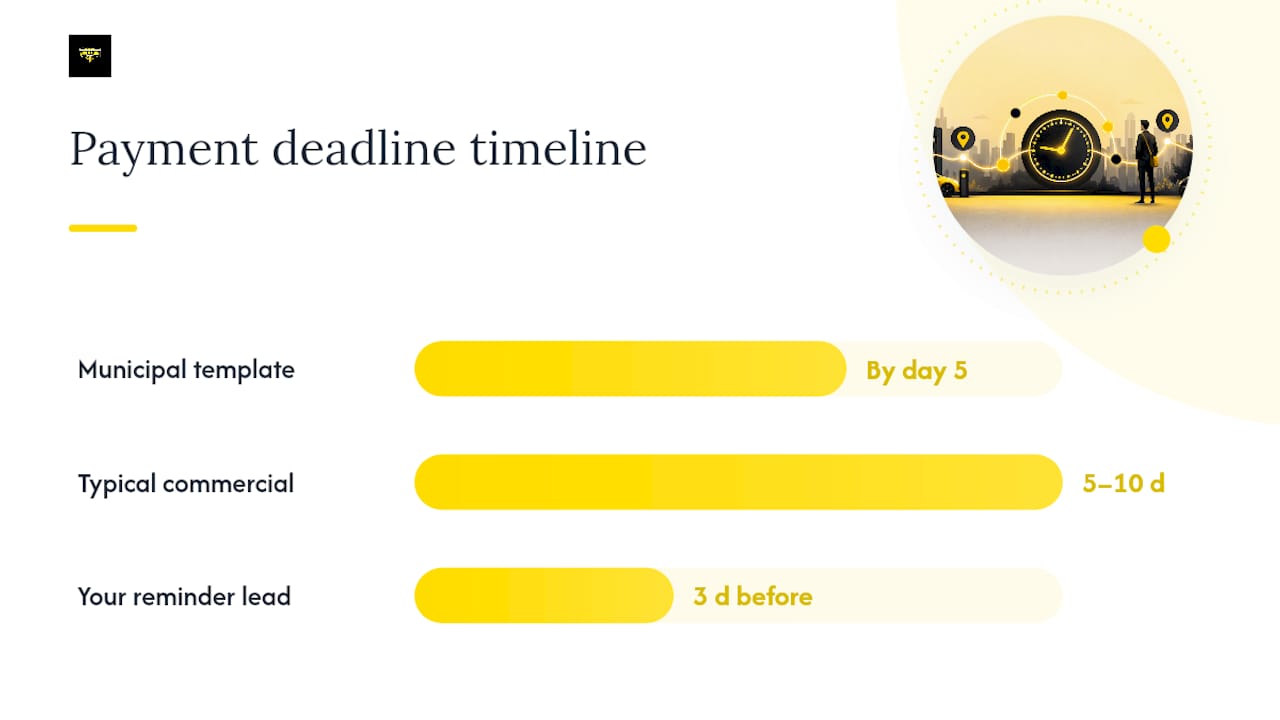
A widely used municipal template has payment due on the 1st, with a late fee applied and privileges revoked if payment isn't received by 5 p.m. on the fifth day. Commercial operators run similar timelines.
Pro Tip: Set your own payment reminder three days before the due date, not on it. Some operators auto-charge cards on file, but if that card expires mid-cycle, the failed transaction still starts the late-fee clock.
Watch for:
- Prorated first month: partial charges for whatever's left of the current billing cycle
- Late-fee structure: one recurring subscription model applies a 5% late fee with a $15 minimum starting on day five
- NSF or returned-payment fees: flat charges layered on top of the late fee, sometimes triggering permit disablement automatically
- Activation and admin fees: one-time or recurring charges that rarely get mentioned until the invoice arrives
That short cure window, often just five to ten days between missed payment and revoked access, is the part most new signers underestimate.
Access Credentials, Permits, and Why They Can't Be Shared
License plate registration and access cards or decals are how the operator enforces the entire contract. Your credential is tied to a specific vehicle and, usually, a specific person, and treating it as transferable is one of the fastest ways to trigger a breach.
Handing your access card to a coworker, parking a second vehicle under one credential, or letting a friend borrow your spot for a week all count as misuse under most operator terms, even when nothing malicious is happening.
- Keep license plate and vehicle information current with the operator at all times
- Expect a replacement fee for lost, stolen, or damaged cards and decals
- Group or corporate accounts make the primary holder responsible for every assigned user's actions
Pro Tip: If you manage a fleet or a family account, ask specifically how the operator's access control system verifies plates. Some flag mismatches automatically and disable the credential before a human ever reviews it.
What Happens When You Break the Rules
Operators reserve broad enforcement rights in nearly every standard agreement, and the remedies escalate quickly once a violation occurs.
- Suspension first. Nonpayment or a credential mismatch typically triggers a suspension notice before anything more severe.
- Immediate termination for serious breaches. Safety violations, repeated nonpayment, or confirmed permit sharing can end the contract without a notice period.
- Towing as a last resort. Standard parking agreement templates give operators the right to tow vehicles that violate terms after warnings go unheeded.
- Reactivation fees. Getting back in good standing often costs more than the missed payment itself, and you may be billed daily rates while suspended.
- Dispute the charge in writing. Email or use the operator's portal, keep every confirmation number, and request written reinstatement terms before paying anything you believe is wrong.
Who's Actually Liable if Something Happens to Your Car
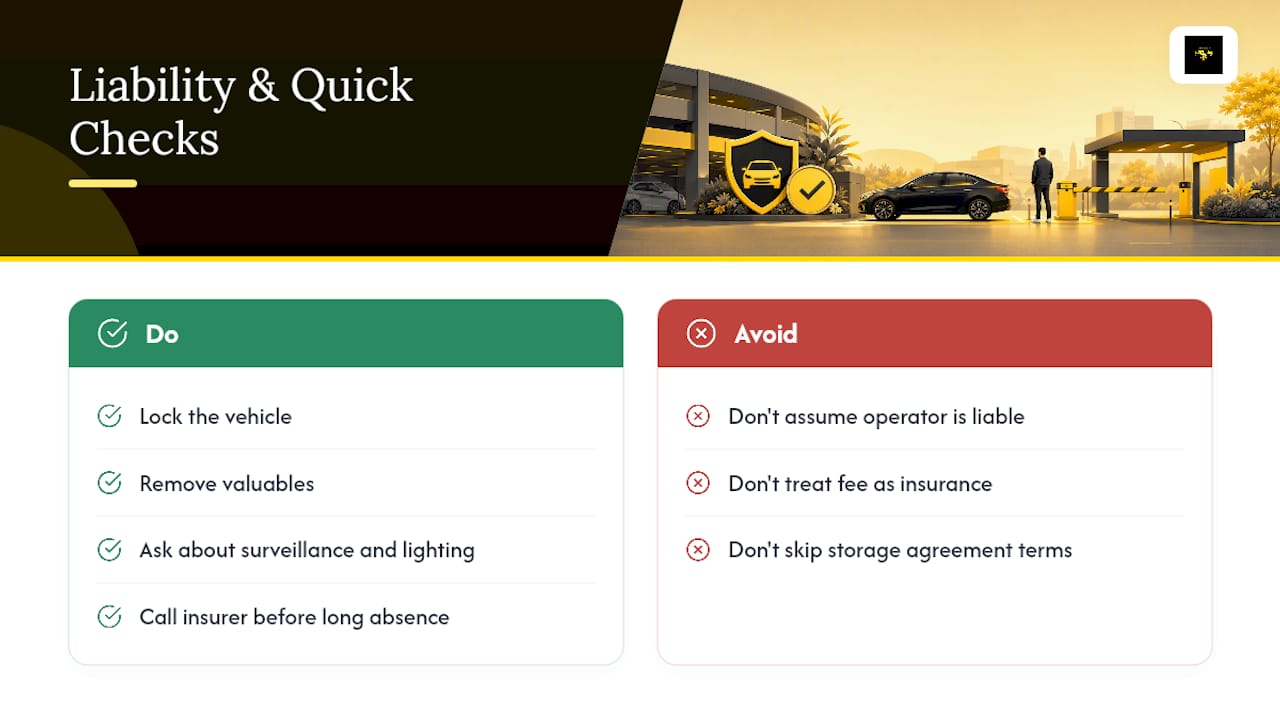
Most monthly parking contracts include a "park at your own risk" disclaimer. The operator typically limits its liability for theft, vandalism, or weather damage, meaning your monthly fee doesn't function as insurance.
Your personal auto policy usually still applies while the car is parked, but coverage for a long absence (say, a two-week cruise) can vary by insurer, so it's worth a quick call before you leave. If the facility offers a separate storage agreement for extended stays, read whether it adds any protection beyond the base parking terms.
Practical steps that cost nothing: lock the vehicle, remove valuables, and ask the operator directly about surveillance coverage and lighting before you sign anything.
The Fees Nobody Mentions Until the Invoice Arrives
The advertised monthly rate is rarely your real monthly cost. Add these before comparing any two operators:
- Activation or setup fee: often non-refundable, charged once at signup
- Card or decal replacement: a flat fee per lost or damaged credential
- Monthly admin fee: sometimes bundled quietly into the base rate, sometimes billed separately
- Promotional rate reversion: an introductory discount that expires after month one or two
A $99 advertised rate with a $25 activation fee and a $10 admin charge is really a $134 first month, not $99. Ask for the full fee schedule before you compare prices anywhere.
What a Customer-Friendly Parking Contract Looks Like
Asphalt Lots structures its VIP Unlimited Parking Membership around the exact pain points this article covers: guaranteed reserved spots on cruise days, priority shuttle service, and 24/7 surveillance stated up front rather than buried in a rider.
Cancellation runs through a direct customer contact rather than a maze of portals. Replacement fees for access credentials are disclosed rather than discovered on an invoice. For frequent cruisers and military families managing deployment-length storage, that clarity around renewal and credential rules is worth as much as the security cameras.
A Quick Checklist Before You Sign Anything
Check the due date, the exact cancellation method, and the credential rules before you sign. Red flags: no stated way to cancel, late fees with no cap, or no listed contact for disputes. Always get your cancellation confirmed in writing, and save the confirmation number.
— Martin
Ready to Book Cruise Parking With Terms You Can Actually Read
Compare that against a contract with no clear cancellation path, and the difference shows up the first time you need to change plans. Asphalt Lots puts its terms in writing: VIP members get guaranteed spot availability on cruise days, the cancellation process runs through direct contact rather than a hidden portal, and replacement fees for access credentials are disclosed before you ever need one.
Before signing with any operator, ask for the notice period, the late-fee cap, and the replacement-fee schedule in writing. If you're heading out on a cruise from Norfolk and want secure indoor parking with a free shuttle and no guesswork about your monthly terms, reserve your spot with Asphalt Lots and get the full agreement before you commit.
Sample Contracts Worth Comparing Line by Line
Compare payment schedules using the Miami-Dade parking agreement, cancellation language via Durham's monthly permit application, and credential rules through Impark's terms. For event-based group parking logistics, see this parking planning guide.
Sources
- Monthly Parking Agreement (Miami‑Dade County)
- Monthly Subscription Terms & Conditions - Secure Parking USA
- Terms & Conditions - Impark
- Monthly Parking Permit Application (Durham, NC)