
For most extended trips, the smartest move is pre-booking an off-airport economy lot or an airport long-term lot. Both balance cost and security better than daily garages or valet, which get expensive fast once you're gone more than a few days. Before booking anything, check three things: the price, the security setup, and how reliable the shuttle actually is.
- Best for cost: Off-airport economy lots, which frequently undercut on-airport rates by 30 to 50 percent.
- Best for convenience: On-site long-term lots when your flight or cruise departs early or your return time is unpredictable.
One exception: if you're storing a vehicle for a month or longer, or you own an RV, boat trailer, or classic car, skip standard lots entirely and look at covered, indoor, bailee-style storage instead. Facilities that meet lighting benchmarks like IES RP-20 and operators such as Asphalt Lots, which offers indoor cruise parking near Norfolk, are built for exactly that kind of extended, higher-stakes storage.
Key Takeaways
Choosing parking for long trips comes down to matching trip length and vehicle risk to the right tier: off-airport or long-term economy lots for most extended trips, and covered bailee-style storage for month-long or high-value vehicle needs.
| Point | Details |
|---|---|
| Match parking to trip length | Use daily garages for 1 to 3 days, but switch to economy or off-airport lots for anything longer than four days. |
| Book two to six weeks ahead | Reserve two to three weeks out normally, and four to six weeks out during holiday travel windows. |
| Verify security and insurance | Confirm CCTV retention, gated access, lighting, and bailee's coverage before leaving your car for weeks. |
| Document vehicle condition | Photograph the car, record the odometer and fuel level, and get a countersigned condition report at drop-off. |
| Consider Asphalt Lots for cruise trips | Asphalt Lots offers indoor, monitored parking with a free terminal shuttle and a VIP membership for frequent cruisers near Norfolk. |
Table of Contents
- How to Choose Parking for Long Trips Based on Duration
- What Are Your Options for Long-Term Vehicle Parking?
- What Does Long-Term Parking Typically Cost?
- What Security and Insurance Details Should You Confirm?
- What Questions Should You Ask Before Booking?
- How Asphalt Lots Handles Long-Trip Parking Near Norfolk
- Frequently Asked Questions
- Sources
How to Choose Parking for Long Trips Based on Duration
The right parking tier depends almost entirely on how many days your car sits. Here's the breakdown that actually holds up:
- 1 to 3 days: Daily garage or terminal parking is fine. The premium you pay is small relative to the total trip cost.
- 4 to 7 days: Switch to economy or long-term lots. Valet and terminal rates compound quickly once you cross the four-day mark.
- 8 to 14 days: Off-airport shuttle lots usually win on price, and most offer weekly rate breaks that daily lots don't.
- 15 to 30+ days: This is where monthly or extended-stay pricing matters most. Some on-airport lots cap stays around 30 days, so confirm the limit before you book a month-long trip.
Rideshare only beats parking when your round-trip fare, multiplied by two trips, stays below what two to three weeks of lot parking would cost. Run that math with surge pricing in mind. Airport pickups during peak travel windows routinely double the base fare.
Pro Tip: If your flight leaves before 6 a.m. or your cruise requires a pre-dawn check-in, book a park-stay-fly hotel package instead of same-day parking. You get a night's sleep, free parking for the trip duration, and you skip driving in the dark on no rest.
What Are Your Options for Long-Term Vehicle Parking?
Four categories cover almost every long-trip scenario, and each trades convenience for cost differently.
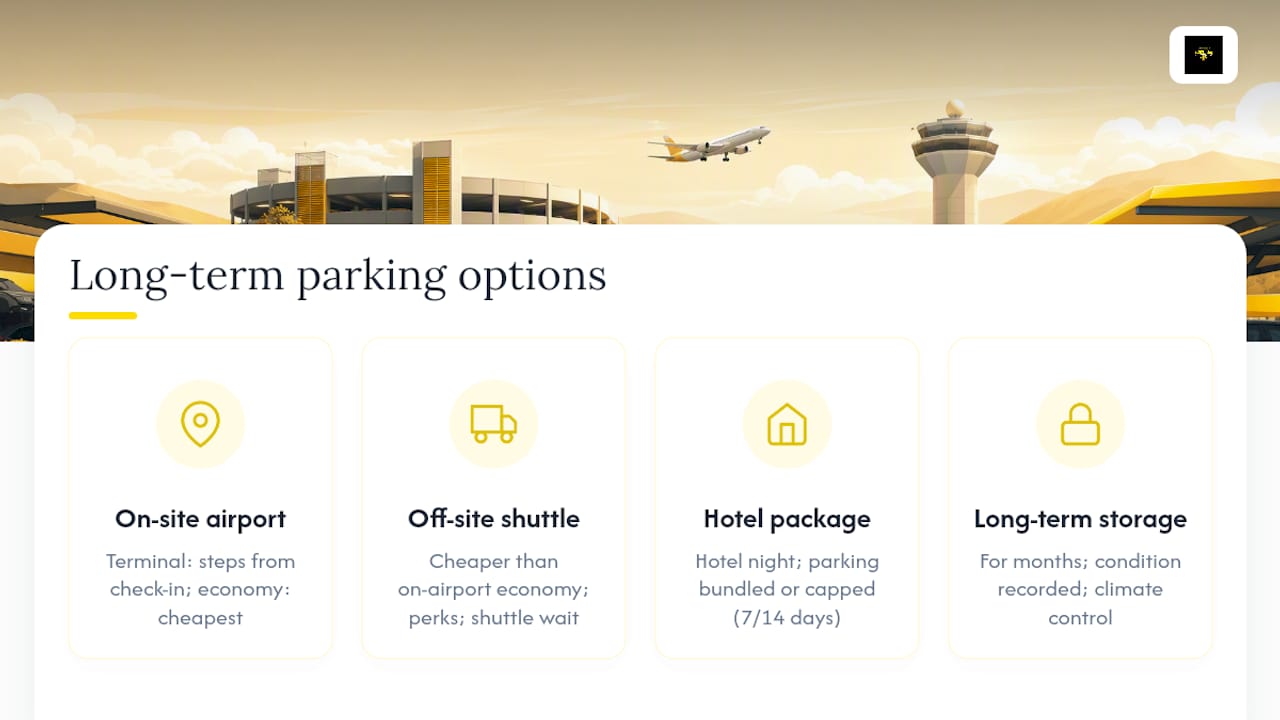
On-site airport lots break into terminal garages, daily garages, and economy or long-term lots. Terminal garages put you steps from check-in but charge the most per day. Economy lots sit farther out with a shuttle, and they're the cheapest option still located on airport property.
Off-site shuttle lots typically undercut even on-airport economy pricing and often throw in perks like luggage assistance, car washes, or covered spaces. The tradeoff is shuttle wait times, which matter more on red-eye returns.
Hotel park-stay-fly packages make sense when you need one night's stay anyway, either because your flight is early or your trip starts with a long drive. Verify what the package actually includes: some bundle unlimited parking days, others cap it at seven or fourteen.
Dedicated long-term storage is built for stays measured in months, not days. These facilities document vehicle condition at drop-off, often provide climate control, and become genuinely cost-effective for RVs, boats, and classic cars sitting for extended periods. Asphalt Lots' long-term storage options fall into this category for Norfolk-area cruisers and deployed military personnel.
What Does Long-Term Parking Typically Cost?
Prices vary by market, but the tiers are consistent nationwide. Terminal garages and hourly lots sit at the top of the price range. Daily garages run moderate. Economy and off-airport lots sit lowest, and covered indoor storage prices separately based on vehicle size and stay length.
Here's a simple way to think about it: a $20 daily garage rate over 10 days runs $200. The same trip at an off-airport lot charging $12 a day runs $120, an $80 savings before you factor in any weekly discount.
- Book at least two to three weeks ahead for routine trips, and four to six weeks ahead during peak holiday periods like Thanksgiving or spring break, since economy lots do sell out.
- Compare park-stay-fly packages against standalone parking for early departures.
- Check shuttle hours before booking. A lot that's $3 cheaper per day isn't a deal if the last shuttle runs at 10 p.m. and your flight lands at midnight.
- Skip valet for anything over a few days. The per-day premium multiplies fast compared to economy parking.
For a deeper breakdown of rate structures, multi-day pricing examples show how quickly a low daily rate can outpace a facility with better long-term pricing.
What Security and Insurance Details Should You Confirm?
Leaving a car unattended for two weeks or two months is a different risk profile than a daily commuter lot, and the questions you ask should reflect that.
- Confirm the perimeter setup. A fenced lot with gated, badge-controlled access limits who can walk up to your car.
- Ask about camera coverage and retention. Facilities handling long-term storage should run CCTV with at least 30 days of retention, enough to review footage even if you don't notice an issue until you're back.
- Check lighting. Perimeter lighting that meets standards like IES RP-20 isn't just cosmetic. It's a documented deterrent against nighttime break-ins.
- Ask about insurance directly. A serious long-term operator carries bailee's customer goods coverage, which protects vehicles in their custody. That's separate from your own comprehensive auto coverage, which you should keep active regardless.
- Get a condition report at drop-off. Photograph all four sides, the roof, and any existing damage. Record the odometer reading and fuel level, and have staff countersign it.
- For stays over 30 days, ask about periodic inspections. Operators managing extended storage should conduct monthly checks with timestamps, not just a lockup-and-forget approach.
Before you leave the car, take a few minutes on prep. Battery drain is one of the most common return-day problems for trips over a week, so disconnect the battery or use a maintenance charger, set tire pressure to spec, and unplug anything drawing power when the engine's off. Ask if the lot offers jump-start service just in case. A pre-storage vehicle checklist covering paint protection and interior prep is worth running through if your car will sit for more than a few weeks.
What Questions Should You Ask Before Booking?
Call the lot before you book, not after something goes wrong. A few direct questions separate a reliable operator from one that's cutting corners.
- What are your shuttle hours, and does the last shuttle run late enough for red-eye or delayed returns?
- Is the lot staffed 24/7, or does it go unattended overnight?
- What insurance do you carry on vehicles in your care, and what's excluded?
- How long do you retain camera footage, and can I request it if needed?
- Do you offer covered or indoor spots, and what's the price difference?
- What's your cancellation and date-change policy if my trip shifts?
Red flags are usually easy to spot once you know what to listen for: vague or evasive answers about cameras and staffing, no written agreement or rate confirmation, no overnight staff at all, or a shuttle schedule that doesn't match your actual return window. Unclear pricing with hidden daily caps is another one. If the quote doesn't match what shows up at pickup, that's a problem you should catch during the phone call, not the parking lot exit.
Weigh your priorities against your trip type. A three-day work trip favors cost and convenience. A three-week deployment or a multi-month RV storage need should weigh security and documentation first, since the financial exposure is higher the longer the vehicle sits. Reviewing what reliable local parking should include before you commit saves a lot of second-guessing later.
Why extended-stay parking gets treated differently
Operators think about a two-week booking differently than a two-day one, mostly because the liability window is longer. Our priorities at Asphalt Lots start with the same three things this guide covers: verified security, documented vehicle condition, and a shuttle schedule you can actually count on. Indoor, monitored parking and a consistent shuttle aren't add-ons for cruise travelers and deployed service members, they're the baseline. If you want specifics on how we handle extended storage or military deployment parking, reach out directly and we'll walk you through it.
How Asphalt Lots Handles Long-Trip Parking Near Norfolk
If you're heading out on a cruise or a multi-week trip and don't want to think about your car again until you're back, that's exactly the gap Asphalt Lots fills. The facility offers secure indoor parking with round-the-clock surveillance, a free shuttle straight to the cruise terminal, and reserved spots so you're never scrambling for space on a busy sailing day.
Every checklist item covered above, insurance verification, condition documentation, gated access, and 24/7 monitoring, is built into how Asphalt Lots operates day to day. Frequent cruisers can lock in the VIP Unlimited Parking Membership for guaranteed availability and priority shuttle service, while one-time travelers and deployed military personnel can book daily, monthly, or long-term storage without a membership commitment. If you're planning a cruise or an extended trip out of Norfolk, check availability and reserve your spot before your travel dates fill up.
Frequently Asked Questions
What's the best parking option for a trip longer than two weeks? An off-airport economy lot or dedicated long-term storage facility typically works best. Off-airport lots usually support monthly arrangements, while some on-airport lots cap stays around 30 days.
Is off-airport parking safe for long trips? It can be, provided the facility has gated access, active CCTV with at least 30 days of retention, and staff on-site. Ask about these details directly before booking rather than assuming coverage.
How much can I save by pre-booking parking instead of paying at the gate? Pre-booking off-airport or long-term economy lots can save roughly 30 to 50 percent compared to daily garage rates, and considerably more compared to valet.
Should I disconnect my car battery before a long trip? Using a battery maintenance charger or disconnecting the battery helps prevent drain on trips over a week, since dead batteries are one of the most common issues travelers face on return.
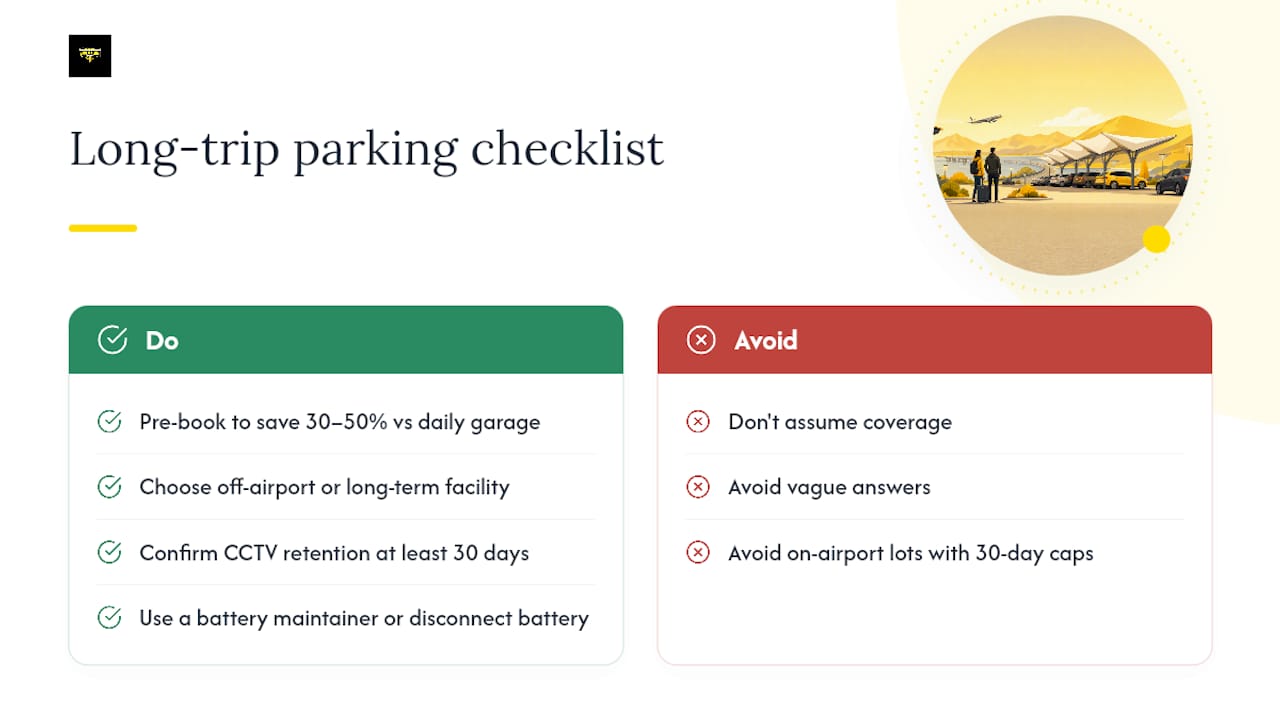
What should I ask a parking operator before booking a long-term spot? Ask about shuttle hours, overnight staffing, insurance coverage, camera retention length, and the cancellation policy. Vague answers on any of these are worth treating as a red flag.
Sources
- Parking Overnight and Long-Term Storage Operations: RV, Boat, and Extended Parking | Parking Professional
- How to Save on US Airport Parking in 2026 — Long-Term, Off-Airport & Park-Stay-Fly | CompareFlights
- Airport Long Term Parking: Your Stress-Free Guide
- Extended-Stay Airport Parking: 2+ Weeks Guide | ParkON
- Leaving Your Car for a Week or More: What to Know About Long-Term Airport Parking - TechBullion