
The true cost of parking is defined as the full financial burden of vehicle storage, including direct fees, hidden charges, time lost, and indirect economic effects on housing and urban land. Most travelers and commuters see only the ticket price. The real number is far higher. Monthly garage parking averages $450/month in major US cities, and annual commuting costs including parking, fuel, and insurance routinely exceed $800 to $1,200 per month. Add hotel surcharges, cruise port billing quirks, and the societal cost of parking mandates, and what is the true cost of parking becomes one of the most underestimated questions in personal finance.
How do commuting parking costs add up beyond the basic fee?
Parking fees are only the starting point for commuters. The full parking expense analysis must include fuel, insurance, vehicle maintenance, and the time cost of driving. When you factor all of these in, driving to work costs far more than most people budget for.
The numbers behind daily commute costs
Monthly parking in Manhattan ranges from $400 to $700 per month. Outer boroughs run $150 to $350 per month. Mid-size US cities average around $180 per month for garage parking, with daily commuter fees ranging from $10 to $30 per day. Those daily fees compound fast. A commuter paying $20 per day, five days a week, spends roughly $400 per month before touching gas or insurance.
The IRS mileage rate sits at $0.67 per mile in 2025. That rate exists because it accounts for insurance, depreciation, and maintenance, not just fuel. Using it as your benchmark, driving often costs $600 to $900 per month total, compared to $130 to $200 per month for public transit. That gap is the hidden cost most commuters never calculate.
Commuters who spend $2,000 to $5,000 annually on commuting often undercount because they separate parking from fuel and insurance mentally. In high-cost urban areas, parking alone can exceed $7,000 per year. That figure does not include the hours spent circling for spots or the wear on tires and brakes from stop-and-go city driving.
Pro Tip: Divide your monthly parking pass cost by the number of days you actually drive to the office each month. If that number is lower than the daily rate at your garage, the monthly pass pays for itself. If you work remotely two or three days a week, a daily payment model often wins.
Here is a straightforward breakdown of how commute costs stack up:
- Base parking fee: Daily or monthly rate paid directly to the garage or lot.
- Fuel cost: Calculated by miles driven divided by fuel economy, multiplied by current gas price.
- IRS-equivalent vehicle cost: Multiply total commute miles by $0.67 to capture insurance, maintenance, and depreciation.
- Time cost: Hours spent driving and parking, valued at your hourly wage or opportunity cost.
- Parking fines and overages: Tickets, overstay fees, and meter violations that accumulate unpredictably.
What should travelers know about parking costs during trips?
Travel parking costs carry a different set of surprises than commuter fees. Hotels, airports, and cruise ports each have their own billing structures, and the average parking cost at these locations rarely appears in the headline price.
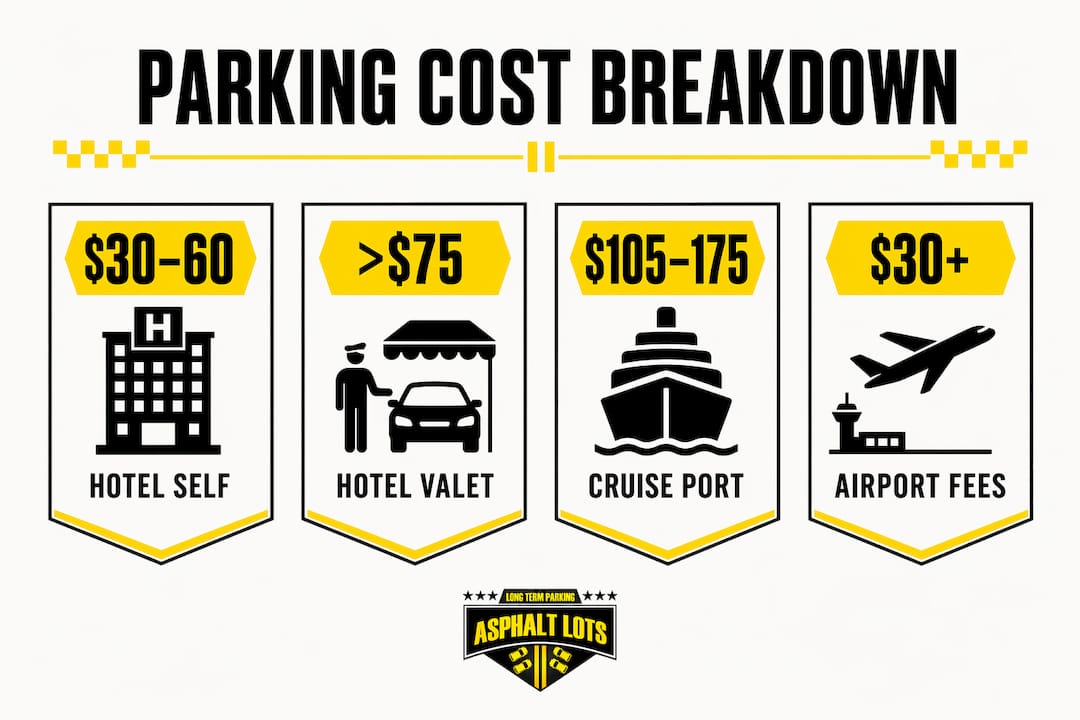
Hotel self-parking ranges from $30 to $60 per night, with valet pushing past $75 per night at urban properties. A five-night hotel stay can add $150 to $375 to your trip budget before you order room service. Valet fees at resort properties in cities like New York, Chicago, or Miami regularly exceed $100 per night.
Cruise port parking carries its own billing trap. Most ports charge by calendar day, not by 24-hour period. That means a cruise departing monday morning and returning saturday afternoon may bill you for six full calendar days even if your actual time away is closer to five days and a few hours. Cruise port parking runs $105 to $175 per week, and hidden add-ons can inflate a cruise trip budget by $2,400 to $3,900 beyond the base fare when you include parking, port fees, and onboard charges.
Travel industry experts note that hotel parking fees are rarely included in the upfront booking price. The Federal Trade Commission's junk fees rules have improved transparency in some areas, but optional charges like parking remain a consistent blind spot for travelers. Reviewing the final price screen before confirming any hotel or port booking is the single most effective way to catch these charges before they hit your card.
Pro Tip: Before booking any hotel near a cruise port, call the property directly and ask for the total parking cost for your stay. Online booking engines frequently omit or bury this figure. Knowing the number upfront lets you compare it against off-site parking options, which are often 30% to 50% cheaper.
Key hidden charges travelers should watch for:
- Calendar-day billing at cruise ports: You pay for the day you arrive and the day you leave, regardless of the hour.
- Shuttle fees: Some off-site lots advertise low daily rates but charge separately for the shuttle to the terminal.
- Credit card authorization holds: Airports and hotels place $50 to $100 per day holds on your card, reducing your available credit during the trip.
- Credit card processing fees: Some parking operators add a 2% to 3% surcharge for card payments.
- Reservation cancellation penalties: Non-refundable pre-paid parking spots lock in your cost even if plans change.
For travelers using cruise transfers, services like Cape Town cruise shuttle providers demonstrate how bundling transport with port arrival can reduce the total cost compared to paying for parking and transfers separately.
How does parking policy drive up housing costs?
The impact of parking costs on consumers extends well beyond the parking lot. Zoning laws in most American cities require developers to include a minimum number of parking spaces in every new building. Those mandates carry a price that renters and buyers absorb directly.
Mandatory parking requirements raise new housing construction costs by over 50% in some projects. A two-bedroom unit with two required parking spaces may carry a $1,000 per month cost subsidy compared to $425 per month for an equivalent unit with no parking requirement. That $575 monthly gap is a parking tax paid by every resident, whether they own a car or not.
Free parking creates hidden societal costs by encouraging car dependency, consuming urban land, and raising housing prices across entire neighborhoods. When cities require large surface lots or structured garages, they reduce the land available for housing, retail, and green space. The result is lower density, longer commutes, and higher rents.
| Scenario | Monthly housing cost | Parking requirement |
|---|---|---|
| New unit, 2 parking spaces required | ~$1,000/month subsidy | 2 spaces mandated by zoning |
| New unit, no parking requirement | ~$425/month subsidy | 0 spaces required |
| Cost difference per unit | ~$575/month | Parking mandate drives the gap |
Policy makers increasingly recognize minimum parking requirements as a hidden tax on housing. Cities including Minneapolis, Buffalo, and San Jose have repealed or reduced parking minimums. Early results show faster housing construction, lower per-unit costs, and better transit ridership in affected neighborhoods.
How can travelers and commuters reduce parking expenses?
Cutting parking costs starts with knowing your actual spending. Most travelers and commuters underestimate their total outlay because they track fees in isolation rather than as a combined expense.
For commuters, the monthly versus daily pass calculation is the first step. Divide the monthly pass price by the number of days you drive. If the daily rate is higher, buy the monthly pass. If you drive fewer than 15 days per month, daily payments usually cost less. Parking apps help find lower-cost spots nearby and let you avoid peak-hour pricing at major garages.
For travelers, the most reliable cost-saving move is booking parking before arrival. Pre-booked spots at off-site lots near airports and cruise ports consistently run below the walk-up rate at on-site facilities. Pairing pre-booked parking with a free shuttle option eliminates the shuttle surcharge that some lots add at the gate.
Pro Tip: Use a dedicated travel credit card for all parking charges. This limits the impact of authorization holds on your primary card's available credit. Some travel cards also offer parking purchase credits or reimburse airport parking fees as part of their annual benefit package.
Additional ways to reduce your parking bill:
- Compare multi-day parking rates at off-site facilities before committing to port or hotel parking.
- Ask your employer about pre-tax commuter benefits, which let you pay for parking with pre-tax dollars and reduce your effective cost.
- Consider public transit for trips where parking would exceed $20 per day. Transit passes in most major cities cost $130 to $200 per month total.
- Review cruise port parking options in advance to understand billing cycles and avoid calendar-day surprises.
Key Takeaways
The true cost of parking always exceeds the posted rate because hidden fees, billing quirks, and policy-driven costs add hundreds or thousands of dollars to what travelers and commuters actually pay.
| Point | Details |
|---|---|
| Commuter costs run deep | Monthly parking plus fuel and insurance often totals $800 to $1,200 per month in major cities. |
| Travel parking hides fees | Hotel valet, calendar-day billing, and credit card holds inflate trip budgets significantly. |
| Parking mandates raise rents | Zoning requirements can add over $575 per month to housing costs per unit. |
| Monthly passes need math | Divide the monthly pass by your actual driving days to confirm it beats daily rates. |
| Pre-booking saves money | Off-site lots with free shuttles consistently undercut on-site port and airport parking rates. |
Why most people still get this wrong
Most travelers and commuters I talk to think of parking as a minor line item. They budget for flights, hotels, and food, then treat parking as a rounding error. That mental model is expensive.
The number that surprises people most is the housing connection. Parking mandates are not an abstract policy debate. They are the reason a two-bedroom apartment in a new building costs $575 more per month than it would without a required parking space. You pay that cost whether you park there or not. That is the definition of a hidden cost.
On the travel side, the calendar-day billing practice at cruise ports catches even experienced cruisers off guard. You leave on a monday and return on a saturday, and you expect to pay for five days. The port charges six. That is not a scam. It is a billing convention that nobody explains at booking. Knowing it in advance is the difference between a budgeted expense and an unpleasant surprise.
My honest advice: treat parking as a category in your travel or commute budget, not a miscellaneous expense. Run the break-even math on monthly passes. Pre-book off-site lots. Check the final price screen on every hotel booking. These are not complicated steps. They just require treating parking with the same attention you give to airfare.
— Martin
Secure parking for your next cruise from Norfolk
Cruise travelers departing from Norfolk face the same parking cost traps as any major port. Asphaltlotsva removes them.

Asphaltlotsva is a veteran-owned indoor parking facility located 15 minutes from Norfolk, offering long-term vehicle storage with round-the-clock surveillance and a free shuttle to the terminal. Pricing is transparent with no calendar-day billing surprises. The VIP Unlimited Parking Membership guarantees a reserved spot on every cruise day, priority shuttle service, and fixed pricing for frequent cruisers. For travelers who have done the math on port parking fees and want a straightforward alternative, Asphaltlotsva is the practical answer.
FAQ
What is the average cost of parking per month in the US?
Monthly garage parking averages $450 per month in major US cities and around $180 per month in mid-size cities. Manhattan ranges from $400 to $700 per month depending on the neighborhood.
How much does cruise port parking typically cost?
Cruise port parking runs $105 to $175 per week at most major US ports. Ports bill by calendar day, so a five-day cruise often incurs six days of charges.
What are the hidden costs of parking at hotels?
Hotel parking fees range from $30 to $60 per night for self-parking and over $75 for valet. Credit card authorization holds of $50 to $100 per day can also reduce your available credit during your stay.
Does parking affect housing costs?
Zoning mandates requiring parking spaces raise construction costs by over 50% in some projects. A unit with two required parking spaces can cost $575 more per month than an equivalent unit with no parking requirement.
How can I lower my parking costs as a traveler?
Pre-book off-site parking lots near airports and cruise ports, which consistently cost less than on-site facilities. Pairing pre-booked parking with a free shuttle service eliminates additional transfer fees and reduces your total trip cost.