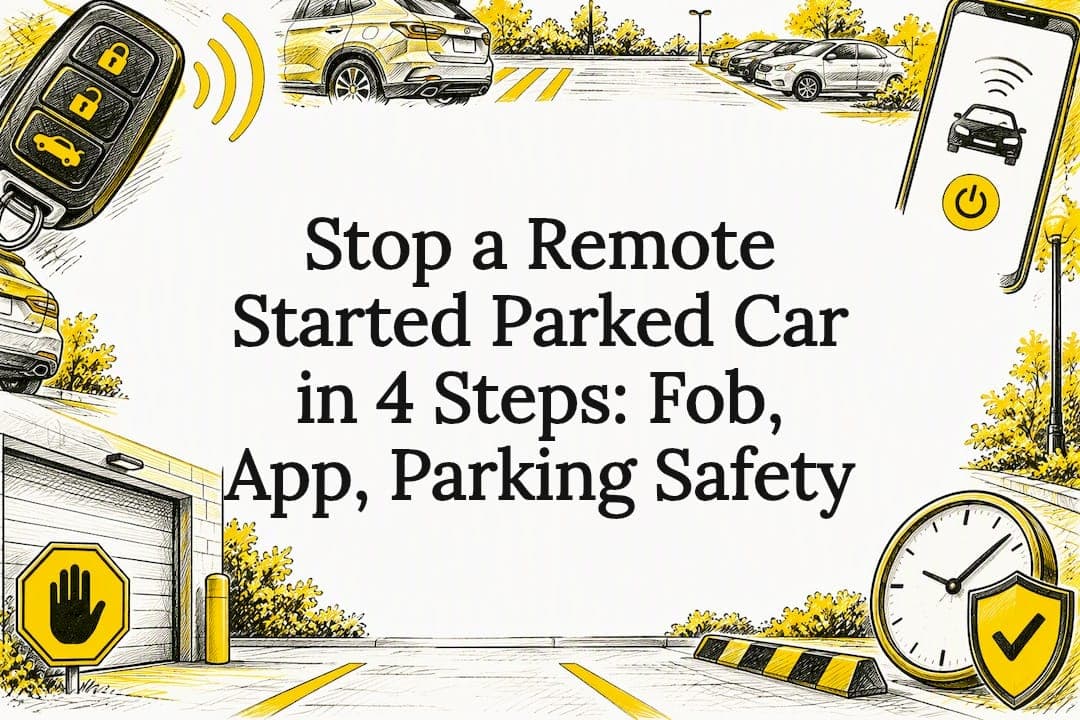
Press your key fob's Remote Start button a second time, or press Unlock, to stop the engine right away. If you started the vehicle through a manufacturer app, open that app and use its remote stop control. If neither works, the engine will typically shut off on its own within the factory run time limit, or you can walk out and turn it off from inside.
TL;DR:
- Remote start cancellation typically requires close proximity to the vehicle and may involve multiple button presses depending on the manufacturer.
- Using manufacturer apps for stopping the engine depends on an active subscription and a stable cellular or GPS connection; otherwise, commands may not go through.
- Factory remote start systems generally shut off automatically within 10 to 20 minutes, with safety triggers like door opening terminating the session early.
- Aftermarket remote start kits often have different cancel procedures than factory systems and may require contacting the original installer for troubleshooting.
- It remains safest to manually turn off the vehicle from inside the cabin if remote commands fail, especially in public or high-traffic parking lots.
Table of Contents
- Canceling remote start with the key fob: common button sequences to try
- Using manufacturer apps and telematics to stop a remote start
- How long remote start runs before it shuts off on its own
- Troubleshooting push-to-start exceptions and aftermarket systems
- Step-by-step checklist to cancel a running remote start
- Asphalt Lots safety perspective on remote start and parked vehicles
- When remote start makes sense and when it doesn't
- Asphalt Lots: a secure option for cruise travelers who use remote start
- Sources
- FAQ
Canceling remote start with the key fob: common button sequences to try
Most factory remote start systems respond to a small set of fob commands, though the exact sequence depends on your manufacturer. Try these in order before assuming something is broken.
- Press the Remote Start button a second time. Ford vehicles are designed so pressing Remote Start twice cancels the session.
- Press the Unlock button once. Toyota's system treats this as a stop command for a remote-started engine.
- Hold the Lock button for two or more seconds. This is Toyota's alternate method, and it shuts the engine off while keeping the doors locked.
- Try a double press if a single press does nothing. Some models require the redundant press to register the cancel command.
One detail catches a lot of owners off guard: you often need to stand closer to the car to cancel a remote start than you did to trigger it. Engine noise and signal reflection off nearby structures can shrink the fob's effective range, so a command that worked from your porch might not reach the car from the same spot once the engine is running.
Before you troubleshoot further, do a quick safety check. Confirm the vehicle is outside in open air, not in a closed garage, and make sure no child or pet has been left inside. These checks matter more than the cancel sequence itself if something has gone wrong.
Using manufacturer apps and telematics to stop a remote start
If you started your vehicle through a phone app rather than the fob, that same app is usually your fastest way to stop it, provided the car has an active connection and a live subscription.
- Open the Ford app and use the remote start control. Ford's system uses a toggle you slide to stop the running engine, mirroring the start action in reverse.
- Open the Toyota app and select Remote Stop. This works only if the vehicle was started through Remote Connect in the first place and the subscription is active.
- Open the Subaru STARLINK app and tap Engine Stop. The option sits alongside the remote start control in the same screen.
These app-based controls come with real limits. Toyota's Remote Connect can only process a stop request if the car was started through the app and the subscription hasn't lapsed, and a manually started engine may not respond to a remote stop at all. You also need enough cellular or GPS signal for the command to reach the vehicle, so a car parked in a concrete structure or a dead zone may not receive it even with a valid subscription. If you're on a free trial that expired or never activated the connected service, the stop button may appear in the app but do nothing.
How long remote start runs before it shuts off on its own
Every factory remote start system has a built-in clock, and that clock is your backstop when a cancel command doesn't land.
Toyota vehicles limit a remote-started engine to about 10 minutes per session, with a cap of up to 20 minutes total across two starts before the system requires you to restart it manually. Other manufacturers use similar windows, generally in the 10 to 20 minute range, though the exact figure varies by model.

Beyond the timer, a few real-world events will force an automatic shutdown regardless of how much time is left. Opening a door, unlocking the vehicle, or triggering the hood latch sensor all act as safety failsafes built into the system. That's intentional: the manufacturer wants the engine off the moment someone approaches the car with intent to get in or open the hood.
The practical takeaway is simple. If your fob and app commands both fail, you're not stuck with a car idling indefinitely. Within the factory timeout window, the vehicle will shut itself off, and knowing your model's specific limit tells you exactly how long that wait will be.
Troubleshooting push-to-start exceptions and aftermarket systems
Not every remote-stop failure means something is broken. Sometimes it means the vehicle was never in a state where remote stop could work.
- If you started the engine manually with the push-to-start button rather than remotely, many apps lose the ability to remotely stop it, since the system only tracks sessions it initiated itself.
- Aftermarket remote start kits often use different button sequences than the factory system, so OEM instructions and MyKey guidance may not apply at all.
- If the fob commands fail outright, move closer to the vehicle and try again, since range issues are common with both factory and aftermarket setups.
- For persistent problems with an aftermarket system, a dealer may not be able to help. Contact the original installer instead.
Pro Tip: If you're not sure whether your remote start is factory or aftermarket, check your owner's manual or the original sales paperwork before troubleshooting, since the cancel steps genuinely differ between the two.
When all else fails, your simplest and most reliable option is walking back to the vehicle, putting it in park, and using the in-cabin Start/Stop button. No signal range, subscription status, or button sequence can interfere with that.
Step-by-step checklist to cancel a running remote start
Work through these steps in order rather than jumping around, since each one rules out a specific cause before you move to the next.
- Walk within a few feet of the vehicle and try the fob sequence: press Remote Start again, then try Unlock, then try holding Lock for two or more seconds.
- If you started the car through a manufacturer app, open it and use the remote stop control, following the model-specific steps for your brand.
- If both the fob and the app fail, return to the vehicle, confirm the transmission is in park, and use the in-cabin Start/Stop button to shut it off directly.
- If the remote start is an aftermarket install or seems to be malfunctioning, don't leave it running unattended. Contact the dealer or the original installer.
A technical breakdown of idle behavior can help explain why a vehicle sometimes behaves unpredictably at idle, which is useful context if your remote-stop commands seem to work inconsistently rather than not at all.
Asphalt Lots safety perspective on remote start and parked vehicles
Leaving a car running unattended, even briefly, carries some risk no matter how reliable the cancel system is supposed to be. A vehicle idling in a public lot draws attention, and a failed remote-stop command means it could sit there longer than planned. That's part of why monitored indoor parking with round-the-clock surveillance reduces exposure compared to an open, unwatched lot.
If you're evaluating a facility for a trip where you might need to leave a vehicle running briefly, a few operational details matter more than they seem. Check whether camera coverage is continuous across the lot rather than limited to entrances, ask about shuttle timing so you're not stranded waiting during a run-time window, and confirm the facility uses secure, controlled access rather than an open gate.
A few habits apply regardless of where you park. Never let a remote-started engine idle in an enclosed or semi-enclosed space. Never leave a child or pet in a vehicle, running or not. And on high-traffic days, a facility with guaranteed reserved spots removes the pressure of circling for parking while a vehicle sits running back at your original spot.

When remote start makes sense and when it doesn't
Remote start earns its keep on a freezing morning or a scorching afternoon when you want the cabin ready before you step outside. That convenience only holds up when you're using it the way it's meant to be used: in open air, with the vehicle attended within a reasonable time, and in line with whatever local idling rules apply where you live.
Where I'd draw the line is anywhere ventilation is uncertain or the car will sit unattended longer than you'd normally allow. When in doubt, walk back to the vehicle or choose monitored parking so a failed cancel command isn't the thing standing between you and peace of mind.
— Martin
Asphalt Lots: a secure option for cruise travelers who use remote start
Heading out on a cruise often means leaving your car parked for days, and a remote start habit that's harmless in your own driveway carries more risk in an unfamiliar public lot. Asphalt Lots gives Norfolk-area cruise travelers an indoor facility with 24/7 surveillance, so your vehicle isn't sitting exposed while you're at sea.
- Norfolk Carnival Cruise Parking runs $10 per day, with monthly, daily, and long-term storage options available for different trip lengths.
- The Unlimited VIP Cruise Parking Membership costs $100 per month and guarantees a reserved spot plus priority shuttle service, useful if you cruise often and want one less thing to plan around.
- A free shuttle runs between the facility and the terminal, so you're not waiting on a ride while your vehicle sits parked.
If you'd rather not worry about a running engine or an unattended car while you travel, check current parking plans before your next trip.
Sources
For model-specific steps, go straight to the source: Ford's MyKey cancel guide, Toyota's engine shutoff instructions, and Toyota's remote start runtime article all cover exact button sequences and timing. For broader vehicle safety context, inspection guidance from Ride Scouts and Asphalt Lots' cruise travel safety guide are worth a read before a long trip.
- How do I cancel a remote start using MyKey?
- How long does the vehicle run when I start it with Toyota Remote Connect?
FAQ
Can remote start be disabled?
Yes. Most factory systems let you cancel a remote start with the key fob or a manufacturer app, and the engine will also shut off automatically once it hits its built-in run time limit. If those options fail, you can always turn the engine off from inside the vehicle.
Is there a way to bypass Toyota remote start?
Toyota's supported method is pressing Unlock or holding Lock for two or more seconds to stop a remote-started engine. Community suggestions involving hood-latch sensor bypasses exist, but they aren't manufacturer-endorsed and can create safety or warranty problems.
Can you deactivate a FOB remotely?
You can't deactivate a fob itself remotely, but you can use it to cancel a remote start by pressing the same or a related button, such as Remote Start again or Unlock. Keep in mind you may need to be closer to the vehicle to send a cancel command than you did to start it.
Why do Toyotas turn off after remote start?
Toyota remote start sessions are capped at about 10 minutes each, with a maximum of 20 minutes total across two starts, after which the system shuts down automatically. The engine will also stop early if a door is opened, the vehicle is unlocked, or the hood latch sensor is triggered, since these are built-in safety failsafes.