Whether you hand over your keys depends entirely on the parking type you book. Self-park lots let you keep your keys the whole time your car sits there. Valet and "meet and greet" services require you to hand keys to staff so they can move your car, and that comes with real security tradeoffs you should understand before you drive to the port. Read the checklist and security steps below before you book anything.
TL;DR:
- Self-park lots allow you to keep your keys and generally provide faster exit, but require walking to transport shuttles and minimal vehicle security.
- Valet or "meet and greet" services necessitate handing over your keys, increasing the risk of vehicle mishandling or loss, especially if policies are unclear.
- Always confirm in writing whether your keys will be retained, how they are stored, who has access, and whether vehicle movement is logged before booking.
- Protect valuables, photograph your vehicle, and use Faraday pouches for keyless fobs to reduce theft risks when leaving your car with a third party.
- In case of lost keys or vehicle movement issues, immediately document the problem, notify the operator, and consider police or insurance claims if theft or damage occurs.
Table of Contents
- How Parking Type Determines Whether You Leave Keys Cruise Parking
- What to Ask Before Booking Cruise Parking (and Red Flags to Avoid)
- Protecting Your Keys and Valuables Before You Hand Over the Car
- If Your Keys Go Missing or Your Car Gets Moved
- Why the "Just Trust the Lot" Advice Falls Short
- How Asphalt Lots Handles Keys and Vehicle Security for Cruise Travelers
- Sources
- FAQ
How Parking Type Determines Whether You Leave Keys Cruise Parking
Not all cruise parking works the same way, and the booking page usually tells you which model you're getting if you know what to look for.
Self-park means you drive in, park your own car, take your keys, and walk to a shuttle or the terminal. Nobody touches your vehicle until you come back. This is the model most port-owned lots and many independent facilities use, and it's the one that lets you skip the key-handover question entirely.
Valet or "meet and greet" parking flips that. A staff member takes your car, sometimes right at the terminal curb, and parks it for you, often at a satellite lot miles away. You get your keys back only at pickup. Operators do this to pack more cars into less space and shuffle vehicles between lots as bookings shift, which is a legitimate operational reason but one that only works if they can move your car whenever they need to.
Port-owned parking at some terminals explicitly advertises that you keep your keys, since it's really just a self-park structure with terminal proximity built in. Off-site independent lots vary more, and some blend models by offering both self-park and valet at the same facility for different price points.
Booking language gives it away fast. Watch for phrases like "valet service included," "we'll park it for you," or "attendant parking" — all of that means keys change hands. "Self-park," "park and go," or "keep your keys" mean you don't.
- Keeping your keys: faster exit on return, no third party ever touches your car, but you're on your own for the walk to the shuttle.
- Handing over keys: often faster drop-off curbside, but you're trusting someone else with your vehicle for the length of your cruise.
What to Ask Before Booking Cruise Parking (and Red Flags to Avoid)
A five-minute phone call or email before you book saves you from a bad surprise on return day. Ask these questions directly, and don't accept vague answers.
- Do you retain my keys, and for how long? Get a straight yes or no, tied to the specific service tier you're booking.
- How and where are keys stored? A locked key safe with an access log is a very different answer than "in a drawer at the front desk."
- Who has access to stored keys? You want a short, named list of staff, not "whoever's working."
- Is vehicle movement logged? Ask whether they track when and where your car gets moved between lots.
- What's your damage-claims process? Get this in writing, including timelines and who to contact.
- What happens if my ship returns late? Confirm staffing and pickup hours actually cover delayed disembarkation.
Red flags that should make you look elsewhere: no written key policy anywhere on the site, no staff physically present at the lot, a storage location the operator won't describe, or a pattern of reviews mentioning lost keys or missing vehicles. One industry guide on valet cruise parking recommends checking specifically for written procedures and controlled access before you commit, and that advice holds regardless of which operator you're considering.
Pro Tip: Ask for written confirmation of the key policy at check-in, not just at booking. Policies get quoted differently by phone reps versus on-site staff, and a text or email record protects you if there's a dispute later.
Protecting Your Keys and Valuables Before You Hand Over the Car
Security here isn't complicated, but skipping it is how small problems become expensive ones. Do these five things before you walk away from your car, no matter which parking type you chose.
- Clear out valuables and documents. Never leave a spare key, insurance card, or registration in the glovebox. Parking facilities routinely limit liability for personal items left inside, so anything valuable travels with you.
- Photograph everything. Take timestamped photos of all four sides of the car, the odometer reading, and any existing dings, before you hand off keys. This is your baseline record if a damage dispute comes up later.
- Protect keyless fobs. A Faraday pouch blocks the signal that makes relay theft possible, a real and growing risk for keyless entry vehicles left with a third party.
- Get names and paperwork. Note the staff member's name, your booking ID, and ask for a signed handoff receipt if the operator offers one.
- Confirm coverage. Check whether your auto policy or a travel insurance plan covers theft or damage while your car sits with a third party, and enable any OEM vehicle tracking your car supports.
Local news coverage out of Tampa documented customers whose keys were lost by a parking company after a cruise, resulting in long delays and real frustration. That kind of incident is rare, but it's exactly why the five steps above take fifteen minutes and save you a much worse week.
If Your Keys Go Missing or Your Car Gets Moved
Retrieval delays happen for reasons that sound minor but add up: your car got shuffled to a satellite lot, the shuttle schedule doesn't line up with your ship's docking time, or the staff member who knows where your keys are stored isn't on shift yet. A well-run operator should still be able to produce CCTV footage and a key-movement log within a reasonable window.
If you discover your keys or car are missing, work through this sequence:
- Notify the operator immediately and get a name and incident number on record.
- Document everything — take photos of the empty spot, save texts or emails, and keep your original booking confirmation.
- Contact police if the operator can't produce your vehicle or keys within a reasonable timeframe.
- Use your VIN or OEM tracker if your car has one, since this can pinpoint location faster than waiting on staff.
- Contact your insurer with your documentation to start a claim if theft or loss is confirmed.
Request that the operator preserve CCTV footage in writing, since some systems overwrite recordings after a set number of days. For a full walkthrough of the return process and what to bring with you, this guide to vehicle retrieval after a cruise covers the documentation step by step. Keeping a spare key at home and leaving accessible contact details with the operator also cuts down on friction if police need to reach you while you're still at sea.
Why the "Just Trust the Lot" Advice Falls Short
Most cruise parking advice stops at "book early and check reviews," which misses the actual decision point. The real question isn't whether an operator is trustworthy in the abstract. It's whether their key-handling policy is specific enough that you could hold them to it if something went wrong.
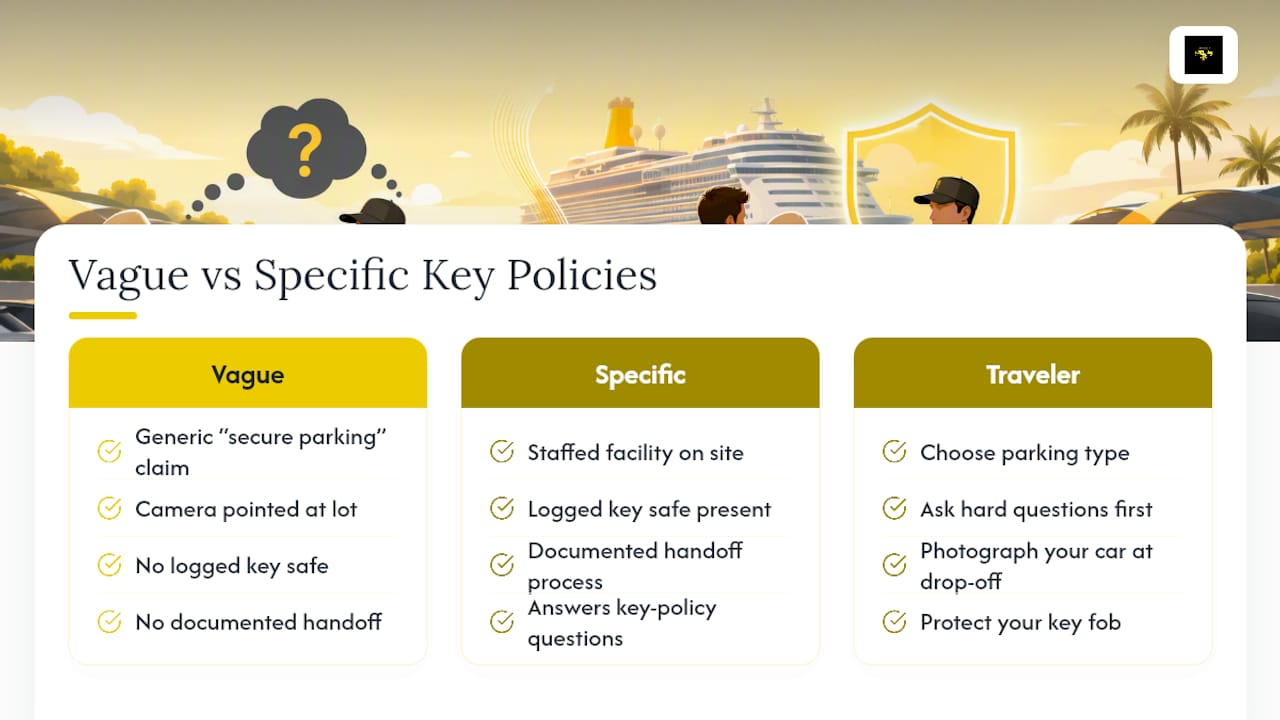
Vague marketing about "secure parking" means almost nothing on its own. A camera pointed at a lot is not the same as a staffed facility with a logged key safe and a documented handoff process, and travelers who don't ask the difference are the ones who end up in the kind of dispute that makes local news. The operators worth booking are the ones who answer key-policy questions without hesitation and put it in writing.
If there's one thing the conventional advice underrates, it's how much control you actually have here. You choose the parking type, you choose whether to ask the hard questions before you pay, and you choose whether to photograph your car and protect your fob before walking away. None of that requires luck. It requires five extra minutes at drop-off that almost nobody takes.
— Martin
How Asphalt Lots Handles Keys and Vehicle Security for Cruise Travelers
A veteran-owned, indoor facility with 24/7 surveillance near Norfolk operates on the idea that a cruise traveler shouldn't have to gamble on where their car sits for a week or more.
Staffed presence and controlled access matter more than any single camera, and that's the model the facility follows: trained attendants on site, a car park you can drive into rather than a lot you're guessing about from a listing, and an ID-match process on return so your vehicle only goes back to you. For travelers who cruise often, the VIP Unlimited Cruise Parking Membership locks in a guaranteed reserved spot on every cruise day along with priority shuttle service, so you're never negotiating availability the morning of departure. Daily parking runs $10 per day for travelers who just need one trip covered. Whether you're booking a single cruise or setting up recurring monthly parking, you can check current service options and availability directly and get your key-handling questions answered before you drive down.
Sources
For a deeper look at real incidents and policy language, see the Tampa cruise parking key-loss report for what can go wrong, the valet cruise parking guide for operator-side procedures, and the Southampton car park theft coverage for security lessons drawn from a real theft incident.
- ‘It's negligent': Customers returning from cruise say Tampa parking company lost their keys — WFLA
- Valets
FAQ
Where Do I Leave My Car When I Go on a Cruise?
You have three main options: self-park lots near the port, port-owned garages, or off-site independent facilities that offer a shuttle. The right choice depends on whether you want to keep your keys, need long-term storage, or are looking for guaranteed availability during peak cruise season.
How Much Does It Cost to Leave a Car at a Cruise Port?
Costs vary widely by location, lot type, and trip length, so there's no single standard rate. Asphaltlotsva's daily parking near Norfolk runs $10 per day, while frequent cruisers can get guaranteed availability through the VIP Unlimited Membership for $100 a month.
Do You Have to Leave Your Keys at Airport Parking?
It depends on the same self-park versus valet distinction that applies to cruise parking. Self-park airport garages let you keep your keys, while valet drop-off services require you to hand them over so staff can park the vehicle for you.
What Happens if a Parking Operator Loses My Keys?
You should immediately document the situation, request an incident report, and ask the operator to preserve any CCTV footage. Local reporting on a Tampa parking company that lost customer keys shows how delays and disputes typically unfold when an operator lacks a clear key-tracking process.
Is It Safer to Choose Self-Park Over Valet for Cruise Parking?
Self-park removes the third-party handling risk entirely, since your keys never leave your possession. Valet can still be safe if the operator has a documented, staffed key-control process, but you're taking on more risk if that process is vague or unverified.