Six features move the needle on parking security, and they don't carry equal weight. Start with lighting and CPTED-based site design, since that combination has produced the largest documented drops in incidents. Layer video surveillance with AI analytics and license plate recognition parking tools next, then add access control and physical barriers. Emergency communications and staffing run alongside all three, not after them. Get those specs and costs right and the rest of your security budget goes a lot further.
TL;DR:
- Lighting and CPTED-based site design upgrades should be prioritized first as they significantly reduce crime and are quick to implement with low to medium costs.
- Implementing LED lighting, shielding fixtures, and reflective surfaces can improve visibility and incident response without requiring extensive permits or downtime.
- Camera placement at high-risk chokepoints, combined with AI analytics and license plate recognition, enhances surveillance but depends on proper coverage and does not replace physical security measures.
- Access control systems such as gates, bollards, and emergency hardware should be added after lighting and surveillance, with costs influenced by existing infrastructure and permitting needs.
- Regular maintenance of lighting, cameras, and vegetation is critical to sustain security effectiveness and should be incorporated into ongoing operational budgets.
Table of Contents
- What Parking Security Features Should You Prioritize First?
- Why Lighting and CPTED Design Come First
- What Camera Placement and AI Analytics Actually Deliver
- Access Control and Physical Barriers: What to Install
- Small Design Changes That Close Off Hiding Spots
- Choosing Emergency Call Stations and the Right Staffing Model
- Keeping Your Security Investment From Decaying
- Building a Phased Security Roadmap on a Real Budget
- A Practitioner's View: How Asphalt Lots Puts This Into Practice
- Where to Read the Original Standards
- The CPTED-First Case, and Where the Industry Gets Distracted
- Sources
What Parking Security Features Should You Prioritize First?
Here's the order that gets you the most protection per dollar spent, ranked by impact and typical cost:
- Lighting and CPTED design fixes (low to medium cost). Retrofitting fixtures and repainting reflective surfaces is the fastest way to reduce hiding spots and dark zones.
- Natural surveillance improvements (low cost). Trimming or replacing landscaping and opening sightlines around stairwells costs little and pays off immediately.
- Video surveillance with analytics and LPR (medium to high cost). Cameras plus AI detection extend your eyes into blind corners around the clock.
- Access control and barriers (medium to high cost). Gate arms, credentialed entry, and crash-rated bollards control who gets in and when.
- Emergency call stations and dispatch integration (medium cost). Panic hardware tied to live monitoring shortens response time.
- Staffing and patrol strategy (ongoing operating cost). Guards or mobile patrols add a human deterrent that technology alone can't replicate.
Items one and two are your quick wins. They require no permits in most cases and can be finished in weeks, not months. For a broader look at what transportation-focused lots should have in place, this cruise parking facilities checklist breaks down the essentials by category.
Why Lighting and CPTED Design Come First
A university parking garage study found that comprehensive lighting and access-control upgrades based on Crime Prevention Through Environmental Design (CPTED) principles cut reported crime by more than 50%. No other single category of parking security features comes close to that return on investment. CPTED itself isn't a product you buy. It's a design philosophy, formalized in the OJP's Crime Prevention Through Environmental Design handbook, built around eliminating concealment, maximizing sightlines, and making legitimate use of a space visible and normal.
The Illuminating Engineering Society of North America (IESNA) sets footcandle targets for parking areas, but uniformity matters more than raw brightness in a lot of cases. A garage lit to 5 footcandles evenly beats one with 10-footcandle hotspots next to pitch-black corners, because criminals exploit contrast, not just darkness. Uneven lighting creates the exact blind pockets CPTED tries to eliminate.
Retrofit priorities that deliver results without a full electrical overhaul:
- Swap aging metal-halide or fluorescent fixtures for LED, which improves color rendering and makes camera footage far more usable.
- Aim and shield fixtures to kill glare and light trespass into stairwells and corners.
- Paint garage ceilings and walls white or another highly reflective finish. This alone can meaningfully boost ambient light without adding a single fixture.
- Set a lamp and lens cleaning schedule. Dirty lenses and dead bulbs quietly erode coverage that looked fine on installation day.
Most lighting retrofits run low to medium cost and finish in two to six weeks, according to Security Info Watch's CPTED guidance, which also flags lighting shortfalls as a recurring contributor to parking-facility incidents. Maintenance is a recurring line item, not a one-time fix.
What Camera Placement and AI Analytics Actually Deliver
Cameras earn their keep at specific chokepoints, not everywhere at once. Prioritize stairwells, elevator lobbies, entry and exit lanes, pedestrian walkways, and pay stations, since these are the exact zones flagged in NIJ-aligned CPTED guidance as high-risk for concealment and confrontation.
Camera type matters more than camera count in a lot of garages:
- Fixed cameras cover chokepoints reliably and cheaply.
- Pan-tilt-zoom (PTZ) units can track movement across long aisles, and one well-placed PTZ often replaces several fixed units trying to cover an obstructed field of view.
- Low-light or infrared sensors matter most in ramps and corners where lighting upgrades haven't fully reached yet.
- Anti-vandal, weatherproof housings are non-negotiable in any exposed structure.
AI analytics layered on top of that camera network add loitering alerts, dwell-time tracking, and in some deployments weapon detection, according to a 2026 AI security sector playbook for parking facilities. The same playbook is direct about the limits: AI depends entirely on the camera coverage underneath it, and false positives are common enough that human review still matters. License plate recognition parking systems are excellent for after-the-fact investigation and for automating entry and exit, but they don't prevent an incident in progress. They document it.
Pro Tip: Compare parking cameras vs. patrols honestly. Cameras document and deter from a distance; patrols interrupt in real time. Most secure lots need both, not one instead of the other.
Monitored live-response setups cost more than recorded-only systems but cut response time dramatically. Recorded-only footage is cheaper and still useful for investigations and insurance claims, just slower to act on.
Access Control and Physical Barriers: What to Install
Access control decides who gets into your lot and when, and it pairs directly with cameras and license plate recognition parking systems for incident attribution after the fact. If a vehicle enters on a stolen credential or without ticketing, that's the first data point investigators pull.
Common options, from lightest to heaviest:
- Gate arms with ticketing or credentialed entry control vehicle flow and create a timestamped record of every entry.
- Crash-rated bollards stop vehicle-ramming attempts at pedestrian zones and building entries; the AIA's best-practice guidance on secure parking recommends standoff distance and crash-rated barriers for facilities near critical structures.
- Pedestrian egress hardware, including panic bars and door alarms, keeps emergency exits usable without becoming unmonitored entry points.
Installation costs range widely depending on whether you're retrofitting existing openings or cutting new ones, and ADA clearance requirements will shape gate and bollard placement. Budget for permitting time, not just equipment. A guide to access control in parking lots walks through how these systems shape the traveler experience specifically.
Small Design Changes That Close Off Hiding Spots
Natural surveillance is the CPTED principle that costs the least and gets ignored the most. The goal is simple: nobody should be able to hide in your lot in plain sight.
- Open sightlines. Remove or relocate anything that creates a blind corner, especially near stairwells and payment kiosks.
- Replace overgrown shrubs with low-profile, slow-growing plantings. Trimming shrubs repeatedly is a losing battle; replanting with species that stay low prevents regrowth from restoring the hiding spot within a season.
- Reconsider ramp and stair placement where renovation allows. Glass-enclosed stairwells visible from the street or from attendant booths deter far more than a solid concrete stairwell tucked in a back corner.
- Repaint ceilings and support columns white. This does double duty, boosting reflected light while making the space feel less institutional and abandoned.
None of these require a security vendor. They require a maintenance budget and someone willing to walk the property at dusk to see where the shadows actually fall.
Choosing Emergency Call Stations and the Right Staffing Model
Emergency call stations and intercoms tied into your camera system let a person in trouble trigger a live camera call-up instantly, giving dispatch eyes on the scene before anyone arrives physically.
Staffing models vary by budget and risk level:
- Dedicated on-site guards provide constant visible deterrence but cost the most to sustain year-round.
- Contracted mobile patrols cover multiple properties on a rotating schedule, cheaper per hour but with gaps between passes.
- Hybrid randomized patrols mix scheduled sweeps with unpredictable timing, which raises the perceived risk of getting caught more than a fixed schedule does, according to property manager guidance on parking lot security.
Twenty-four-hour dispatch integration and digital incident logging matter as much as the patrol itself, since documented response times and written reports protect a facility in a liability claim. Armed guards make sense only where risk assessments and local regulation specifically support it, not as a default upgrade.
Keeping Your Security Investment From Decaying
A security system is only as good as its maintenance schedule. Set recurring checks for:
- Lamp output readings and fixture replacement on a fixed interval, not just when something visibly fails.
- Camera lens cleaning, especially in garages exposed to exhaust and road grime.
- Vegetation trimming tied to the growing season, not an annual afterthought.
- Signage that states monitoring is active, posts clear rules, and marks emergency call locations.
Any vendor contract should specify response-time guarantees and camera uptime percentages in writing, and you should audit those service-level terms quarterly rather than trusting they're being met.
Building a Phased Security Roadmap on a Real Budget
Start with an audit that maps your highest-risk spots: dark corners, blind stairwells, unmonitored entries.
- Phase one, weeks one through six: lighting fixes, landscaping trims, reflective paint. Low cost, fastest impact.
- Phase two, months two through four: camera additions at chokepoints, plus analytics if budget allows.
- Phase three, months four through eight: access control, gate systems, and any crash-rated barrier work requiring permits.
Track reported incidents, camera-triggered alerts, and lighting or camera uptime monthly. A simple patron perception survey twice a year tells you whether the changes actually feel safer, not just look safer on paper.
A Practitioner's View: How Asphalt Lots Puts This Into Practice
Martin's take: none of these features work in isolation. The lighting matters because it makes the cameras useful. The cameras matter because they give staff something to act on. Staffing matters because a camera alone doesn't stop anything.
A facility near Norfolk offers indoor parking with round-the-clock surveillance and a VIP Unlimited Parking Membership that guarantees reserved spots for frequent cruisers. Indoor parking alone removes weather and visibility problems that outdoor lots never fully solve, a point covered in more depth in this comparison of indoor and outdoor cruise parking.
Where to Read the Original Standards
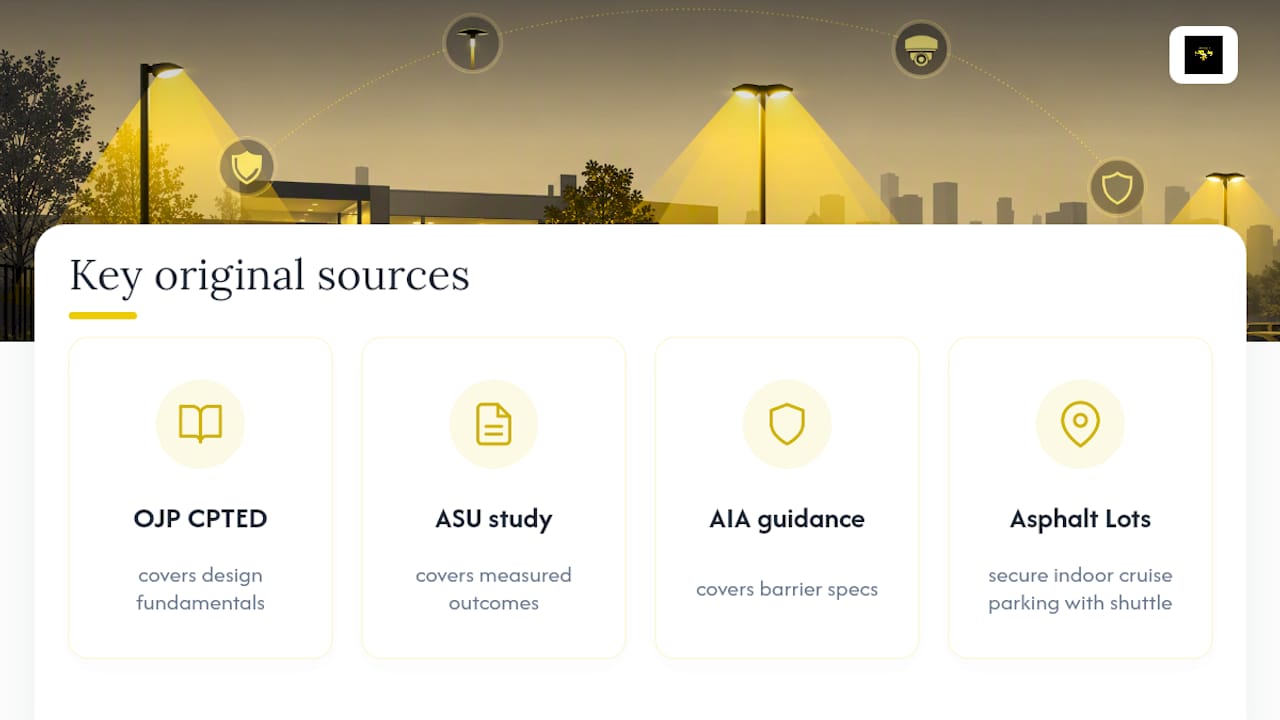
For primary guidance beyond this summary: the OJP CPTED handbook covers design fundamentals, the ASU parking garage study covers measured outcomes, and AIA's secure parking guidance covers barrier specs.
Leaving your car for a week or more while you cruise out of Norfolk works best when the lot handling it already applies this layered approach rather than leaning on a single feature. Asphalt Lots' secure indoor parking near Norfolk combines the surveillance, access control, and staffing pieces covered above into one facility built specifically around overnight and multi-day cruise parking, with shuttle service included. If you're weighing options for an upcoming trip, the VIP membership details outline what guaranteed availability actually looks like on cruise days. Travelers researching a wider set of options can also see how the Panama City Beach parking guide frames similar safety considerations for a different coastal market.
The CPTED-First Case, and Where the Industry Gets Distracted
The industry loves talking about AI cameras and license plate recognition parking systems because they're the flashiest line item on a proposal. That's backwards. The ASU garage study that found a crime drop over 50% wasn't testing AI. It was testing lighting and access control applied through basic CPTED logic.
Technology amplifies a good foundation; it doesn't substitute for one. A weapon-detection algorithm pointed at a dark, obstructed stairwell is still pointed at a dark, obstructed stairwell. Fix the sightlines and the lighting first, then let the cameras and analytics do what they're actually good at: extending human attention into places staff can't watch every minute.
Property managers who skip straight to tech usually do it because lighting retrofits feel unglamorous. They're wrong to skip it. Paint, fixtures, and trimmed shrubs outperform a lot of expensive hardware, dollar for dollar. Start there, then build up.
— Martin
Sources
- Performance of Campus Parking Garages in Preventing Crime
- Crime Prevention Through Environmental Design handbook (OJP)
- Parking Facilities: 2026 AI Security Sector Playbook