What community-focused parking actually means
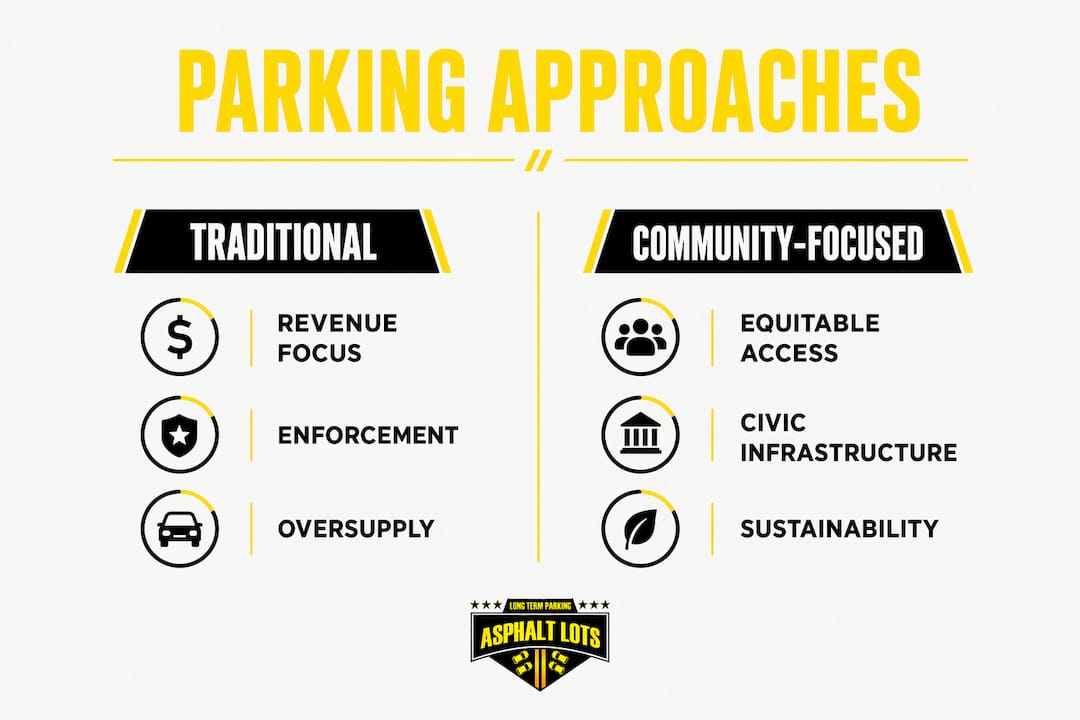
Community-focused parking treats parking as civic infrastructure rather than a revenue stream. The goal is equitable access, neighborhood livability, and local economic vitality, not citation volume or meter revenue. That shift in purpose changes everything: who gets priority, how decisions get made, and what success looks like.
At its core, this approach recognizes that parking occupies roughly 20% of all land in many American cities, often more in downtowns. That is too much public space to manage purely for financial return. When managed well, parking supports walkable districts, reduces time wasted circling for spots, and gives local businesses a real advantage.
Key principles that define community-focused parking:
- Equitable access: Prioritize users with the greatest need, including people with disabilities, transit riders, and customers over long-term commuter storage.
- Inclusivity: Retain cash payment options and accessible design so no population segment gets locked out.
- Community engagement: Involve residents, business owners, and advocacy groups before policies are finalized.
- Right-sized supply: Match parking to actual local demand rather than generic code minimums.
- Alignment with broader goals: Connect parking decisions to housing, transit, walkability, and economic development.
Why traditional parking management creates problems
Most cities still manage parking through spreadsheets focused on revenue and enforcement rather than community outcomes. That framing produces predictable failures.
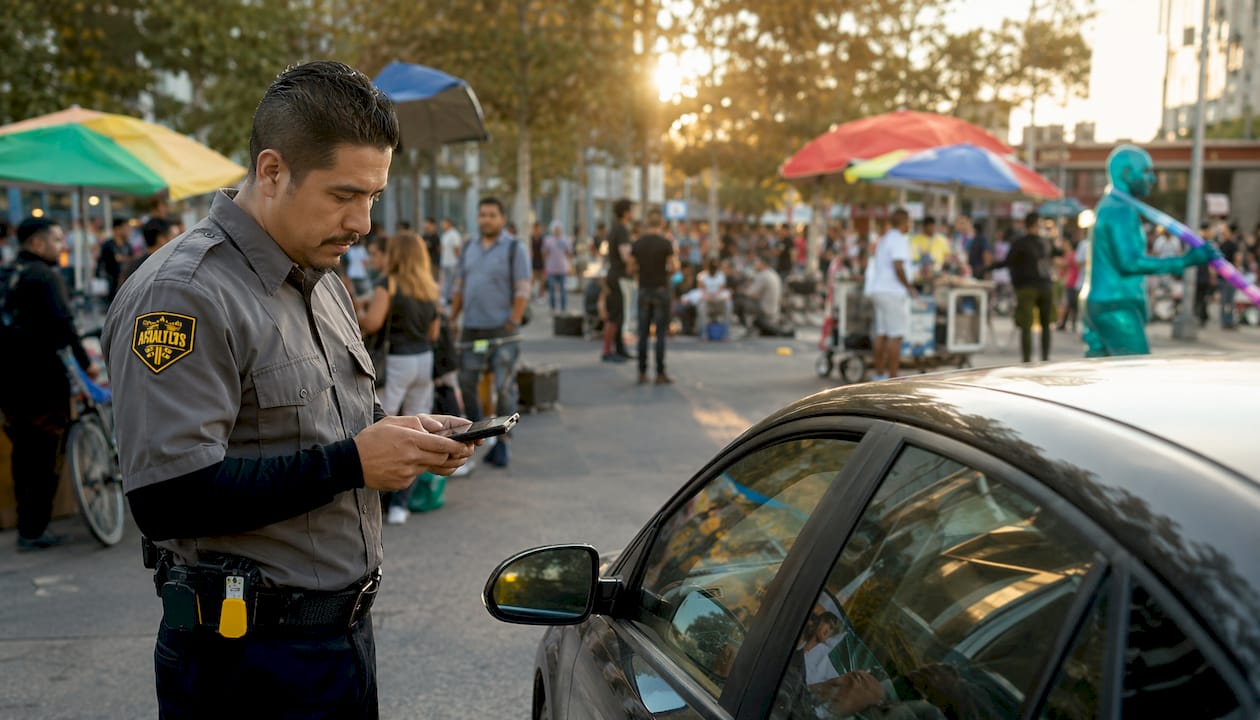
Uniform meter rates and identical time limits applied citywide ignore the fact that a restaurant district at 7:00 PM has nothing in common with a government office block at 9:00 AM. The result is chronic oversupply in some areas and brutal scarcity in others. Spillover into residential streets follows, and with it, the neighbor-versus-shopper conflicts that make parking one of the most emotionally charged issues in local government.
Common parking problems that community-focused approaches address:
- Inefficient allocation that leaves private lots empty while public streets overflow
- Overparking requirements that force developers to build garages nobody fills
- Conflicts between residents, employees, and visitors competing for the same curb space
- Negative impacts on walkability when acres of surface lots fragment neighborhoods
- Underused parking that still generates heat island effects and stormwater costs
"Parking conflicts often stem from poor management rather than lack of space. Effective solutions balance priorities among residents, visitors, and employees, ensuring convenient spaces serve vital functions." — Victoria Transport Policy Institute
Over-supplied parking also subsidizes car use and degrades environmental quality. Fewer paved acres mean less runoff, less heat absorption, and more room for trees and housing. Getting the supply right is not just a planning nicety; it has direct consequences for public health and city budgets.
How community engagement shapes better parking solutions
Effective parking policy grows from a consensus-building process that pulls in business owners, neighborhood associations, developers, and local institutions before anything gets implemented. Cities that skip this step tend to face organized opposition that stalls or reverses reforms.
Engagement methods that work in practice:
- Local advisory committees that meet regularly and include diverse stakeholders
- Public meetings held in the neighborhoods affected, not just city hall
- Surveys and intercept studies that capture actual user behavior and preferences
- Parking Meter District Advisory Boards, as used in San Diego, which give communities direct control over meter revenue allocation and improvement planning
Steps for building a productive engagement process:
- Define the parking market together: agree on priority users, time limits, and decision triggers before choosing tools.
- Bring in outside experts to explain trade-offs, so the conversation is informed rather than reactive.
- Pilot visible, low-cost changes first, such as improved signage or wayfinding, to build trust before introducing pricing reforms.
- Create a standing feedback mechanism so the community can flag problems after implementation.
- Publish results: occupancy data, revenue use, and access outcomes, so residents can hold the program accountable.
San Diego's Parking Meter District Advisory Boards illustrate what structured engagement produces. Boards receive 45% of district meter revenues and use that funding to implement locally designed solutions, including variable permit fees tailored to each neighborhood's specific demand patterns.
What urban planning experts say about implementing this approach
"Public parking isn't a commercial asset in the same way as a private garage or office building is. It is civic infrastructure. It shapes how people experience a city, how they access opportunity, and how inclusive and livable the community can be." — Reframing Municipal Parking, 2026
The expert consensus is clear: parking operators must evolve from revenue collectors into strategic partners evaluated on accessibility, customer satisfaction, and contribution to economic vitality. That requires different metrics entirely.
Oregon's Department of Land Conservation and Development frames this as a "Parking Management Journey." Communities start with simple, low-cost interventions like signage and wayfinding, then advance to time limits and permit programs, and eventually to Parking Benefit Districts. Each step builds operational momentum and community trust before the next, harder change.
The cumulative impact of this approach is well documented. A comprehensive program combining 5–10 small, low-cost measures, including improved signage, permit programs, metering, and validation partnerships, can reduce parking demand by 20–40% in specific areas. No single tool comes close to that result on its own.
Pro Tip: When modernizing payment systems, retain at least one cash-accessible option. Roughly 15% of users still rely on cash, and removing it entirely creates barriers for unbanked populations whose access to work and commerce depends on affordable parking.
Real-world examples of community-focused parking in action
Several American cities have moved well past theory on this. Portland divided its downtown into 13 parking management zones, applying the 85% occupancy rule at the zone level rather than block by block. That means 15% of spaces stay available in each district at all times, giving customers confidence they will find a spot without requiring endless new supply.
San Ysidro, a dense border community in San Diego, built its parking plan through years of community engagement before adopting it in 2016. The resulting strategy combined on-street metering, shared parking arrangements, and a "park once" approach that encourages visitors to walk between destinations rather than move their cars. The plan explicitly connects curb management to public health, economic vitality, and sustainability goals.
Oregon cities including Bend, Eugene, Hood River, and McMinnville have each built programs that prioritize short-term customer access as an engine for business district vitality. Their shared approach: centralized management through public-private partnerships with downtown business associations, coordinated on- and off-street pricing, and strong wayfinding so visitors actually find the available spaces.
How to measure whether community-focused parking is working
Measuring effectiveness means tracking outcomes beyond revenue. The 85% occupancy benchmark is a practical starting point: if more than 85% of spaces in a zone are consistently full, demand exceeds supply and access suffers. Below 60%, supply likely exceeds demand and resources are being wasted.
Useful metrics for evaluating a community parking program:
- Occupancy rates by zone and time of day, not just aggregate averages
- Average search time for a parking space, tracked through intercept surveys or sensor data
- Business revenue trends in the district, since parking access directly affects foot traffic
- Accessibility complaints and ADA compliance audits to catch physical barriers
- Community satisfaction scores gathered through annual surveys of residents and business owners
- Mode shift data showing whether transit, walking, or cycling trips increased as parking was right-sized
Parking standards should be based on local data, not generic ITE generation rates copied from other cities. Conducting your own occupancy counts and turnover studies gives you a defensible baseline and makes it far easier to build community support for changes.
How community-focused parking improves urban mobility and sustainability
Integrating parking with land use reduces vehicle ownership and promotes transit use. That is not a side effect; it is the mechanism. When parking is priced and managed to reflect actual demand, driving becomes one choice among several rather than the only practical option.
Right-sized parking frees land for housing and green space. Fewer surface lots mean less heat-absorbing asphalt, less stormwater runoff, and more tree canopy. Areas with well-managed parking tend to be more walkable, which compounds the environmental benefit by reducing short car trips. For communities near transit hubs, shared parking arrangements between offices, restaurants, and residential buildings can cut total required spaces substantially while improving access for everyone.
Parking decisions also affect housing affordability directly. Excessive minimum parking requirements raise construction costs, which flow through to rents and purchase prices. Cities that right-size their requirements and allow shared or unbundled parking consistently see more housing production at lower cost per unit. That connection between a parking space and a family's rent is one reason community-focused parking has moved from a planning niche to a mainstream urban policy priority.
For travelers who depend on reliable vehicle storage near transit hubs, the same principles apply at the facility level. Asphaltlotsva's secure parking near Norfolk demonstrates how community-oriented parking operates in practice: reserved spots, guaranteed availability, and a priority shuttle service designed around the actual needs of the people using it, not just occupancy targets.
If you are planning a cruise departure and want parking that works the way community-focused principles say it should, the nearby cruise parking checklist from Asphaltlotsva covers exactly what to look for.
For parking lot operators managing community-facing facilities, understanding breakdown protocols is part of delivering the reliable access that community-focused parking promises.
Key Takeaways
Community-focused parking works because it treats parking as civic infrastructure, measures success by access and livability, and builds policy through genuine community engagement rather than top-down mandates.
| Point | Details |
|---|---|
| Core purpose | Prioritize equitable access and neighborhood livability over revenue or enforcement volume. |
| Demand reduction | A comprehensive program combining 5–10 low-cost measures can reduce parking demand by 20–40% in specific areas. |
| Engagement first | Consensus-building with business owners, residents, and advocacy groups improves policy acceptance. |
| Measure outcomes | Track occupancy rates, search time, business revenue, and community satisfaction, not just citations. |
| Sustainability link | Right-sized parking reduces heat islands, stormwater runoff, and housing costs while supporting transit use. |