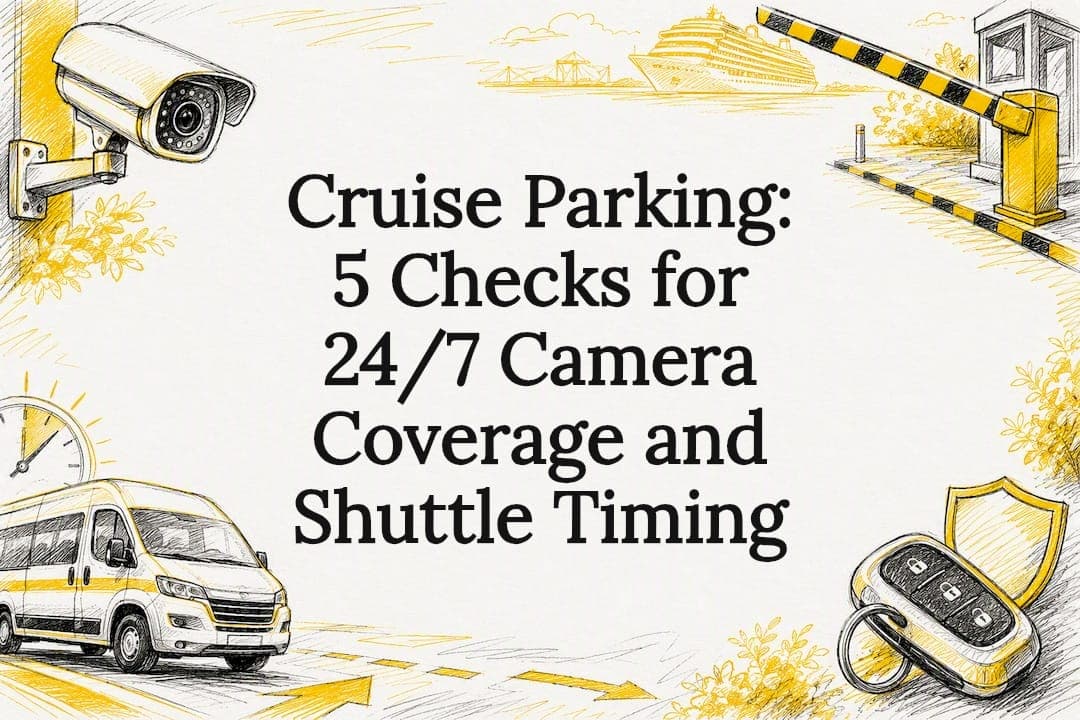
For cruise parking, "24/7 parking cameras" means facility-run continuous on-site video monitoring and recording that operates alongside gated access and staffed check-in. It has nothing to do with a dash cam or a car's own recording mode. Before you pay for a spot, confirm the facility records continuously (not just on motion) and lock down the exact shuttle schedule for your return day.
TL;DR:
- Continuous recording at least 30 days is essential, especially during peak cruise seasons, to ensure footage is available for disputes or claims.
- Gated access, on-site staffed personnel, and proper lighting are critical to physical security, with cameras serving as part of an integrated security system.
- Shuttle services must run on schedule with capacity aligned to cruise ship arrivals to prevent delays that undermine overall security.
- Before booking, verify policies on footage retention, access, and incident handling, and document your car's condition with timestamped photos.
- Review recent customer feedback focusing on return-day shuttle performance and problem resolution, not just star ratings or vague praise.
Table of Contents
- What Good 24/7 Parking Camera Coverage Actually Looks Like
- Checklist: What to Verify Before You Book Monitored Long-Term Parking
- How Cameras and Staff Work Together to Actually Prevent Problems
- How to Prepare Your Car Before Leaving It for a Cruise
- The Baseline Security Features Every Facility Should Have
- What Happens to Your Footage: Privacy and Data Policies
- How to Judge Reviews and Reputation Before You Trust a Facility
- Why Continuous Recording and Shuttle Timing Come First
- How Asphalt Lots Meets This Standard
- Sources
What Good 24/7 Parking Camera Coverage Actually Looks Like
Motion-activated cameras sound reasonable until you realize what they miss. A camera that only triggers on movement can skip the slow, deliberate walk of someone casing a row of cars, or fail to catch the moments right before and after an incident. Continuous recording captures everything, which is why surveillance guidance for secure vehicle lots treats round-the-clock capture, not motion triggers, as the baseline for any facility that expects to hand a customer real evidence after something goes wrong.
Coverage also has to be placed with intent. A facility doing this right prioritizes:
- Entry and exit lanes, where every vehicle and driver get recorded on the way in and out
- The perimeter fence line and any gaps in lighting or sightlines
- Parking rows themselves, not just the aisles between them
- Shuttle pickup and drop-off zones, where bags and passengers are most exposed
On the technical side, 1080p is the floor and 4K is increasingly the standard for anything worth calling secure. Camera density guidance for large vehicle lots suggests roughly one camera for every four parking spaces as a workable ratio, paired with a video management system (VMS) that timestamps and exports clips on request. License plate recognition (LPR) at the entry gate adds another layer, logging every vehicle automatically instead of relying on a guard's memory or a paper sign-in sheet.
Pro Tip: Ask the facility directly whether their cameras record continuously or only on motion. Continuous recording holds up far better if you ever need to dispute a claim, because there's no gap in the timeline for someone to argue about.
Checklist: What to Verify Before You Book Monitored Long-Term Parking
Booking cruise parking over the phone or online takes ten minutes. Verifying it properly takes maybe five more, and it's the five minutes that actually protect your car. Work through this before you hand over a credit card number:
- Ask if cameras run continuously, and get a specific number for footage retention. Many well-run lots keep footage for a minimum of 30 days, which covers most cruise lengths with room to spare.
- Confirm the lot has gated entry, staffed hours (not just a camera watching an empty booth), and a published shuttle frequency.
- Ask what happens on your return day specifically. Shuttle capacity during a mass debarkation is a different problem than shuttle capacity on a random Tuesday.
- Request the vehicle check-in process. Does staff document your car's condition when you drop it off?
- Ask how to request footage if you ever need it, and whether there's a fee or a delay.
Beyond those five, a few more items round out the picture:
- Confirm insurance and incident-handling policy in writing, not just verbally
- Check that the lot fits your vehicle's size and height before you drive up
- Get the cancellation and rescheduling terms, since cruise departure times shift more often than people expect
Facilities that answer these questions clearly and quickly tend to be the same ones that invest in better physical security overall. A vague answer to a direct question is itself useful information.
How Cameras and Staff Work Together to Actually Prevent Problems
A camera alone is a recording device. It doesn't stop anything by itself; it just documents it after the fact. What deters theft and vandalism is the combination of live monitoring, staffed gates, and procedures that make an incident harder to get away with in the first place. There's a real difference between a facility where someone is physically watching monitors in real time and one where footage sits on a server for a third-party service to review only after you file a complaint.
The operational side matters as much as the hardware. A facility doing this properly will:
- Photograph your vehicle at check-in, creating a timestamped record of its condition
- Log entry and exit times automatically through gate systems or LPR
- Require ID verification or an authorization code before releasing a vehicle to anyone other than the original driver
- Keep those logs accessible enough that staff can pull them up in minutes, not days
That last point connects directly to how access control systems log entry and exit, which is worth understanding if you want to know exactly what gets recorded every time a gate arm lifts.
Pro Tip: If you ever need footage, ask for it in writing and reference your exact arrival timestamp. Vague requests like "sometime last week" waste time; a specific window gets you a faster answer.
Shuttle logistics matter here too, even though they seem unrelated to security. A lot with excellent cameras but a slow, disorganized shuttle on return day still leaves you standing in a parking lot stressed and rushed, which is exactly the moment people forget to check their car over. Good return-day shuttle performance is part of the security picture, not a separate convenience feature.
How to Prepare Your Car Before Leaving It for a Cruise
A monitored facility handles the big risks. You still control a handful of small ones. Before you walk away from your car:
- Remove valuables from the interior and glovebox, including any documents with your home address
- Take time-stamped photos of your car's exterior and note the mileage before you leave
- Keep your booking confirmation and check-in receipt somewhere accessible, not buried in your suitcase
- Leave the fuel tank around a quarter full, and disconnect or trickle-charge the battery if you're gone longer than two weeks
- If someone else will pick up the car, tell the facility in advance and provide clear written authorization
This last step matters more than people realize. Facility logs only protect you if the paperwork matches the person standing at the gate. A pre-departure checklist built specifically for cruise travel covers a few more details worth reviewing the night before you leave.
The Baseline Security Features Every Facility Should Have
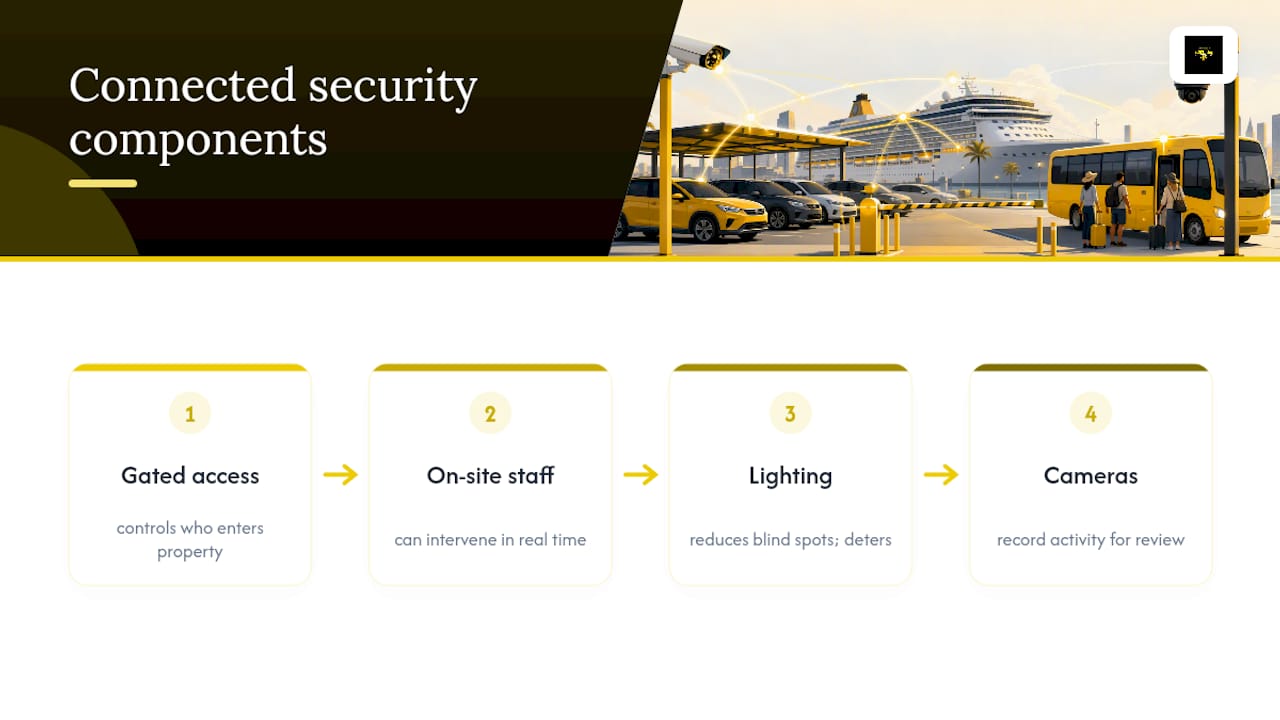
Cameras don't operate in a vacuum. They're one piece of a system that includes gated access, on-site staff, and lighting, and a facility missing any of those three has a real gap regardless of how good its cameras are. Gated entry controls who gets onto the property at all, which matters just as much as recording who does. A card, code, or staffed checkpoint at the gate means random foot traffic isn't wandering the rows at 2 a.m.
On-site staff during operating hours changes the equation because a person can intervene in real time, something a camera alone cannot do. Lighting is the quietest of the three but arguably the most overlooked. Cameras record in low light, but poor lighting still creates blind spots and makes footage harder to use later. A well-lit lot also discourages opportunistic problems before they start, since most people looking to cause trouble prefer not to be seen doing it.
A well-run cruise parking operation treats gates, staff, lighting, and cameras as one connected system rather than four separate boxes to check. When you're comparing facilities, ask about all four together. A lot that only advertises cameras and skips the other three is telling you something by omission.
What Happens to Your Footage: Privacy and Data Policies
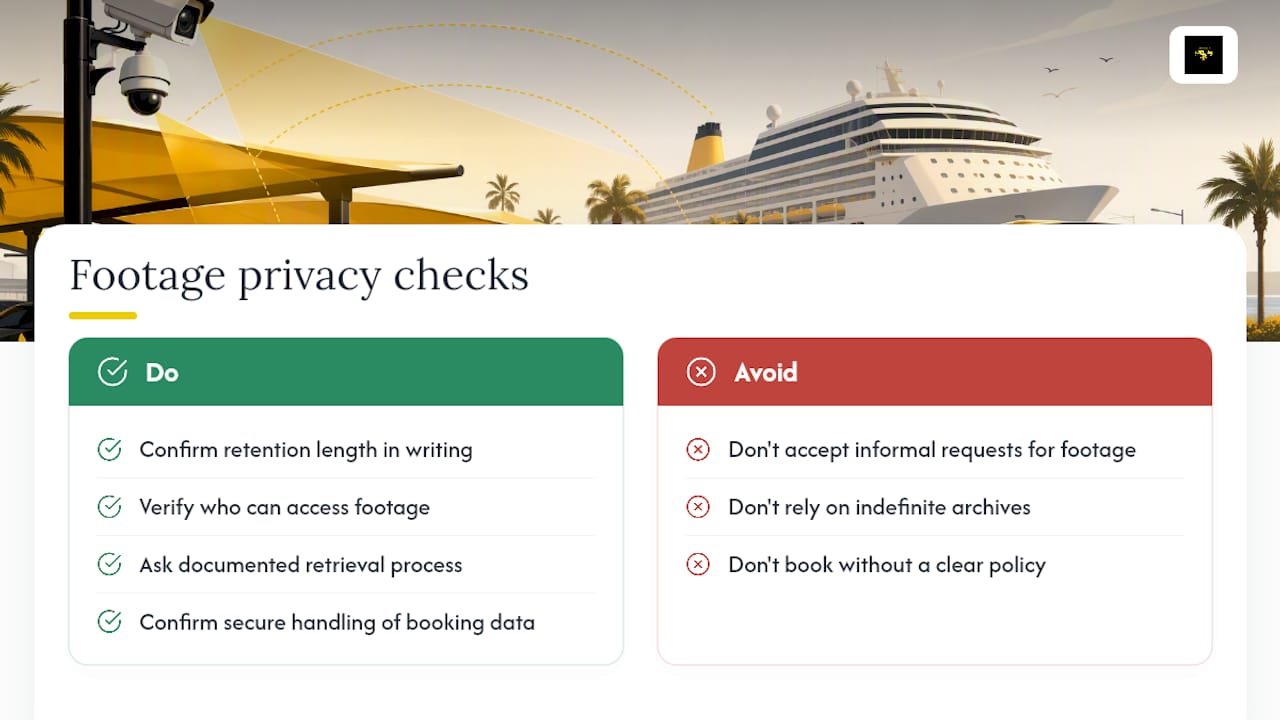
Recording your car around the clock raises a fair question: who else sees that footage, and for how long? A legitimate facility should have a written policy covering retention length, who has access to stored video, and what happens to footage after the retention window closes. Most facilities that take this seriously delete or overwrite footage automatically once it ages out, rather than keeping an indefinite archive.
Access matters as much as retention. Footage should be reviewable only by authorized staff, and released to a customer or law enforcement only through a documented request process, not handed over informally because someone asked nicely at the front desk. If you ever need footage for an insurance claim or a dispute, ask specifically how to submit that request and how long it typically takes to get a response.
None of this needs to be complicated, but it does need to be in writing somewhere you can find it before you book. A facility that can't explain its own footage policy in plain language probably hasn't thought it through carefully. On the technical side, secure handling of any vehicle or credential data tied to your booking is worth confirming too, and guidance on securing vehicle credential data is a useful reference if you want to understand what "secure" should actually mean in practice.
How to Judge Reviews and Reputation Before You Trust a Facility
Star ratings alone don't tell you much. What matters is whether recent reviews, specifically from the last six to twelve months, talk about the thing that actually affects your trip: return-day performance. A facility can have great reviews from three years ago and a completely different shuttle situation today, especially if it's grown or changed management.
Read for specifics rather than tone. A review that says "shuttle showed up within ten minutes of us calling on our return day" tells you far more than one that just says "great service." Look for mentions of how staff handled a problem, whether check-in was quick, and whether anyone mentions camera footage being provided when requested. Reviews that describe a resolved dispute, calmly and specifically, are often more trustworthy than a wall of five-star ratings with no detail behind them.
Also pay attention to how a facility responds publicly to negative reviews. A defensive or dismissive response pattern says more about how they'll treat you during an actual problem than any five-star review does. Documented shuttle performance and recent customer feedback are two of the clearest signals available before you've ever set foot on the property.
Why Continuous Recording and Shuttle Timing Come First
Every operational decision at a facility like this comes down to two priorities: does the footage hold up, and does the shuttle actually run on time. Continuous recording matters more than people expect until they need it. Motion-triggered systems create gaps, and gaps are exactly where disputes get complicated. A full, unbroken record removes the guesswork.
Return-day problems are almost always logistics failures, not security failures. A car sits fine for a week, but the traveler comes back exhausted after debarkation to a shuttle line that hasn't moved in twenty minutes. That frustration has nothing to do with cameras, yet it colors how someone remembers the entire experience. Coordinating shuttle capacity around real cruise ship schedules, rather than a generic timetable, is the difference between a smooth pickup and a stressful one.
The mistake most travelers make is judging a facility purely on its camera specs while ignoring how it handles the ten minutes right after they step off the ship. Both pieces need to work.
— Martin
How Asphalt Lots Meets This Standard
A facility operating on the exact standard this article describes offers secure indoor parking with round-the-clock surveillance, gated access, and staffed operations, located near Norfolk. Some offer a free shuttle to the cruise terminal, and frequent cruisers may be able to lock in guaranteed availability through VIP memberships that also include priority shuttle service on cruise days.
When you're ready to book, ask the same questions this guide walks through, recording policy, footage retention, and shuttle timing, and expect straight answers. Indoor parking also removes weather exposure entirely, which is worth weighing against any outdoor lot alternative you're considering. Check availability and reserve your spot directly through Asphalt Lots before your next cruise date fills up.
Sources
- What to Look for in a Secure Truck Parking Facility
- Secure Cruise Parking In Southampton – CCTV & Long-Stay
- Finding a Secure and Safe Long Term Car Parking Lot