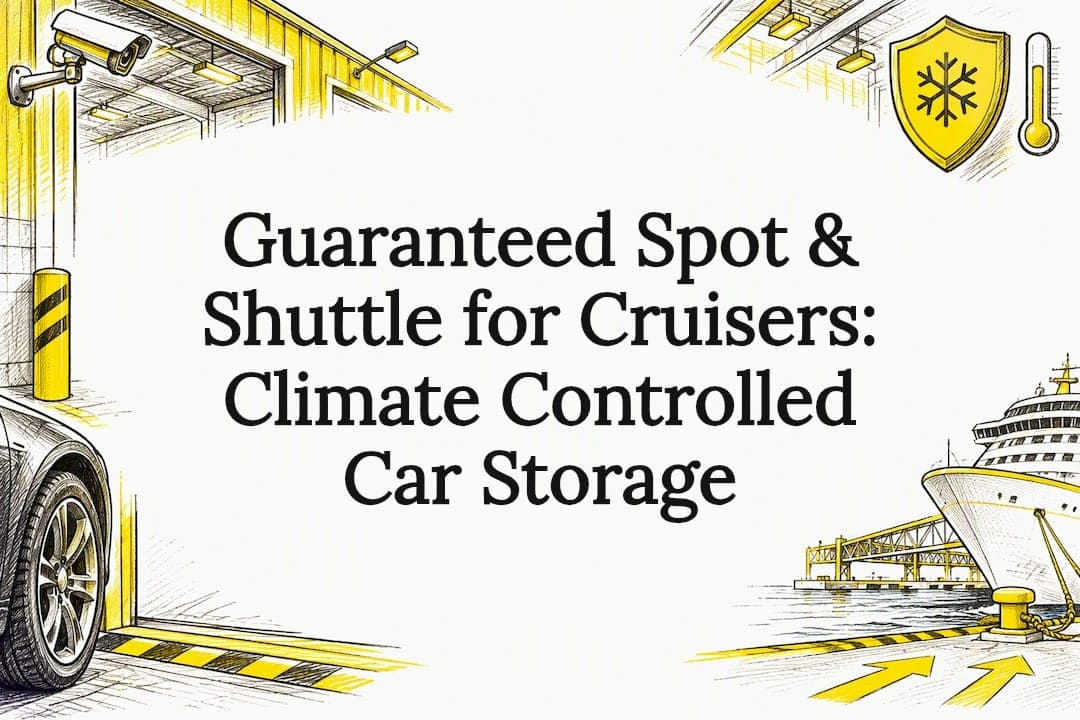
Indoor climate controlled car storage is the right call for any vehicle sitting idle for weeks or months, since it prevents the humidity and temperature swings that damage interiors, seals, and electronics. Expect to pay roughly $70 to $300 a month depending on location, unit size, and amenities. Some providers offer membership and long-term parking options built for cruise travelers who need that protection without the hassle.
TL;DR:
- Climate controlled storage costs between $70 and $300 monthly, with higher prices in dense metro areas or near cruise ports due to demand.
- Security features such as cameras, gated access, and on-site staff are essential for protecting high-value or rarely driven vehicles.
- Most 10x20 units are suitable for standard sedans and small SUVs, but larger vehicles require bigger spaces like 10x25 or 10x30 units.
- Proper preparation includes filling the tank with stabilizer, inflating tires, and covering the car with breathable material to prevent damage.
- Long-term storage benefits from monitoring humidity, ensuring battery maintenance, and selecting providers with clear access, contract, and insurance policies.
Table of Contents
- Why climate control matters for vehicle preservation
- Facility features and security: what to demand from a storage site
- Unit sizes and fit: using 10x20 as the baseline and when to upsize
- Pricing expectations and what affects monthly rates
- Preparing your car for storage: step-by-step checklist
- How to choose a climate controlled storage provider
- Contract terms and minimum rental periods for climate controlled car storage
- Insurance options and requirements for stored vehicles
- Access hours and convenience factors relevant to commercial users
- Cancellation policies and flexibility considerations
- Publisher perspective: Martin and Asphalt Lots' experience serving cruise travelers
- Asphalt Lots services: VIP membership, long-term storage, and how to reserve
- Sources
- FAQ
Why climate control matters for vehicle preservation
A parked car takes a beating from the air around it. Humidity swings pull moisture into upholstery and carpet, feeding mold and corroding metal components, while temperature swings cause seals and gaskets to expand and contract until they crack. Electronics fare no better: circuit boards and connectors are sensitive to condensation, and a car left in an unconditioned space for months can develop electrical gremlins that never show up in daily driving.
Some vehicles have more to lose than others.
- Classic cars with original leather, chrome, and wiring degrade faster without stable conditions.
- Luxury vehicles often carry sensitive electronics and premium interior materials that punish neglect.
- Electric vehicles depend on battery chemistry that performs best in a moderate temperature range.
Indoor climate controlled storage commonly costs between $150 and $270 per month, a premium over outdoor parking that reflects the protection it buys. For high-value or rarely driven vehicles, that gap is usually worth paying.
Facility features and security: what to demand from a storage site

Not all "car storage" means the same thing. Outdoor lots expose vehicles to weather and theft risk. Covered storage blocks rain and sun but leaves temperature and humidity uncontrolled. Indoor, climate controlled units offer the most protection because they regulate both.
Security is where facilities separate themselves from a parking lot with a fence. Before signing anything, look for:
- Cameras covering entrances, exits, and the storage area itself, not just the office.
- Gated or key-code access that logs who comes and goes.
- On-site staff during business hours rather than a fully unattended lot.
- Alarmed or individually secured units for higher-value vehicles.
For cruise travelers specifically, a few operational details matter as much as security. A reserved spot guaranteed on your departure date, a shuttle that actually runs on your schedule, and confirmed access when you return from a week at sea all reduce the stress of leaving a car behind.
Unit sizes and fit: using 10x20 as the baseline and when to upsize
A 10x20 unit is the industry standard for single-vehicle storage and fits most sedans, crossovers, and small SUVs, giving roughly 200 square feet of space and enough ceiling height for comfortable clearance. It is the size most facilities default to when a customer asks for "a spot for my car."
Larger vehicles need more room to maneuver safely:
- Full-size trucks and long SUVs typically need a 10x25 unit.
- A 10x30 unit suits oversized trucks, vehicles with racks or accessories, or owners who want extra room for boxes and gear.
- Check the drive-in door width and ceiling height before booking, especially for lifted trucks or vehicles with roof cargo.
If your vehicle needs a lift, a specialty pad, or unusual clearance, ask the facility directly rather than assuming a standard bay will work.
Pricing expectations and what affects monthly rates
Location drives most of the variation in what you will pay. Indoor climate controlled storage generally costs between $70 and $300 per month, with unit size, amenities, and market demand pushing the number up or down within that range. A facility near a dense metro area or a popular cruise port tends to sit at the higher end.
Beyond the base rate, a few line items commonly surprise renters:
- A one-time administrative or setup fee due at move-in.
- A required certificate of insurance (COI) naming the facility, or an insurance add-on sold by the provider.
- Higher rates for drive-up access versus a shared loading area.
When comparing quotes, ask each facility to break out the base rent, any deposit, and whether insurance is included or purchased separately. A quote that looks cheaper on paper can end up costing more once fees are added.
Preparing your car for storage: step-by-step checklist
Getting a car ready properly is what determines whether it starts cleanly on pickup day or needs a jump and a tow.
- Treat the fuel. AAA recommends filling the tank and adding a fuel stabilizer for any storage period past 30 to 45 days, then driving 5 to 10 miles so the stabilizer circulates through the system.
- Protect the battery. A float-style battery tender is generally preferred over disconnecting the battery, since it maintains charge without forcing you to reset the clock, presets, and memory settings later.
- Inflate the tires fully before storage to reduce the risk of flat spots, and consider jack stands only if you have experience placing them correctly, since improper placement carries real risk.
- Clean and wax the exterior, place moisture-absorbing desiccant packs inside the cabin, and block the tailpipe and air intake to keep rodents out.
- Check fluids before you leave the vehicle, and cover it with a breathable cover rather than plastic to avoid trapping moisture.
- Plan for movement. Short weekly idles can do more harm than good; a longer drive of 15 to 30 minutes that brings the engine to full operating temperature does a better job preventing condensation and keeping the battery charged.
Pro Tip: Set a recurring calendar reminder for whoever checks on your car. A battery tender only helps if someone confirms it is still connected.
For more detail on tire care specifically, see this guide to preventing flat spots during storage, and for humidity targets, this breakdown of storing cars at 40 to 50% relative humidity is worth a read before you drop off your keys.

How to choose a climate controlled storage provider
Pick a provider the way you would vet any long-term contract, not just by the first search result. Ask direct questions before committing:
- What temperature and humidity range does the facility maintain, and is it monitored?
- What security measures are in place: cameras, gated access, on-site staff?
- Is insurance required, and does the facility accept a certificate of insurance (COI) from your own policy?
- What is the access policy if you need your car outside normal hours?
- What happens if the vehicle needs jump-starting or maintenance while stored?
Red flags include facilities that will not show photos of the actual storage area, have no recent reviews, or are vague about who handles insurance claims if something goes wrong. A quick way to compare options is to weigh three factors side by side: protection level, convenience (access hours, shuttle service, location), and price. The best fit rarely wins on all three, but it should not lose badly on any of them.
Pro Tip: Call the facility directly and ask what happens during a power outage. The answer tells you a lot about how seriously they take climate control.
Contract terms and minimum rental periods for climate controlled car storage
Most climate controlled facilities operate on month-to-month agreements, though some require a minimum commitment, often 30 to 90 days, especially for premium indoor units or discounted long-term rates. Read the contract for language about automatic renewal, since many agreements roll over unless you give written notice before a specific cutoff date.
Ask specifically what triggers a rate increase. Some contracts lock your rate for the length of an initial term and only adjust at renewal, while others reserve the right to raise rates with 30 days' notice at any point. Also check whether the facility charges differently for a short stay of a few weeks versus a season-long commitment: providers structure their pricing to reward longer contracts, so a two-month stay may cost more per month than a six-month one.
For deployment or extended absences, ask whether the facility offers a long-term storage rate distinct from its standard monthly parking, and whether that rate requires proof of the reason for the extended stay, such as military orders. A written agreement should spell out access rights during the contract term, what happens if payment lapses, and who is liable if the vehicle is damaged while in storage. Get all of this in writing rather than relying on a verbal promise from staff.
Insurance options and requirements for stored vehicles
Storing a car does not automatically remove the need for insurance, and most facilities will ask for proof of coverage before handing you a gate code. The most common requirement is a certificate of insurance, or COI, naming the storage facility, which confirms your existing auto policy covers the vehicle while parked on their property.
If your policy lapses to a storage-only or comprehensive-only tier while the car sits unused, confirm with your insurer that the facility's address and use case are covered. Some facilities offer their own supplemental insurance for an added fee, which can be worth considering if your personal policy has gaps around theft or fire while the vehicle is not being driven.
Before you sign anything, ask the facility directly how they handle a damage claim: whether they carry their own liability coverage for the property, and how a dispute over responsibility gets resolved. A facility that cannot answer clearly is one to think twice about.
Access hours and convenience factors relevant to commercial users
For everyday storage, access during business hours is often enough. For commercial or frequent users, hours and flexibility matter a lot more. A contractor storing a work vehicle, a small business storing a fleet car, or a cruise traveler timing a pickup around a ship's arrival all need to know exactly when they can get to their vehicle.
Ask whether the facility offers extended or 24/7 access, or whether pickup and drop-off are restricted to set windows. For cruise travelers in particular, a facility that coordinates shuttle timing with cruise terminal schedules removes one more variable from a trip, since ships do not wait for a slow gate line.
Confirm what happens if you arrive outside normal hours: some facilities have an after-hours protocol, others simply lock the gate. If your schedule is unpredictable, this single detail can matter more than price.
Cancellation policies and flexibility considerations
Plans change, and a storage contract should not punish you for that. Ask upfront how much notice is required to cancel a month-to-month agreement, since many facilities require 30 days' written notice rather than allowing an immediate walk-away.
For memberships or subscription-style parking plans, check whether you can pause billing during a period you will not need the space, or whether cancellation forfeits any prepaid time. Facilities that build in flexibility, like allowing a member to skip a month without penalty, tend to be a better fit for people whose travel or storage needs shift throughout the year.
Also ask about refunds for unused prepaid periods and whether a deposit is refundable at the end of the contract. A facility that spells out its cancellation terms clearly, rather than burying them in fine print, is generally one that stands behind its service.
Publisher perspective: Martin and Asphalt Lots' experience serving cruise travelers
Working with Asphalt Lots has made a few things obvious. Humidity control and battery maintenance are the two issues that actually cause problems on pickup day, not theft or vandalism, which get most of the attention in ads for storage facilities. A car with a dead battery or a musty interior after two weeks away is a common complaint, and both are preventable with the basics covered above.
The VIP Unlimited Cruise Parking Membership solves a narrower but real problem: booking anxiety before a trip. Knowing a spot is guaranteed, without calling ahead or hoping the lot has room, removes one more thing to think about before a cruise.
That said, climate controlled storage is not always necessary. A daily driver stored for a single week does not need the same protection as a classic car parked for a season. Match the service to the actual risk.
— Martin
Asphalt Lots services: VIP membership, long-term storage, and how to reserve
If you are heading out on a cruise, Asphalt Lots gives you a way to park once and stop thinking about your car until you get back. Norfolk Carnival Cruise Parking runs $10 per day for standard daily parking, and the Unlimited VIP Cruise Parking Membership costs $100 per month, covering a guaranteed reserved spot on every cruise day along with priority shuttle service.
For longer absences, Asphalt Lots also offers Monthly Parking and Deployment & Long-Term Parking, both described in detail on the services page. Before you reserve, have your vehicle information, travel dates, and proof of insurance ready so booking takes minutes rather than a back-and-forth call.
Whether you are leaving for a week at sea or a longer deployment, book your spot at Asphalt Lots before your departure date to lock in guaranteed access and skip the uncertainty of a public lot.
Sources
- Can You Store a Car in a Storage Unit? (2026)
- Parked car storage tips — AAA
- How to maintain an infrequently driven car — AAA (2026)
- Winter car storage tips — AAA Magazine
FAQ
How much does it cost to store a car in a climate controlled storage unit?
Indoor climate controlled units typically run $150 to $270 a month, with the wider market range landing between $70 and $300 depending on location and amenities. Unit size, added security features, and local demand all push the price within that range.
Is it illegal to put a car in a storage unit?
Storing a car in a storage unit is generally legal as long as the vehicle is registered, insured as required by the facility, and not left in a state of disrepair that violates the facility's lease terms. Rules vary by facility, so check the specific contract before assuming any use is permitted.
Can a 10x20 storage unit hold a car?
Yes, a 10x20 unit is the industry standard for a single vehicle and comfortably fits most sedans, crossovers, and small SUVs. Larger vehicles like full-size trucks or long SUVs generally need a 10x25 or 10x30 unit instead.
Where to store a car for 2 months?
An indoor, climate controlled facility is the best option for a two-month gap, since it protects against humidity and temperature swings that a driveway or outdoor lot cannot control. For cruise travelers, a facility like Asphalt Lots that combines secure indoor parking with shuttle service to the terminal adds convenience on top of protection.