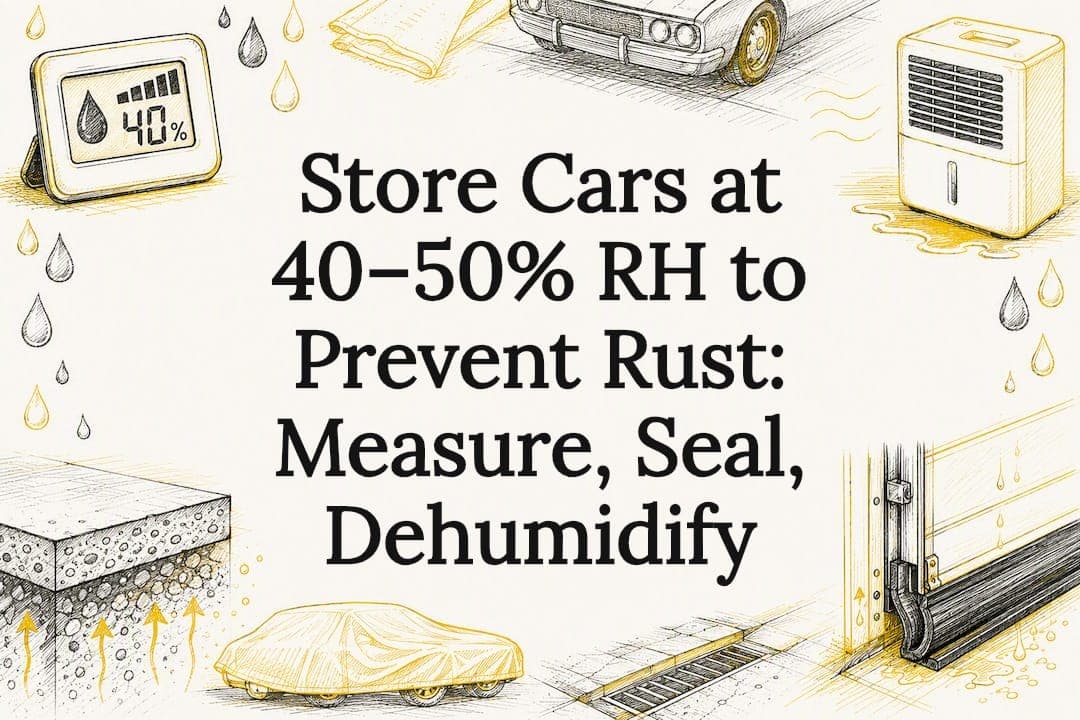
Keep your storage space between 40% and 50% relative humidity. That's the range that stabilizes the micro-environment around a parked car and holds corrosion and mold at bay. Your first move isn't buying equipment. It's putting a calibrated digital hygrometer in the space today, because you can't fix a number you haven't measured. From there, you're choosing between active dehumidification and targeted desiccants, often both.
TL;DR:
- Measure humidity with a calibrated digital hygrometer before investing in any dehumidification solutions, and place it properly away from condensation-prone areas.
- Use a dehumidifier suitable for your garage size, prioritizing models with continuous drainage and appropriate capacity, especially if temperatures fall below 45°F.
- Seal the slab with vapor barriers or coatings, and check garage door seals and grading to prevent moisture intrusion from the foundation or outside water pooling.
- Avoid relying solely on silica packs or moisture absorbers for large spaces, and layer desiccants inside the vehicle for best protection.
- Consider professional climate-controlled storage if your garage cannot be sealed effectively or your vehicle is high-value and needs maximum protection.
Table of Contents
- Why Humidity Control Matters for Car Storage
- How Do You Measure and Monitor Garage Humidity?
- Which Dehumidifier Type Is Right for Your Garage?
- Do Silica Packs and Moisture Absorbers Actually Work?
- How Do You Stop Moisture From Getting Into the Garage?
- What Should You Do to the Car Before Storing It?
- How Often Should You Check on a Stored Car?
- When Does Professional Climate-Controlled Storage Make More Sense?
- What Actually Moves the Needle on Car Storage Humidity
- Sources
Why Humidity Control Matters for Car Storage
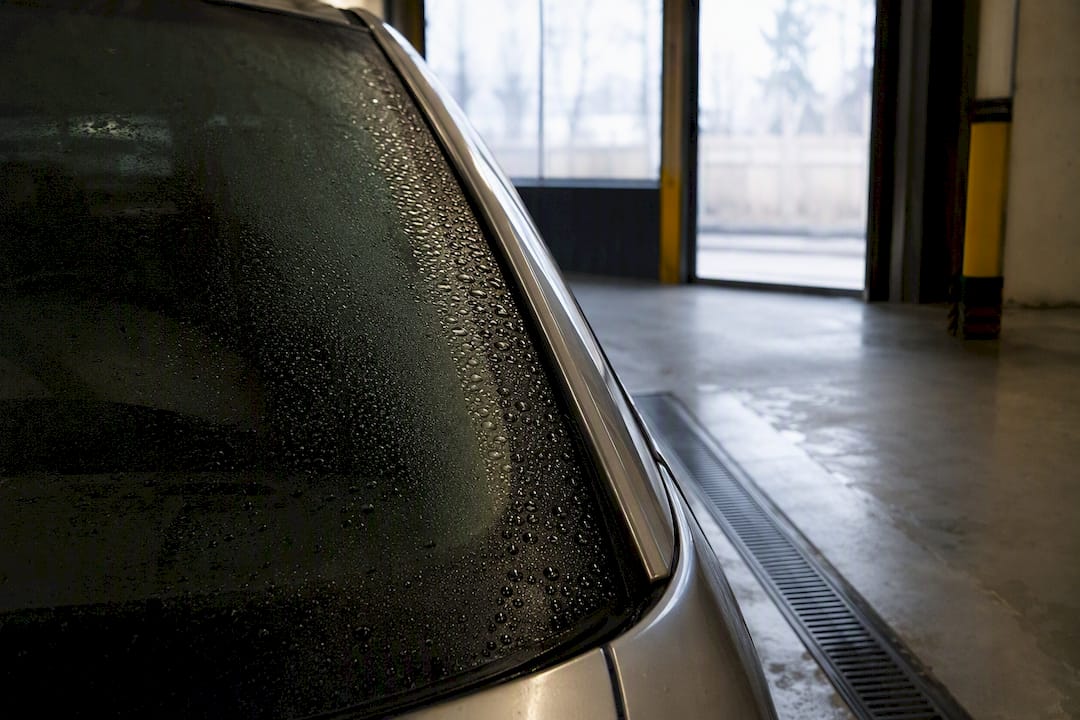
Relative humidity, or RH, measures how much moisture the air holds compared to the maximum it could hold at that temperature. Dew point is the temperature at which that moisture starts condensing on a surface. A cold windshield on a humid morning shows you dew point in action.
Garages make this worse than you'd think. A concrete slab absorbs heat and cold slower than the air around it, so when outside temperatures swing, the slab and anything resting near it lag behind. Warm, moist air meets a cool car body or a cool floor, and you get condensation nobody sees until rust shows up months later. This is the thermal-shock moisture event that catches most owners off guard.
Push RH above 50% for extended periods and you invite mold on upholstery, mildew smells in carpet, and steady corrosion on anything metal. Drop it much below 30% and you dry out gaskets, leather, and rubber seals until they crack. Neither extreme is good, which is why 40% to 50% RH is the target range for long-term preservation, not a suggestion.
The components that suffer first tend to follow a pattern:
- Underbody seams and pinch welds, where moisture collects and paint coverage is thinnest
- Wheel wells and brake lines, especially on vehicles that saw winter road salt
- Interior seams, headliners, and carpet padding, where trapped moisture breeds mold
- Chrome trim and exposed fasteners, which spot rust fastest once humidity climbs
How Do You Measure and Monitor Garage Humidity?
Buy a digital hygrometer with data logging and good accuracy. Cheap analog dial gauges drift over time and won't tell you when humidity spiked at 3 a.m. while you were asleep.
Placement matters more than most people assume. Set the hygrometer at mid-level, off the concrete floor where cold and moisture pool, and near the car without letting it touch any surface. A unit tucked into a corner behind a toolbox will read the corner's microclimate, not the air around your vehicle.
Once it's running, check the logs daily for the first week to catch patterns tied to weather swings, then move to a weekly glance once you trust the baseline. Many data loggers support smartphone alerts when RH crosses a threshold you set, which beats remembering to check manually.
- Choose a model with logging, not just a live readout
- Mount it mid-level, several feet from the car
- Set an alert threshold around 55% RH so you catch drift early
- Recalibrate or replace the sensor annually since accuracy fades with age
Pro Tip: Place a second, cheap hygrometer near a suspected trouble spot, like a garage corner or near a garage door seal, for a week. If it reads noticeably higher than your main unit, you've found a leak point worth sealing before you spend money on a bigger dehumidifier.
Which Dehumidifier Type Is Right for Your Garage?
Refrigerant (compressor) dehumidifiers pull air across a cold coil, condense the moisture, and drain it off. They're efficient in normal garage temperatures but lose effectiveness and can freeze up once things get cold. Desiccant dehumidifiers use a moisture-absorbing wheel or material instead of refrigerant, so they keep working reliably below the temperatures where compressor units start to struggle, generally under 45°F.
Sizing follows the space, not the car:
- Small single-car garages (under 400 square feet) generally do fine with a 30 to 50 pint compressor unit or a mid-size desiccant model
- Medium two-car garages (400 to 700 square feet) usually need 50 to 70 pint capacity, more if the slab tests wet
- Large or poorly sealed spaces, including detached shops with exposed framing, often need commercial-grade units or two smaller ones running in different zones
Run the unit with continuous drainage, such as a hose routed to a drain or condensate pump, to avoid frequent manual emptying. Pairing the dehumidifier with air sealing and drainage fixes does more than the appliance alone ever will.
- Compressor units cost less upfront but draw more power and struggle in cold
- Desiccant units cost more but keep working through winter without freezing
- Continuous drain setups beat manual bucket emptying for unattended storage
- Clean or replace filters roughly every one to three months depending on dust load
Pro Tip: If your garage regularly drops below 45°F in winter, don't buy a compressor unit and hope. Buying the wrong dehumidifier that freezes solid leaves your car completely unprotected during exactly the months it needs help most.
Do Silica Packs and Moisture Absorbers Actually Work?
They work, but only at small scale. Silica gel packets and calcium chloride products like DampRid handle enclosed volumes well: a glovebox, a trunk, a sealed cabin. They're undersized for a whole garage, and expecting one to condition 400 square feet of open space sets you up for disappointment.
- Cabin and trunk placement: effective, especially for musty-smell prevention
- Glovebox packs: cheap insurance against electronics corrosion
- Whole-garage use: don't bother, capacity runs out fast
- Replacement cadence: swap disposable packs every 30 to 60 days, or recharge reusable crystal-based units per the label
The right combination is layered, not either/or. Run a properly sized dehumidifier for the room and place desiccant packs inside the car itself. That split covers both the space and the sealed pockets a room dehumidifier can't reach as effectively.
How Do You Stop Moisture From Getting Into the Garage?
Start with the slab, since that's the moisture source most owners never test. Tape a two-foot square of plastic sheeting to the concrete and leave it for 24 hours. Condensation under the plastic means the slab is emitting moisture upward, a phenomenon called vapor drive that's invisible to a hygrometer sitting at chest height.
- Run the plastic-sheet test before buying any equipment; it tells you whether you have a slab problem at all
- If it fails, apply an epoxy coating or a penetrating concrete sealer rated for vapor blocking
- Check garage door bottom seals and weatherstripping for gaps, and replace worn seals
- Grade the ground outside away from the foundation and clean gutters so rainwater doesn't pool against the wall
- For a quick, temporary fix while you plan a permanent one, lay heavy poly sheeting under the car as a makeshift vapor barrier
Sealing alone isn't the finish line. Stagnant air lets microclimates form in corners and under the car, where surfaces can still hit dew point even when the room average looks fine. A small, low-speed fan running continuously breaks up those pockets without adding much to your power bill. Some owners aim for roughly six air changes per hour in a sealed storage space, which a couple of inexpensive DC fans can deliver if positioned to actually move air across the car rather than just around the room.
Pro Tip: Run the plastic-sheet slab test before you spend a dollar on a dehumidifier. A wet slab can overwhelm even a well-sized unit, and sealing it first often cuts your dehumidifier's workload dramatically.
What Should You Do to the Car Before Storing It?
- Wash the entire vehicle, including the undercarriage, to strip road salt and grime that hold moisture against metal
- Dry it completely, then apply a coat of wax or paint sealant, plus a rust inhibitor spray on wheel wells and exposed undercarriage metal if the car has any age on it
- Place silica or reusable desiccant packs in the cabin, trunk, and glovebox, and wipe down leather with a conditioner so it doesn't dry out and crack during a long sit
- Hook up a battery maintainer and check fluid levels; neither is technically a humidity fix, but both prevent problems that compound with a long, unattended storage stretch
Detailed step-by-step prep guidance can walk you through the full checklist if this is your first extended storage stint. If your paint needs more than wax, a climate-controlled wrap installation offers another layer of finish protection worth understanding before a long storage period. For interior leather that's already showing wear from sun or age, conditioning products aimed at repairing sun-damaged interiors are worth a look before you seal the car away.
How Often Should You Check on a Stored Car?
Weekly, do a quick check: glance at the hygrometer log, open the door and sniff for a musty smell, and look for surface condensation on glass or trim. Monthly, go deeper: check under the car for rust bloom starting on brackets or bolts, inspect tires for flat-spotting, and confirm the dehumidifier drain hasn't backed up.
- Condensation on interior glass usually means RH crept above your target band
- A musty smell means mold has likely already started somewhere in the cabin
- Any RH spike beyond 55% for more than a day or two warrants immediate action
If the hygrometer logs show repeated spikes despite an active dehumidifier, that's your signal to upgrade capacity or finally tackle the slab sealing you've been putting off. A quick related check worth adding to that monthly pass: tire flat-spot prevention during long, stationary storage.
When Does Professional Climate-Controlled Storage Make More Sense?
A home garage with a sealed slab, good drainage, and a properly sized dehumidifier can protect a car well. But some situations tilt the math toward paying for monitored storage instead of managing it yourself.
- A high-value or collector vehicle where a single rust season costs more than a year of storage fees
- Extended absences, cruise trips especially, where nobody's home to notice a dehumidifier tripped its breaker
- Older garage construction with an unsealed slab, poor grading, or no realistic path to fixing either soon
Continuous surveillance and a sealed, monitored building envelope solve the exact failure point that trips up most DIY setups: nobody catches the problem until they're standing in front of it weeks later.
Asphalt Lots built its indoor facility around that gap, and the difference between indoor and outdoor lot storage comes down to exactly this kind of unattended risk.
What Actually Moves the Needle on Car Storage Humidity
Most advice on this topic buries the lede under gadget recommendations. The dehumidifier isn't the first decision, it's the third. Measure first. Then find and stop the moisture source, usually the slab, sometimes a door seal. Only after that does choosing between a compressor unit, a desiccant model, or a stack of silica packs actually matter, because a great dehumidifier fighting an unsealed slab is just running up your power bill.

The conventional wisdom oversells passive desiccants and undersells the plastic-sheet slab test, which costs nothing and tells you more than a $200 hygrometer ever will on its own. If you take one thing from this article, let it be that sequence: measure, seal, then choose your equipment.
And be honest about your garage. Not every space can hit 40% to 50% RH reliably, especially older construction with a wet slab and no realistic sealing budget. In those cases, a monitored indoor facility isn't an upsell, it's the more rational choice for anyone unwilling to gamble a car on a garage that was never built to hold humidity steady.
— Martin
Ready to skip the guesswork entirely? Asphalt Lots' indoor cruise parking near Norfolk offers 24/7 monitored storage with guaranteed reserved spots, so your car sits in a controlled environment instead of a garage you're hoping holds steady while you're at sea.