Storing a car safely for the long haul comes down to six things: wash and protect the exterior, fill the tank and add fuel stabilizer, keep the battery on a maintainer, manage tire pressure to prevent flat spots, leave the parking brake off, and seal it against pests under a breathable cover. Skip any one of these and you're gambling with a car that won't start, or worse, one that needs a new interior when you finally pull the cover off.
Here's your working checklist before you park it and walk away:
- Wash, dry, and wax the exterior to block moisture and UV damage.
- Fill the tank nearly full and add fuel stabilizer, then run the engine to circulate it.
- Connect a smart battery maintainer, or disconnect the negative terminal if power isn't available.
- Inflate tires to the sidewall's recommended pressure, or slightly above for short-term storage.
- Release the parking brake and use wheel chocks instead.
- Cover the car with a breathable fitted cover and seal off entry points against rodents.
Storage problems move fast. A neglected 12-volt battery can drop below starting voltage in as little as two to three weeks without a maintainer, and flat-spotted tires can set in even sooner if the car sits fully loaded on the same contact patch. If you're storing an EV or plug-in hybrid, the rules change on battery state of charge, so jump to the EV and Plug-In Hybrid Storage: What Changes? below before you do anything else.
Key Takeaways
Storing a car safely for months requires fresh oil, a stabilized fuel system, a smart battery maintainer, correct tire pressure, an off parking brake, and a breathable cover to prevent rust, dead batteries, flat spots, and pest damage.
| Point | Details |
|---|---|
| Prep before you park | Change the oil, add fuel stabilizer, and wax the exterior before the car sits for more than 30 days. |
| Battery care matters most | A smart maintainer protects lead-acid and AGM batteries better than a basic trickle charger. |
| Tires need attention | Inflate to sidewall spec and use jack stands or periodic moves to prevent flat-spotting. |
| EVs need a different charge target | Store EV and plug-in hybrid batteries at roughly 40% to 60% state of charge, not full. |
| Indoor storage adds real protection | Facilities like Asphaltlotsva offer 24/7 surveillance and climate-protected indoor parking for long-term vehicle storage near Norfolk. |
Table of Contents
- What Counts as Long-Term Car Storage?
- Where Should You Store a Car Long-Term?
- How Do You Prepare a Car for Long-Term Storage?
- EV and Plug-In Hybrid Storage: What Changes?
- How Often Should You Check On a Stored Car?
- How Do You Safely Take a Car Out of Storage?
- What Mistakes Cause the Most Storage Damage?
- A Managed Alternative If You'd Rather Not Handle Storage Yourself
- Sources
What Counts as Long-Term Car Storage?
Short-term storage means a few weeks: a work trip, a hospital stay, a two-week cruise. Long-term storage means a month or more, and it's the point where fuel starts to break down, batteries drain past recovery, and tires begin to deform under sustained weight in one spot.
The line matters because the prep differs sharply:
- Under 30 days: top off fluids, keep the battery charged, and check tire pressure. Skip the oil change.
- 30 to 90 days: add fuel stabilizer, use a battery maintainer, and consider jack stands if you won't be moving the car.
- 90 days or more: change the oil and filter first, since used oil carries combustion byproducts that turn corrosive over time and attack internal engine surfaces during extended dormancy. This is also when climate-controlled storage starts paying for itself.
Common triggers for long-term prep: seasonal storage over winter, military deployment, an extended overseas trip, or handing a car down to someone who won't drive it for a while. Each scenario calls for the same core checklist. Only the check-in frequency changes.
Where Should You Store a Car Long-Term?
Your options break down into four tiers: a personal garage, a private indoor storage unit, shared indoor parking, and outdoor covered or uncovered lots. Each trades off protection, cost, and convenience differently.

A personal garage is free if you have one, but few garages control humidity, and unheated ones in cold climates still expose the car to condensation cycles. Indoor storage facilities go further: climate-controlled and dehumidified units reduce moisture-related damage to paint, leather, and electronics in ways an open garage simply can't match. Shared indoor parking splits the difference on cost but depends heavily on the facility's security setup. Outdoor covered parking is the cheapest option and the least protective, since even a good cover can't stop humidity swings or falling debris the way four walls do.
Before committing to any facility, check for:
- Gated or keycard access control, not just a locked gate at night.
- Active video surveillance with retained footage, not dummy cameras.
- On-site staff or regular patrol checks, especially for multi-month contracts.
- Individually locked units or bays rather than open-bay shared space.
Climate control and dehumidification cost more, but they're worth it once you're storing past the 90-day mark, especially in humid coastal regions where mildew and rust move fast. Before you sign anything, measure your car's height with mirrors folded and confirm the unit's door clearance. A surprising number of SUVs and trucks with roof racks get turned away at the door.
Pro Tip: Ask the facility directly whether your car is covered under their liability policy or only yours. Most storage facilities don't automatically insure a vehicle for external damage, so you may need a storage-specific rider or comprehensive-only coverage.
How Do You Prepare a Car for Long-Term Storage?
Work through these steps in order. Skipping ahead to the cover while the fuel system is untreated is how people end up with gummed-up injectors six months later.
- Wash and wax the exterior. Dirt and road grime trap moisture against the paint. A coat of wax adds a barrier against UV fading and oxidation over months of sitting still.
- Clean the interior thoroughly. Vacuum every crumb, wipe down surfaces, and remove anything edible, wrapped or not. Food residue is what draws rodents in the first place.
- Photograph the car from all angles. Dated photos give you a baseline to compare against when you pull it out of storage, especially useful if you're filing an insurance claim later.
- Change the oil and filter. Fresh oil before storage protects internal components from the corrosive buildup that develops in used oil during long dormancy.
- Top off other fluids. Check coolant, brake fluid, transmission fluid, and power steering fluid against your owner's manual specs. Full reservoirs leave less room for condensation to form.
- Fill the tank nearly full and add fuel stabilizer. A nearly full tank limits the air space where condensation forms, and stabilizer keeps the fuel from breaking down. Run the engine for 10 minutes afterward so treated fuel reaches the injectors and fuel lines.
- Set up battery protection. A microprocessor-controlled smart maintainer beats a basic trickle charger because it monitors voltage and stops overcharging, which matters even more for AGM batteries than standard lead-acid ones. No power source at all? Disconnect the negative terminal instead.
- Handle the tires. Inflate to the sidewall's max recommended PSI, or a few pounds above, for storage under three months. Beyond that, jack stands under the frame rails prevent flat-spotting entirely, or move the car every few weeks to shift the contact patch.
- Leave the parking brake off. Use wheel chocks front and back instead. A parking brake left engaged for months can seize the cables or fuse the pads to the rotors, a common and expensive surprise.
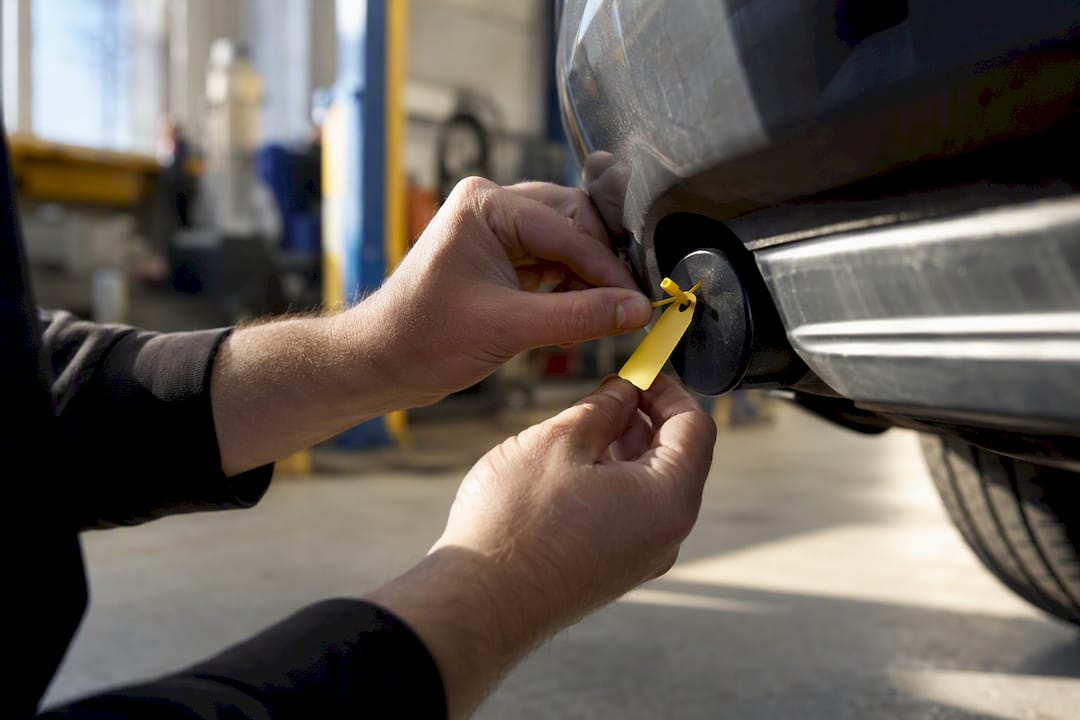
- Seal against pests. Plug the exhaust tip and air intake with breathable steel wool, not solid rags that trap moisture. Check under the hood and inside wheel wells for gaps mice can squeeze through.
- Cover and control moisture. Use a breathable fitted cover, never a tarp, which traps condensation against the paint. Add silica desiccant packs or a small dehumidifier inside the cabin in humid climates, and slide carpet scraps or foam pads under the tires if they'll sit directly on concrete for months.
Follow your specific model's storage instructions where they diverge from general advice, particularly around fuel system additives or battery disconnect procedures on newer vehicles with always-on modules.
Pro Tip: Tape a visible tag to any plug you install in the tailpipe or intake. It sounds obvious until you forget it's there and try to start the car with a wad of steel wool still lodged in the exhaust.
EV and Plug-In Hybrid Storage: What Changes?
Check your owner's manual for exact thresholds before storing an EV or plug-in hybrid. Manufacturers update these recommendations as battery chemistry and software evolve, and following your specific model's guidance matters more here than with gas engines.
That said, the general principle holds across most electric vehicles: store the battery at roughly 40% to 60% state of charge, not full and not empty. Lithium-ion cells degrade faster when left at either extreme for extended periods, so topping off to 100% before a long storage stretch actually shortens battery life rather than protecting it.
Two paths work for maintaining that charge level:
- Leave the car plugged in and use the manufacturer's scheduled or storage-mode charging setting, which automatically maintains the target range without overcharging.
- Charge it to the target percentage manually, then unplug it and check back periodically rather than leaving it connected without a scheduling feature.
The 12-volt accessory battery still needs the same attention as a gas car's, since it runs the infotainment system, alarm, and various modules even while the main battery sleeps. A maintainer or disconnect prevents that smaller battery from dying and locking you out of the car electronically. EVs also tend to need a different check-in rhythm than gas vehicles, and a software update mid-storage can shift what the manufacturer recommends, so it's worth checking your automaker's current guidance before and during a long storage period.
How Often Should You Check On a Stored Car?
- Do a visual walk-around every three to four weeks. A short inspection at this interval catches rodent droppings, battery maintainer faults, and tire pressure loss before they become expensive.
- Check the maintainer's indicator light and tire pressures at each visit. Look for fluid stains under the car and inspect the cover for tears or pooled condensation on top.
- Move the car a few feet if you're able to. Redistributing the tire contact patch and cycling the suspension and brake components prevents flat-spotting and keeps seals from drying in one position.
- If you do start the engine, let it run 10 to 15 minutes with the garage door open. Ventilation matters. Never run a car in a closed garage, even briefly, since carbon monoxide builds up faster indoors than most people expect.
- Use a smart maintainer, not a basic trickle charger, for anything longer than a few weeks. Trickle chargers that lack voltage regulation can overcharge and damage the battery over months of continuous connection.
How Do You Safely Take a Car Out of Storage?
- Remove all plugs and pest barriers first. Pull the steel wool from the exhaust and intake, and check for any nesting material that's collected in the engine bay over the storage period.
- Check tire pressure and inspect for cracking or dry rot, especially if the car sat on the same spot for months without moving.
- Reconnect the battery, or check the maintainer's charge status, and test that the car turns over.
- Check all fluid levels again, since a slow leak that developed during storage often shows up here first.
- Inspect the brakes for surface rust on the rotors and confirm the parking brake releases smoothly.
- Start the engine and let it idle while you check for unusual noises, warning lights, or smoke.
- Shift through the gears while stationary, then test the brakes at low speed in a parking lot before merging into traffic.
- Check headlights, brake lights, and turn signals, then take a short test drive on quiet roads to confirm everything responds normally before resuming regular use.
What Mistakes Cause the Most Storage Damage?
Four mistakes account for most of the repair bills people rack up after long-term storage: skipping the pre-storage oil change, relying on a basic trickle charger instead of a real maintainer, leaving the parking brake engaged, and treating pest prevention as an afterthought. Any one of these alone can turn a routine wake-up into a tow-truck call.
Manufacturer service documentation backs this up directly. Ford's owner manual guidance recommends a dry, ventilated storage space, an oil change before storage, and a brief engine run-up every 15 days when the owner can manage it.
Relative humidity control between roughly 40% and 50% is what separates preservation-grade storage from ordinary storage. Most owners never think about humidity at all, focusing entirely on the battery and the tires while moisture quietly does its damage to leather, wiring, and trim.
Pro Tip: A cheap hygrometer inside the cabin tells you more about long-term risk than almost anything else on this list. If it reads above 60% consistently, add desiccant or a small dehumidifier before you worry about anything mechanical.
A veteran's-eye view on secure storage
Advising cruise travelers and long-term storage customers day after day teaches you which small oversights turn into the panicked phone calls. Asphalt Lots is a veteran-owned facility near Norfolk offering secure indoor parking with 24/7 surveillance, reserved spots on cruise days, free shuttle service, and dedicated long-term vehicle storage contracts. Every claim in this guide comes from that same standard of care.
A Managed Alternative If You'd Rather Not Handle Storage Yourself
If working through an eleven-step checklist every time you leave town sounds like more than you want to manage, Asphaltlotsva handles the storage side entirely, with 24/7 surveillance and secure indoor parking near the Norfolk cruise terminal instead of an open lot exposed to weather and foot traffic.

The setup maps directly onto the concerns in this guide. Vehicles stay indoors and under continuous camera monitoring, reserved spots come guaranteed for cruise days through the VIP Unlimited Cruise Parking Membership, and a free shuttle gets you to the terminal without hauling luggage across an open lot. Frequent cruisers and deployed military personnel use the long-term storage contracts specifically because they don't want to think about battery maintainers or tire flat-spots while they're away for weeks or months at a time. Membership options and reservation channels are built for repeat use, not just a one-time drop-off.
If you'd rather not manage a battery maintainer, tire rotation schedule, and pest-proofing checklist yourself, reserve your parking or ask about long-term storage options with Asphalt Lots before your next trip.
Sources
- Indoor Vehicle Storage Explained: Costs, Types, and Tips - Jack Cooper
- Car storage: what to know - KBB
- Safe storage tips - Hagerty
- How to Store a Car Long Term: The 2026 Professional Preservation Guide