The most reliable way to prevent tire flat spots is to remove weight from the tires entirely with a 4-post lift or rated jack stands. When that's not possible, keep tires at placard pressure, roll the vehicle every 30 to 90 days, or use a quality tire cradle for shorter stretches. Most light flat-spotting corrects itself after some highway driving; damage from long, hot storage risks becoming permanent.
TL;DR:
- Keeping tires at placard pressure and moving the vehicle every 30 to 90 days minimizes flat-spotting risk; longer storage in hot environments increases permanent damage likelihood.
- Full unloading with a lift or rated jack stands is the most reliable method to eliminate flat-spotting, whereas tire cradles offer limited protection depending on fit and duration.
- Storing your vehicle in a cool, dry, stable environment free from ozone sources and temperature swings helps preserve rubber elasticity and prevent flat-spotting.
- Most flat spots from garage storage resolve through 15 to 30 miles of highway driving, but prolonged or hot storage can cause irreversible damage requiring tire replacement.
- Using the correct inflation strategy, including temporarily bumping pressure toward sidewall maximum for high-performance tires, can slow flat-spot development during short-term storage.
Table of Contents
- Quick Checklist Before Parking a Vehicle for Storage
- How to Use Tire Pressure Correctly for Storage
- Mechanical Prevention: Lifts, Jack Stands, and Tire Cradles
- How Storage Conditions Affect Flat-Spot Risk
- What to Do If Tires Develop Flat Spots
- Recommended Tire Inflation for Different Vehicle Types During Storage
- How Vehicle Weight Distribution Affects Flat-Spot Formation
- Warming Up Tires Correctly After Storage
- Radial vs. Bias Ply: Different Constructions, Different Risks
- A Storage Operator's View on What Owners Get Wrong
- Long-Term Vehicle Storage With Asphaltlotsva Near Norfolk
- Sources
Quick Checklist Before Parking a Vehicle for Storage
A few minutes of prep before you walk away from a stored vehicle makes the difference between a tire that bounces back and one that doesn't.
- Inflate all four tires to the placard pressure listed on the driver's door jamb, and check that valve caps are seated.
- Park on a firm, level, clean surface. Concrete beats gravel or dirt every time.
- Use jack stands or a lift if your garage setup allows it.
- If lifting isn't an option, place quality tire cradles under each tire.
- Move or roll the vehicle a few feet every 30 days if the tires stay loaded.
- Keep the space cool, dry, and away from ozone sources like generators or fluorescent ballasts.
How to Use Tire Pressure Correctly for Storage
Placard pressure, the number stamped on the door jamb sticker, is the baseline for any storage plan. It's calculated for your vehicle's weight distribution, not the tire's maximum rating, so it's the number to return to before you ever drive the car again.
For genuinely short-term storage, some owners bump pressure toward the upper end of what's molded on the tire's sidewall. The Tire Information Service Bulletin specifically recommends this for high-performance tires that get moved every 30 days: temporarily raising pressure toward sidewall maximum helps the tire resist the load concentrating on one contact patch. That's a temporary tactic, not a permanent setting.
Pro Tip: Write your placard pressure on a sticky note and tape it to the steering wheel before storage. It sounds unnecessary until you're standing at a gas station three months later trying to remember if it was 32 or 36 PSI.
A few rules matter here:
- Never exceed the maximum pressure molded on the sidewall, even temporarily.
- Over-inflating beyond that limit stresses the bead and can damage older or dry-rotted valve stems.
- Continental's own guidance is blunt about this: raising pressure slows flat-spotting, it doesn't prevent it outright.
- Always deflate back to placard pressure before regular driving resumes.
Tire age matters too. A five-year-old tire with hardening rubber holds pressure differently than a new one, so check pressure weekly during the first month of storage rather than assuming it holds steady.
Mechanical Prevention: Lifts, Jack Stands, and Tire Cradles
Removing weight from the tire is the only method that eliminates flat-spot risk rather than just slowing it down. A 4-post lift takes the tire out of contact with the ground completely, so there's no static load pressing the rubber into a flat plane at any single point. This is what most professional storage operations use, and it's why REVCity Auto Storage treats full unloading as the gold standard rather than a nice-to-have.
Jack stands accomplish the same result at a fraction of the cost, but they demand more care:
- Use stands rated for at least your vehicle's curb weight, not just "enough."
- Place them under the manufacturer's designated frame or subframe points, never under suspension arms or rocker panel edges.
- Set all four stands to the same height so the vehicle sits level.
- Give the car a firm shake test after lowering onto the stands before you walk away.
Tire cradles, sometimes sold under names like FlatStoppers, sit somewhere in the middle. They increase the tire's supported surface area by cradling the curve of the tread instead of letting it rest on a flat floor. Michelin's own guidance is candid that manufacturers don't have data proving cradles eliminate flat-spotting. Their effectiveness depends heavily on matching the cradle's curvature to your specific tire diameter, and a mismatched cradle can do almost nothing.
Pro Tip: Cradles work best for one to three months of storage on low-clearance cars where a jack simply won't fit underneath. Beyond that window, the math favors a lift every time.
For effort versus payoff: lifts cost the most upfront but need zero maintenance once installed. Jack stands cost little but require real attention to placement. Cradles need no tools at all but offer the weakest guarantee.
How Storage Conditions Affect Flat-Spot Risk
Heat is the enemy of rubber memory. Tire compounds hold their shape through elasticity, and elasticity degrades faster the hotter the storage environment gets. A garage that swings from 40°F at night to 90°F in direct sun during the day accelerates the rubber's tendency to take a permanent set at whatever point it's resting on.
Ozone and airborne chemicals compound the problem. Ozone from electric motors, fluorescent lighting ballasts, and even nearby welding work attacks the sidewall compound over time, creating the fine surface cracking you sometimes see on tires that sat in a corner of a shop for years. Solvents, gasoline vapor, and oil splatter do similar damage to the rubber's surface chemistry.
Aim for a storage space that stays as close to a stable, moderate temperature range as your setup allows, with low humidity and good airflow. Climate-controlled storage facilities exist specifically because that consistency is hard to replicate in a home garage.
Before committing to a spot, check for:
- A firm, level, clean floor without standing moisture.
- No nearby ozone generators, motors, or chemical storage.
- Reasonable temperature stability, not wild seasonal swings.
What to Do If Tires Develop Flat Spots
Most flat-spotting from typical garage storage is temporary, and there's a straightforward way to confirm it and drive it out safely.
- Inflate all four tires to the upper end of the placard pressure range before you move the car.
- Start with slow, straight-line driving at low speed for the first mile or two to let the tire warm and flex.
- Progress gradually into highway speeds over the following miles.
- Give it 15 to 30 highway miles total; that's the range REVCity cites for most light-storage flat spots to roll out.
- Reset pressure to normal placard settings once the vibration disappears.
While you're inspecting the tires, look for sidewall bulging, visible tread undulation, or any sign of internal belt separation, which sometimes shows up as an uneven wear pattern even after the vibration seems to fade. Any of those signs mean the damage is structural, not just a temporary set, and the tire needs professional inspection before you trust it at speed.
Storage duration and heat exposure set the odds here. Light flat-spotting from one to six weeks of garage storage almost always rolls out with driving. Six months or more in a hot environment shifts the odds toward permanent damage that no amount of highway driving fixes. If vibration persists past 30 miles or gets worse, stop driving and get the tire inspected rather than pushing further.
Recommended Tire Inflation for Different Vehicle Types During Storage
A daily driver sedan, a classic car, and a performance coupe don't share the same inflation math, even though the placard sticker approach applies to all of them.
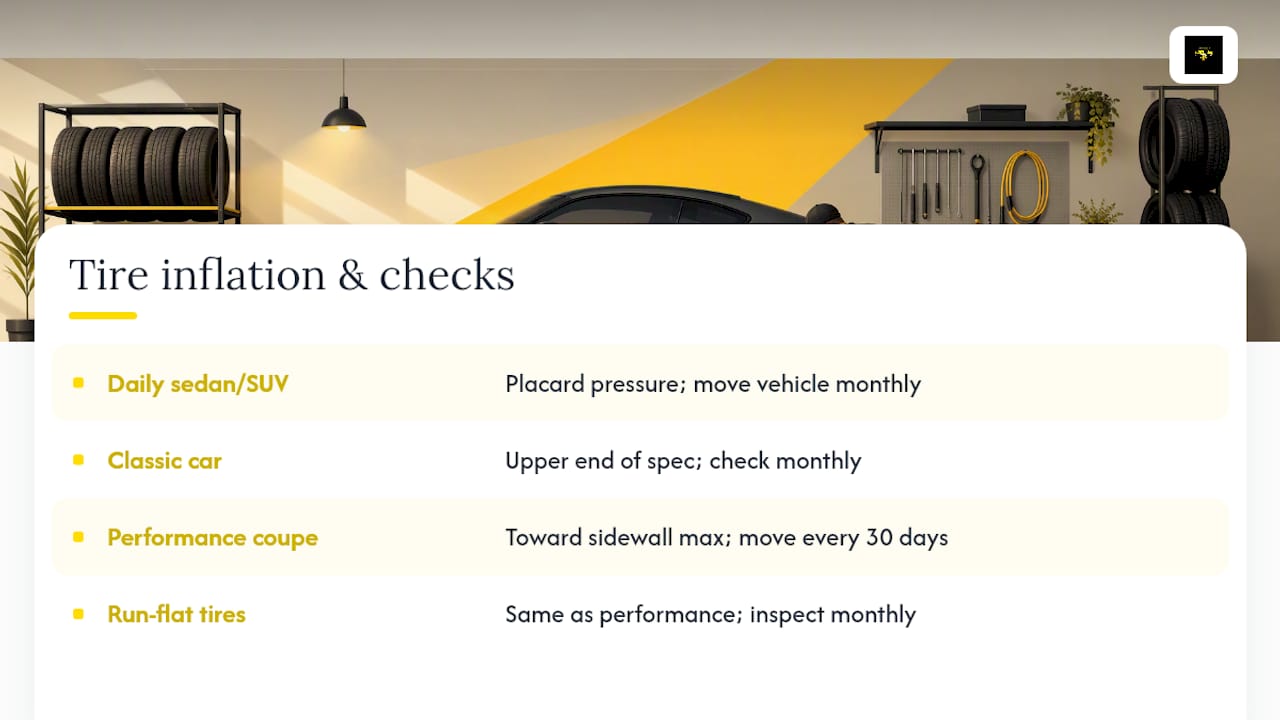
For everyday sedans and SUVs, sticking to placard pressure and moving the vehicle monthly covers most storage situations without any special tactics. These vehicles typically have generous tire volume relative to their weight, so they're less prone to aggressive flat-spotting in the first place.
Classic cars and older restorations deserve extra attention because factory-original tire pressures were often calculated for driving habits and speeds that don't match today's roads. If the car still runs its original-spec tires, lean toward the upper end of that range for storage, and check monthly since older tires lose pressure faster through sidewall porosity.
Performance and high-performance tires are the ones the Tire Information Service Bulletin singles out by name. Their softer compounds grip better on the road but set faster in storage, which is why the bulletin recommends moving these vehicles every 30 days rather than the standard 90-day window, along with temporarily raising pressure toward sidewall maximum.
Run-flat tires need the same caution as performance rubber. Their reinforced sidewalls are built to run without air pressure briefly, but that same stiff compound sets into a flat plane faster under static load than a standard radial does.
How Vehicle Weight Distribution Affects Flat-Spot Formation
Weight distribution decides which tires are most at risk, and it's rarely even across all four corners.
Vehicles with heavy accessory loads compound this. A pickup truck stored with a bed full of tools, a car with a full fuel tank, or an SUV loaded with gear all add static weight that presses harder into whichever contact patch is resting on the ground.
The fix is straightforward: lighten what you can before storage. Drain unnecessary cargo weight, and if the vehicle allows it safely, keeping the fuel tank closer to half full rather than completely full trims a meaningful amount of dead weight without risking fuel system issues from running too low.
For vehicles you can't fully unload onto a lift, rotating which contact point bears the load matters more than people assume. Rolling the car forward or backward by even a tire's width shifts the flat spot's would-be location before it sets. Tire Rack's guidance treats this kind of periodic movement as an imperfect but genuinely useful tactic when a lift or stands aren't available. It's more labor than a one-time setup, since it means physically returning to the garage on a schedule, but it beats leaving four tires locked in the same position for months.
Warming Up Tires Correctly After Storage
Cold rubber that just came out of months of storage behaves differently than rubber that's been driven regularly, and that difference matters most in the first mile.
Tire compounds stiffen in cold, static conditions, and a tire that's held a flat spot needs gradual flexing to redistribute internal stress evenly around the circumference. Jumping straight onto a highway on-ramp skips that redistribution and can mask a flat spot's vibration temporarily rather than actually working it out.
The better approach: drive slowly on straight, flat pavement for the first half mile, giving the tire time to flex through a full rotation repeatedly at low load. From there, increase speed gradually rather than jumping straight to highway pace. Avoid hard cornering or aggressive braking during this warm-up window, since the tire's grip characteristics haven't fully normalized yet.
Cold weather storage recovery takes longer than warm weather recovery. A tire coming out of a 20°F garage needs more warm-up distance than one coming out of a 60°F space, simply because the rubber compound itself is stiffer at lower temperatures. If you're retrieving a vehicle in winter, budget extra time and extra caution before pushing to normal driving speeds.
Radial vs. Bias Ply: Different Constructions, Different Risks
Radial tires, which make up the vast majority of vehicles on the road today, have steel belts running perpendicular to the direction of travel under the tread. That construction distributes static load somewhat more evenly across the contact patch than older designs, but radials still flat-spot under the same conditions: prolonged static weight, heat, and time.
Bias ply tires, still common on classic cars, trailers, and some off-road applications, have their internal cords running diagonally across the tire in overlapping layers. This construction tends to hold its shape differently under static load and can be more prone to noticeable flat-spotting because the sidewall flexes less uniformly than a radial's.
If you're storing a classic car on its original bias ply tires, the periodic movement and jack stand recommendations apply just as strongly, arguably more so, since these older constructions and older rubber compounds combine two risk factors at once. Run-flat and ultra-high-performance radial compounds sit at the opposite extreme: their stiffer, more temperature-sensitive rubber can shift from a recoverable flat spot to a permanent one in as little as two to four weeks under hot storage conditions. Construction type should factor into how aggressively you apply the prevention checklist, not just the vehicle's age or price point.
A Storage Operator's View on What Owners Get Wrong
The mistake I see most often isn't ignorance, it's optimism. Owners plan to check on a stored car "every couple weeks" and then life happens, and two weeks becomes two months. A plan that depends on human follow-through is weaker than a plan that removes the need for follow-through entirely, which is exactly why full unloading beats every other method on this list.
The second mistake is treating cradles as equivalent to a lift. They're not, and manufacturers say so directly. Cradles buy you time for weeks to a few months; they don't solve the problem the way a 4-post lift or rated jack stands do.
Asphaltlotsva's indoor facility removes weight-management guesswork through routine vehicle handling checks and a climate-controlled environment that avoids the heat swings that turn a temporary flat spot into a permanent one.
— Martin
Long-Term Vehicle Storage With Asphaltlotsva Near Norfolk
Asphaltlotsva gives cruise travelers and long-deployment owners something a home garage rarely offers: climate-stable indoor storage without the burden of checking pressure or rolling the car yourself every month.

The facility sits about 15 minutes from Norfolk with 24/7 surveillance, and the storage environment avoids the temperature swings and ozone exposure that push a temporary flat spot toward permanent damage. Frequent cruisers who choose the VIP Unlimited Parking Membership get a reserved spot guaranteed on every cruise day, priority shuttle service to the terminal, and the same consistent indoor conditions every time, instead of gambling on whatever crowded outdoor lot has room that week. For owners planning to be gone for weeks or months at a time, that consistency matters more than any pressure gauge. Check availability and book your spot on the Asphaltlotsva reservation page before your next cruise date fills up.
Sources
- Tire Information Service Bulletin (USTires)
- Tire Flat Spotting: Causes, Prevention, and Solutions (Michelin)
- Flat-spotting (Continental Tires)
- How to Remove Flat Spots From Tires After Storage (REVCity Auto Storage)