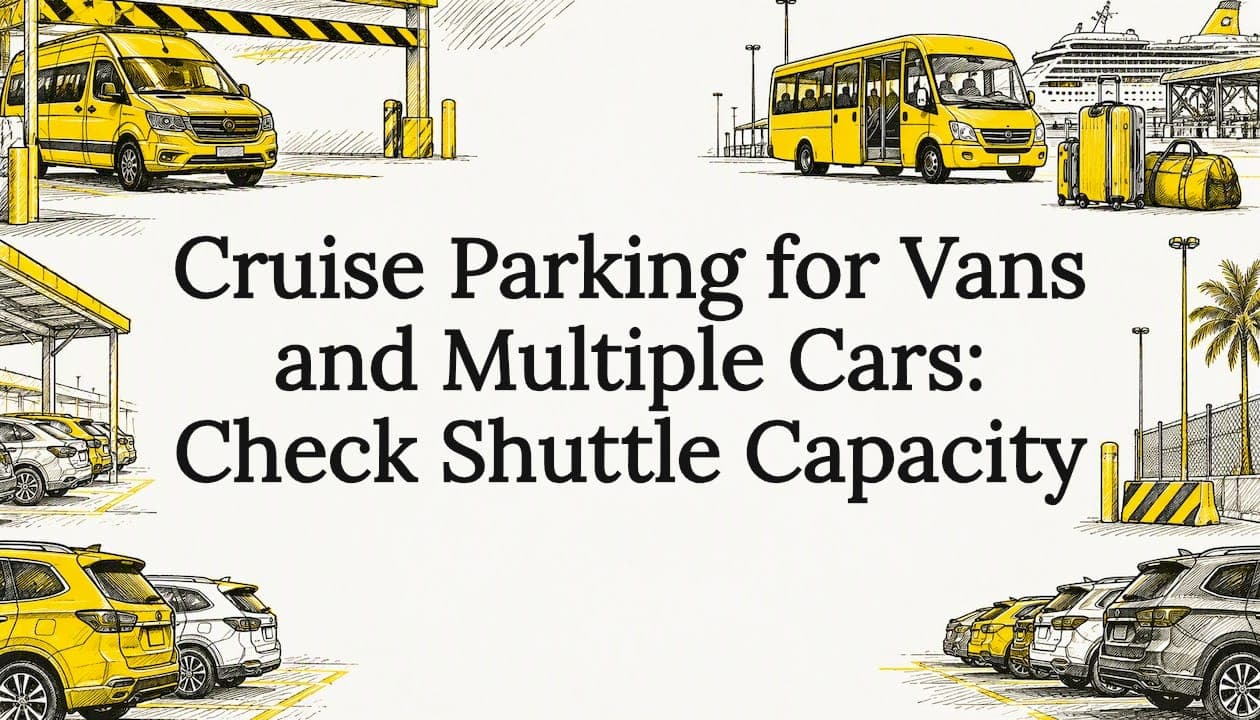
For a passenger van or several vehicles, book a guaranteed reserved spot at a secured off-site indoor lot with shuttle service, unless a port lot confirms in writing that it accepts oversized vehicles. Hotel park-and-stay works for some groups, and long-term storage suits deployments. Before you pay, measure every vehicle, confirm each restriction, and reserve a spot or a VIP membership.
TL;DR:
- Measure each vehicle with roof boxes, racks, and antennas attached, then confirm height clearance, accessory restrictions, oversized fees, and acceptance before booking.
- For multiple vehicles, confirm group parking and shuttle capacity for passengers and luggage; stagger arrivals by 15 to 20 minutes if vehicles overload one shuttle.
- At Norfolk, Carnival lists $15.00 per day, while Asphalt Lots lists $10 per day and a $100 monthly VIP membership; verify current rates before budgeting.
- Before paying, verify that 24/7 cameras cover the entire lot, staff are on site, and access is gated; compare those protections with cheaper rates.
- For deployments or absences lasting weeks, compare monthly indoor storage with daily parking and confirm access terms in writing before leaving vehicles.
Table of Contents
- Which parking options work for a van or several vehicles?
- How do you choose the right parking for your group?
- What should you know about vans, height limits and accessories?
- How do shuttle logistics work for groups on cruise day?
- What do reservations, payments and rates look like for multi-day parking?
- What should you verify about security before leaving several vehicles?
- How does Asphalt Lots fit multi-vehicle cruise parkers?
- Why guaranteed spots matter more than the lowest rate
- How can you book multi-vehicle cruise parking with Asphalt Lots?
- FAQ
- Sources
Which parking options work for a van or several vehicles?
Four categories cover almost every cruise parking situation. Which one fits depends on how many vehicles you bring, how tall they are, and how long you will be gone. Our own guide to types of cruise port parking goes deeper on each.
- On-port parking: You walk or take a short ride to the ship, and port-operated lots are usually patrolled. Ports publish their own rules, though. PortMiami lists terminal garages and surface lots, with oversized-vehicle accommodations at Surface Lot E. Spaces can run out on sailing day, so a van often gets directed to a separate lot.
- Off-site secured lots with shuttle service: A "guaranteed reserved spot" means your space is held for your sailing date, so you are not redirected when the lot fills. Indoor lots add protection from weather and sun, while covered lots only shield the roof. Shuttles run to the terminal on cruise days, and you should confirm the schedule before booking.
- Hotel packages: Park-and-stay deals bundle a night's lodging with parking, usually with a shuttle in the morning. They work for groups that want a relaxed start, but multi-vehicle arrangements need to be confirmed with the hotel in advance. We list partner hotels on our hotels page.
- Long-term storage: If you are deploying or leaving for weeks, a storage-style arrangement beats paying daily rates. Expect a monthly structure, indoor options, and access terms spelled out in writing.
Parking industry professionals advise travelers to confirm a guaranteed reserved spot, because demand can force overflow redirection on sailing day. That one question separates a calm embarkation from a scramble.
How do you choose the right parking for your group?
Work through these steps in order. Each one can eliminate an option before you spend time comparing prices.
- Measure each vehicle. Record height with any roof box, antenna or rack attached, plus length and width.
- Check clearance and oversized availability. Ask the port or lot for its garage clearance and whether a separate oversized area exists.
- Verify shuttle capacity and frequency. Ask how many passengers and bags a shuttle carries and how often it runs on your sailing morning.
- Confirm the reservation policy. Get in writing that your spot is guaranteed, not just "available."
- Check security. Look for 24/7 surveillance, gated access and indoor storage. AAA's travel guidance recommends prioritizing off-site facilities that offer secured environments with 24/7 surveillance, and it advises weighing a lower rate against the security you give up.
- Calculate the full cost. Multiply per-day rates by your cruise length, then compare against any flat rate for the same number of nights.
Once you have the answers, apply these decision rules. If any vehicle exceeds garage clearance, skip the garage and choose a surface lot or an off-site facility that accepts oversized vehicles. If you are bringing many vehicles, pick a facility that explicitly offers group shuttle capacity or reserved group parking. If you will be away for a deployment or an extended absence, choose long-term indoor storage rather than cruise-day parking.
Cost is where multi-vehicle travelers often get surprised, because every extra car multiplies the total. Our multi-day parking rates guide walks through the arithmetic for different cruise lengths.
Pro Tip: Email the lot a photo of your van with its exact height and any attachments, and ask for a written reply. A confirmation you can show at the gate settles any dispute on arrival.
What should you know about vans, height limits and accessories?
Standard parking structures are built for passenger cars, and a van is where the rules tighten. Garages often set a maximum clearance, and taller vehicles get directed to a separate surface or overflow lot. At PortMiami, for example, oversized vehicles are handled through Surface Lot E, which shows how a large port separates them from garage traffic. Always check the specific facility, since limits differ from one place to the next.

Accessories cause more rejections than the vehicle itself. Many facilities enforce height limits and forbid external attachments such as bike racks or hitches, and some charge a penalty or refuse entry to a vehicle that does not comply. Regional cruise-parking guides note that some off-site providers charge extra for oversized vehicles or accessories, so a quote for a standard car may not apply to your setup.
Prepare before you leave home:
- Fold or remove accessories: Take off bike racks, cargo boxes and removable hitches when you can, and store them inside the vehicle.
- Document your dimensions: Write down height, length and width, and keep the numbers on your phone for the check-in conversation.
- Reserve contiguous spaces: If you are bringing two or three vehicles, ask whether the lot can place them together. It makes shuttle coordination and key hand-offs much easier.
- Ask about extra charges: Confirm in advance whether an oversized or modified vehicle costs more than the standard rate.
- Photograph each vehicle: Take timestamped photos of every vehicle at drop-off, showing all sides and the odometer.
A van that fits the rules on paper but arrives with a roof box nobody mentioned can lose its spot. Measuring ahead can help prevent that.
How do shuttle logistics work for groups on cruise day?
Shuttles usually run on a loop or on request during the busy window around embarkation, which means timing matters more than distance. A lot close to the terminal can still take much longer if shuttles are infrequent and your group arrives at once. Regional guides point out that off-site providers differ in shuttle availability, so never assume a schedule.
At drop-off, drivers hand over the vehicle, unload luggage, and board the shuttle with their group. Luggage is typically loaded onto the shuttle, which is why capacity questions matter for a family with oversized bags. Our guide on pinning the terminal and locking your shuttle pickup explains where pickups happen, and our camera and shuttle timing checklist covers the questions worth asking a lot.
Use these steps to keep several drivers and cars in sync:
- Name one contact. One person holds the lot's phone number, the reservation details and the shuttle schedule, and the other drivers follow that person's updates.
- Stagger arrivals if needed. Two vans arriving together can overload a single shuttle, so spacing arrivals by 15 to 20 minutes eases the load.
- Know the boarding cutoff. Ask when the last shuttle leaves for the terminal and plan to arrive well ahead of it, since your ship's own check-in window will be the harder deadline.
- Stage drivers together. Park the group's vehicles close together, then have every driver meet at the same shuttle stop.
- Save driver numbers. On return day, a quick call to the lot when you land speeds your pickup.
Group transport planning has its own playbook. Apex Limo's conference group transportation guide covers coordinating pickups and staging multiple vehicles, and the same habits apply to a convoy of cruise drivers.
If several sailings share one terminal on your date, expect heavier traffic. Our article on parking when multiple cruises use the same terminal explains how to plan around the overflow.
What do reservations, payments and rates look like for multi-day parking?
Parking is priced either per day or as a flat rate tied to cruise length, and which one costs less depends on your trip. Per-day pricing is simple and fair for short sailings. Flat or weekly structures can save money on longer ones, though the savings only show up when you compare totals, not daily numbers.
Ports publish their own figures, so check them before you budget. Carnival's Norfolk port page lists a sample terminal rate of $15.00 per day, noting that rates are subject to change. At our facility, Norfolk Carnival Cruise Parking is $10 per day, and the Unlimited VIP Cruise Parking Membership is $100 per month.
Port-published rate to compare: Carnival lists $15.00 per day for parking at the Norfolk cruise terminal, and for a multi-vehicle trip that daily figure multiplies by every car and every night.
Reservations matter most when you bring more than one vehicle. A prepaid, guaranteed spot protects you from the sailing-day redirection described earlier, and paying ahead can speed your exit when you return. Port information varies here: Cruise Maryland says secured long-term lots may accept walk-in parking, with card payment on arrival, and it publishes a rate table by vehicle type, including RVs by length.
Watch for these extra charges:
- Lost-ticket maximums: Some lots charge the highest possible fee if you lose your entry ticket.
- Oversize or extra-vehicle fees: A van or second car may price differently from the quote.
- Accessory fees: Racks and hitches can add cost or lead to refusal.
- Payment method limits: Confirm whether the lot takes cards, mobile payment or cash.
What should you verify about security before leaving several vehicles?
When one car sits for a week, risk is limited. When three sit for a week, it multiplies, so verify the basics before you commit. A cheap rate is only a bargain if the vehicles are in the same condition when you return.
Port facilities and private lots differ in how they handle security. Port-operated lots are usually the most convenient and often patrolled by security, with handicap-accessible parking and shuttle service provided on cruise days. Official port facilities also coordinate with federal agencies and can apply tighter checks than standard commercial lots. A private lot earns trust through visible, verifiable measures instead.
Run this quick check before you pay:
- Camera coverage: Ask whether cameras run 24/7 and whether they cover the whole lot, not just the entrance.
- Staff presence: Confirm someone is on site, especially at arrival and return times.
- Access control: Look for gated entry and, ideally, indoor storage.
- Reservation proof: Get written confirmation of your guaranteed spot.
- Written shuttle schedule: A lot that publishes its shuttle times is a lot that plans for them.
- Perks and loyalty terms: Check what a membership includes and in writing.
Our guide to 24/7 camera coverage turns these questions into useful checks you can ask over the phone.
How does Asphalt Lots fit multi-vehicle cruise parkers?
Our facility is a veteran-owned, secure indoor lot about 15 minutes from Norfolk, with 24/7 surveillance and guaranteed reserved spots on cruise days. We provide a free shuttle to the cruise terminal and priority shuttle service for members of our Unlimited VIP Cruise Parking Membership, which also carries exclusive perks for frequent cruisers. For deeper checklists and rate walkthroughs, our blog guides are a good next read before you book.
Why guaranteed spots matter more than the lowest rate
Most parking advice fixates on the daily price. I think that is the wrong first question for anyone with a van or several cars. The rate matters, but a rate means nothing if your vehicle is turned away at the gate because of its height, or redirected to a lot you never vetted. What the research supports is that guarantees and security decide whether a trip goes smoothly.
The conventional advice also treats shuttles as an afterthought. For a group with multiple vehicles, shuttle capacity and timing are the real bottleneck on cruise morning, and a lot that cannot move your whole party quickly will cost you more than a few dollars a day ever saves.
So prioritize in this order: first, measure your vehicles and confirm they are accepted. Second, secure a written guaranteed spot. Third, verify security and shuttle timing. Only then compare prices. A secured indoor lot with a reserved space and a priority shuttle, which is what we built our service around, is the approach I would choose for a passenger van or a convoy, because it removes the uncertainty that ruins sailing days.
— Martin
How can you book multi-vehicle cruise parking with Asphalt Lots?
Skip the sailing-day gamble: we offer secure indoor cruise parking with 24/7 surveillance and a free shuttle to the terminal. Check availability for your vehicles before you book.
Start by reading our FAQ and booking details to see how reservations work, then browse our services page to compare daily, monthly and long-term options. If you cruise often, the Unlimited VIP Cruise Parking Membership gives you guaranteed availability and priority shuttle service. Measure your vehicles, tell us how many you are bringing, reserve your spots, and confirm your shuttle timing for your ship date.
FAQ
Where can you legally park overnight for free?
Rules vary by city, street and property, so there is no single answer for cruise travelers. Free overnight street parking is often restricted, and it offers no security for a week-long absence. Check local regulations or choose a secured lot for the duration of your trip.
Where should you leave your car when going on a cruise?
Choose a secured facility that offers a guaranteed reserved spot and shuttle service to the terminal. AAA's guidance is to prioritize off-site lots with 24/7 surveillance instead of the cheapest option. For a van or several cars, confirm height and accessory rules first.
How do you book cruise parking?
Reserve before sailing day, ideally as soon as your cruise is booked. Provide your vehicle details and sailing dates, then keep your confirmation handy for arrival. We take reservations through our FAQ and booking page.
Do you have to pay for parking at the Carnival cruise terminal?
Yes, terminal parking is generally paid. Carnival's Norfolk port information lists a sample rate of $15.00 per day, subject to change. Confirm the current rate with the port before you travel.
Sources
- Drive to Your Next Cruise: Parking, Tips & Savings Guide
- Cruise Terminal and Port Parking: Multi-Day Vehicle Storage and Passenger Processing | Parking Professional
- Parking at PortMiami
- Cape Liberty Cruise Port Parking: What Are Your Options?