Prebook a spot in secure, indoor parking or lock in a VIP reserved membership before your sail date. That single decision solves most of what trips up first-timers: no wandering a packed surface lot with suitcases, no guessing whether your car will be safe for a week, no scrambling for a shuttle that never shows.
Three things a good reservation gets you: guaranteed availability (your spot exists even if the lot fills up), indoor or covered storage with active surveillance (your vehicle isn't baking in a field for seven days), and priority shuttle service straight to the terminal instead of a mystery wait.
Once you book, take two minutes to lock in the details:
- Screenshot your confirmation, including the QR code or booking number.
- Save the lot's address and phone number in your phone, not just your email.
- Note the exact shuttle pickup point before you drive off.
Do that now, and everything else in this guide is just filling in the details.
Key Takeaways
Guaranteed reserved indoor parking with priority shuttle service removes the two biggest risks first-time cruise travelers face: an unsafe vehicle and an unreliable ride to the terminal.
| Point | Details |
|---|---|
| Book early, match dates | Reserve as soon as your cruise dates are confirmed and match them exactly to avoid drive-up pricing. |
| Verify security features | Confirm indoor or covered storage plus 24/7 surveillance before trusting a lot with a week-long stay. |
| Use the drop-first tactic | Unload passengers and luggage at the terminal first, then drive alone to the parking facility. |
| Build a return buffer | Plan 60 to 90 minutes between disembarkation and all-aboard time on shuttle-dependent return days. |
| Consider a VIP membership | Asphalt Lots' VIP Unlimited Parking Membership guarantees reserved spots and priority shuttle access for frequent cruisers. |
Table of Contents
- How Cruise Parking and Shuttle Logistics Actually Work
- What Should You Check Before Booking a Cruise Parking Spot?
- How Do You Book and Time Your Drive to the Port?
- Your Shuttle-Day Packing and Check-In Checklist
- What Happens on Return Day and When Picking Up Your Car
- Why a Vetted Indoor Facility Solves These Problems
- What Does Cruise Parking Actually Cost, and What's Included?
- How Do You Choose a Parking Facility Based on Location?
- What Should You Do If You Miss the Shuttle or Hit a Delay?
- What Cancellation and Refund Terms Should You Confirm First?
- What About Oversized Vehicles, RVs, and Electric Cars?
- Which Membership Tier Fits Your Cruising Habits?
- What This Guide Gets Right That Most Advice Misses
- Book Guaranteed Parking Before Your Next Sailing
- Frequently Asked Questions
- Sources
How Cruise Parking and Shuttle Logistics Actually Work
Cruise travelers run into two basic setups: parking directly at the port, and parking off-site at a private lot or garage. On-site parking is usually the most convenient option since you're steps from the terminal, but it also tends to run the highest daily rate. Off-site lots often save money over a week-long cruise, provided the shuttle service is reliable enough to make up for the extra step.
Who runs the shuttle matters more than most beginners realize. A few common patterns:
- Cruise-line operated shuttles tend to follow the ship's schedule closely, though they can charge a per-person fare on top of parking.
- Port authority shuttles move continuously between designated lots and the terminal, often on a loop rather than a set timetable.
- Private lot shuttles, like those run by dedicated parking facilities, usually include the transfer in the parking fee and schedule pickups around cruise embarkation windows.
Shuttles can be run by cruise lines, port authorities, or private operators, and that ownership affects everything from luggage handling to whether ADA-accessible vehicles are guaranteed. Before you book, check the types of cruise port parking available at your embarkation port so you know which model you're dealing with. A continuous loop shuttle means less waiting; a scheduled-slot shuttle means you need to plan your arrival around specific pickup windows.
What Should You Check Before Booking a Cruise Parking Spot?
Not every "cruise parking" listing means the same thing. Run any option through this quick scorecard before handing over a payment.
- Does the listing say "guaranteed" or "reserved," or just "available"? Vague wording is a warning sign.
- Is the vehicle stored indoors or under cover, not just behind a fence in an open lot?
- Are there 24/7 cameras, gated access, and on-site staff, not just a padlock and a prayer?
- Does the shuttle go directly to the cruise terminal, or does it require a transfer?
- How often does the shuttle run, and what's the process for the return trip?
- What's the cancellation policy, and is pricing charged per day or per booking?
Off-site lots vary widely in security, from a gravel field with a chain to a monitored, gated facility with cameras on every row. For a week or two-week cruise, that difference matters a lot more than a few dollars a day in savings. Review the access control features a facility actually uses, not just what it claims in an ad.
If you sail more than a couple of times a year, or you're heading out on deployment and won't see your car for months, a VIP membership usually beats booking one-off reservations. Members typically get a spot held automatically on cruise days, plus priority shuttle boarding instead of waiting behind drive-up customers.
Pro Tip: Call the lot directly and ask, "What happens if I show up and you're full?" A facility with a real reservation system will have a clear answer. One that hesitates probably oversells its space.
How Do You Book and Time Your Drive to the Port?
Booking early and timing your drive well prevents most of the stress beginners associate with cruise day.
- Book as soon as your cruise dates are confirmed. Matching your reservation dates exactly to your sailing dates protects you from drive-up pricing or being turned away if the lot fills.
- Use the drop-first strategy. Have the driver pull up to the terminal, unload passengers and luggage, then drive alone to the parking facility. This single move cuts shuttle congestion and gets your group into the check-in line faster. Full instructions on the terminal drop-off procedure are worth reading before your first sailing.
- Save everything before you leave home. Screenshot the QR code, the lot's street address, its phone number, and the exact pickup pin. Note operating hours, especially if you're arriving very early or returning late.
- Build in a return buffer. Plan for 60 to 90 minutes between disembarkation and all-aboard time on any port where you're relying on a shuttle, especially on multi-ship days when terminals get crowded.
Your Shuttle-Day Packing and Check-In Checklist
Keep a day bag separate from your checked luggage so you're not digging through a suitcase at the curb.
- Ship card or boarding documents, photo ID, and a payment card.
- Any daily medications and a portable phone charger.
- A screenshot of your parking confirmation, lot address, and shuttle meeting point saved offline.
- Light layers, since terminal buildings run cold with the air conditioning cranked for crowds.
At the lot itself, check-in is usually quick: an attendant scans your reservation, directs you to a spot, and points you toward the shuttle pickup area. If you or someone traveling with you needs a wheelchair-accessible vehicle, confirm ADA lift availability when you book rather than assuming it. Local parking facilities near the port usually handle luggage differently than airport shuttles do, so ask whether attendants help load bags or whether that's on you.
What Happens on Return Day and When Picking Up Your Car
Return day tends to move slower than embarkation, mostly because everyone clears customs around the same time. Shuttles are typically organized by lot, so look for a sign or attendant holding your parking company's name near the luggage claim area, not a generic taxi line.
A few things that make pickup smoother:
- Choose an earlier disembarkation group if your cruise line offers a choice, since it shortens your shuttle wait.
- Keep your lot's phone number handy in case the pickup point isn't where you expected.
- For long-term storage retrieval, bring ID and your payment method, and do a quick walk-around of your vehicle before driving off.
- If you have a same-day flight, add extra buffer between disembarkation and your departure time. Customs delays and shuttle waits both eat into that window fast.
Why a Vetted Indoor Facility Solves These Problems
This is exactly the gap a facility like Asphalt Lots is built to close. It's a veteran-owned, indoor parking facility located about 15 minutes from Norfolk, with round-the-clock surveillance so your car isn't sitting exposed in a surface lot for a week or longer.
- Indoor storage protects against weather and reduces the theft and vandalism risk open lots carry.
- The VIP Unlimited Parking Membership guarantees a reserved spot on every cruise day, no drive-up gamble involved.
- Members get priority shuttle service straight to the terminal, which matters most for deployed military and frequent cruisers who can't afford scheduling surprises.
- Booking generates a QR code and clear pickup instructions, so check-in at the lot takes minutes, not a scavenger hunt.
Pro Tip: If you sail three or more times a year, run the math on a VIP membership versus paying per-trip rates. For frequent cruisers, the guaranteed spot alone often justifies it before you even factor in the shuttle priority.
Guaranteed availability isn't a marketing phrase. It's the difference between showing up on cruise morning with confidence and showing up hoping the lot has room left.
What Does Cruise Parking Actually Cost, and What's Included?
Pricing for cruise parking typically breaks down into per-day rates, flat per-booking rates, or a membership subscription. On-site port parking usually carries the highest daily rate because you're paying for proximity. Off-site lots price lower per day but ask you to factor in shuttle reliability as part of that value.
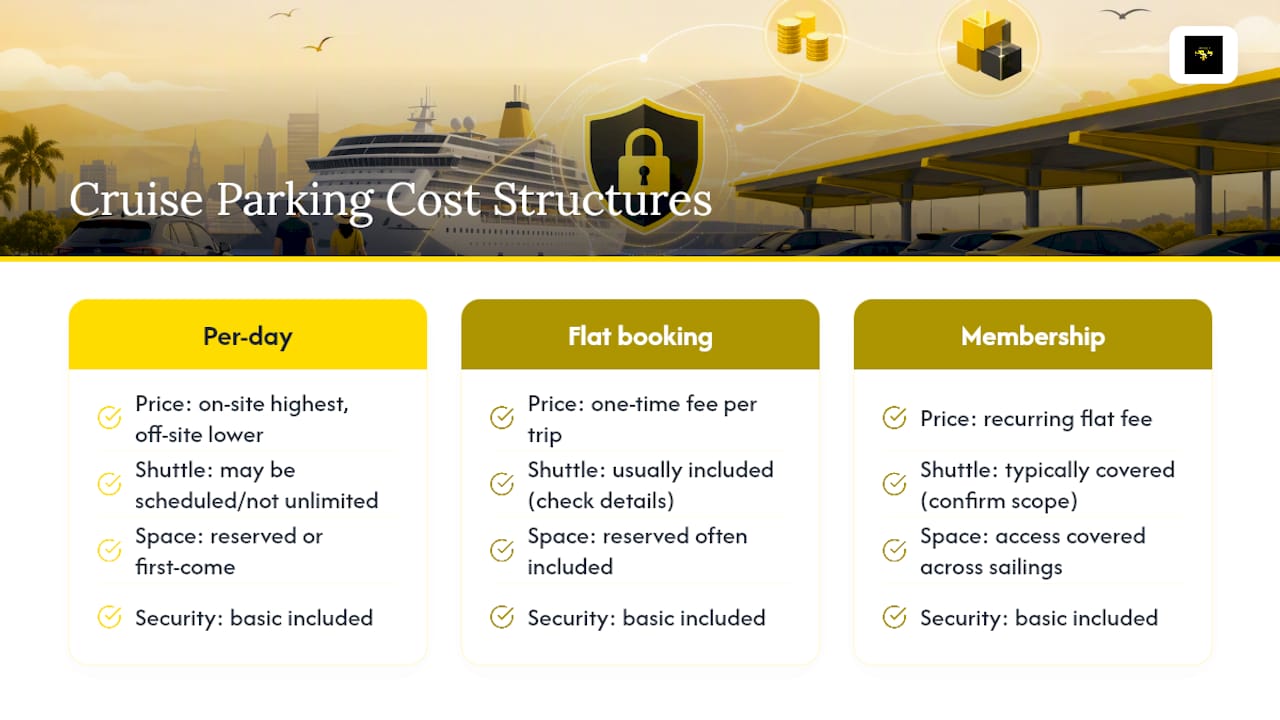
What the fee usually covers: a reserved or first-come space, basic security, and shuttle transfers to and from the terminal. What it often doesn't cover unless stated clearly: luggage assistance, overnight fees if your return is delayed, or guaranteed space during peak sailing weekends like holidays. Read the fine print on whether "unlimited shuttle runs" means continuous service or a handful of scheduled trips.
A membership model changes this math. Instead of paying per trip, a flat recurring fee covers every sailing during the membership period, which tends to work out cheaper for anyone cruising more than a couple of times a year. It also removes the guesswork of comparing daily rates across different lots before each trip. For occasional cruisers, a single prepaid reservation is usually simpler. For frequent cruisers and military families with more than one deployment-related trip a year, the subscription model spreads cost predictably instead of hitting you with one large bill per sailing. Either way, ask directly what's bundled into your rate before comparing two facilities side by side, since a cheaper daily price with a paid shuttle add-on can end up costing more than an all-inclusive rate elsewhere.
How Do You Choose a Parking Facility Based on Location?
Proximity to the port matters, but it's not the only variable worth weighing. A lot that's technically closer but runs shuttles only once an hour can cost you more time than a facility ten minutes farther out with a continuous loop.
Start by checking shuttle frequency before distance. A facility running shuttles every 15 to 20 minutes during peak embarkation hours beats one that's geographically closer but only departs on the hour. Ask directly how many shuttles run during your specific embarkation window, since some lots reduce frequency outside of peak times.
Also weigh road access. A facility near a major highway exit tends to have more predictable drive times than one buried in port-adjacent surface streets that clog up on cruise days. If you're driving in from out of state, factor that into your arrival buffer.
Finally, consider whether the facility serves your specific port. Some private lots split their business across cruise terminals and nearby airports, which is efficient for fly-cruise combination trips but can mean shared shuttle capacity during busy mornings. A facility with a dedicated cruise-terminal shuttle, rather than a shared service, usually gives you shorter wait times when it matters most.
What Should You Do If You Miss the Shuttle or Hit a Delay?
Delays happen, whether from traffic, a late flight connection, or simply misjudging how long check-in takes. The key is knowing your options before you're standing at the curb stressed about it.
If you miss a scheduled shuttle, call the lot's phone number immediately rather than waiting at the pickup point hoping another one appears. Facilities running continuous-loop shuttles usually have another vehicle within 15 to 20 minutes; scheduled-slot shuttles may require you to wait for the next timed departure.
For return-day delays caused by customs lines or a late disembarkation group, most lots build some flexibility into pickup windows, but it's worth confirming this when you book rather than assuming it. Ask specifically: "What happens if my ship docks late or customs runs long?"
If a mechanical issue or traffic accident delays your drive to the lot on embarkation morning, contact the facility as soon as you know you'll be late. A reserved spot with clear communication policies protects you here. A drive-up lot with no communication channel does not.
Pro Tip: Save the lot's direct phone number under a clear label like "Cruise Parking" rather than burying it in an email confirmation you'll struggle to find with spotty signal at the port.
What Cancellation and Refund Terms Should You Confirm First?
Before you enter payment information, read the cancellation policy in full, not just the headline price. Cruise plans change more often than travelers expect, whether from itinerary shifts, illness, or a cruise line rescheduling a sailing.
Check whether cancellations made a certain number of days before your trip get a full refund, partial refund, or credit toward a future booking. Some facilities draw a hard line at 24 or 48 hours before arrival; others offer more flexibility for members versus one-time bookers.
Confirm how date changes are handled separately from outright cancellations. If your cruise line shifts your embarkation by a day, can you simply adjust your reservation dates without penalty, or does that count as a new booking? This is one area where comparing parking services beyond the sticker price actually pays off, since a slightly higher rate with flexible date changes can save you money if plans shift.
Ask what happens if you return later than planned, whether from a delayed ship or a same-day flight complication. Some lots charge automatic late fees per hour past your scheduled return; others build in a grace period. Get this in writing, or at minimum confirmed verbally and noted in your booking confirmation, before you drive off on embarkation day.
What About Oversized Vehicles, RVs, and Electric Cars?
Standard parking spots don't always fit every vehicle cruise travelers show up in, and this is where beginners get caught off guard.
Oversized vehicles, trucks with extended cabs, and full-size vans often need a wider or taller space than a standard indoor bay provides. Confirm vehicle size limits when booking rather than discovering a clearance issue at the gate. Some facilities charge an oversized-vehicle surcharge; others simply can't accommodate certain dimensions at all.
RVs present a bigger challenge since most standard cruise parking facilities aren't built for extended stays of large recreational vehicles. If you're driving an RV to a cruise, call ahead specifically. Very few lots near any port have dedicated RV spaces, and parking one in a standard garage bay usually isn't an option.
Electric vehicles raise a different question: charging access. Not every secure indoor lot offers EV charging stations, and a week-long or two-week cruise means your battery needs to hold a charge the entire time you're gone. Ask directly whether charging is available on-site, and if not, plan your departure charge level accordingly. Indoor storage still protects an EV from weather exposure even without charging access, which matters for battery health during extended dormancy.
Which Membership Tier Fits Your Cruising Habits?
Not every cruiser needs the same level of commitment, and understanding the tradeoffs between one-time bookings and ongoing memberships helps you avoid overpaying or underpreparing.
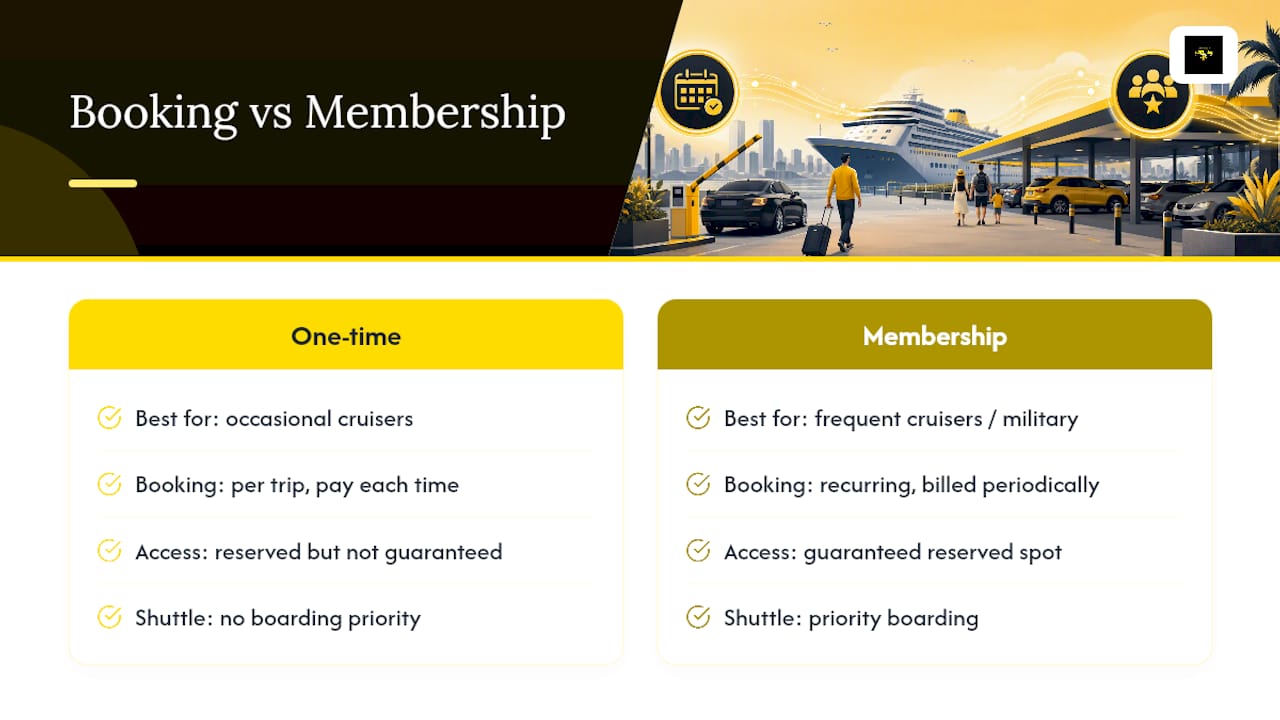
A single prepaid reservation works well if you cruise once a year or less. You pay per trip, match your dates exactly to your sailing, and you're done. The tradeoff is that you're re-booking and re-verifying availability every single time, with no guarantee that a spot exists if you wait too long.
A recurring membership, like Asphalt Lots' VIP Unlimited Parking Membership, suits frequent cruisers and deployed military differently. Instead of booking each trip separately, members get a reserved spot guaranteed on every cruise day covered by the membership, along with priority shuttle boarding ahead of drive-up customers. The tradeoff shifts from "will I get a spot" to "is this worth it if I only sail twice a year," which is exactly why occasional cruisers still lean toward single bookings.
The clearest distinction is guaranteed access versus first-come convenience. A one-time booking might state "reserved," but if a facility oversells during peak weeks, a membership's guarantee terms usually carry more weight contractually. If deployment schedules or repeat sailings define your travel pattern, that guarantee is the deciding factor, not the price difference.
What This Guide Gets Right That Most Advice Misses
Most cruise parking advice treats security and shuttle logistics as separate decisions. That's backward. A cheap lot with an unreliable shuttle isn't actually cheap once you're standing at the curb watching your all-aboard deadline shrink. The real cost of parking isn't the daily rate. It's the risk you're carrying on both ends of the trip.
The conventional wisdom tells beginners to compare prices first. I'd flip that. Compare guarantee language first, security second, and price last. A facility that hedges on whether your spot is truly reserved, or goes vague on shuttle frequency, is telling you something about how it operates under pressure on a busy embarkation morning.
Frequent cruisers and deployed military have the most to lose from a bad guess here, since a missed shuttle or an unsafe lot doesn't just cost money. It costs time you don't get back before a ship pulls out. Prioritize the guarantee, then build your plans around it.
Book Guaranteed Parking Before Your Next Sailing
Compare a dozen listings and you'll notice most only promise "near the port," with no real detail on security or shuttle timing. Asphalt Lots takes a different approach: indoor, veteran-owned parking just 15 minutes from Norfolk, with 24/7 surveillance and a reservation system that actually holds your spot.
If you sail regularly or you're heading out on deployment, the VIP Unlimited Parking Membership means you stop rebooking every trip and start showing up to a guaranteed spot with priority shuttle boarding waiting for you. For occasional cruisers, a standard reservation gets you the same secure indoor storage and shuttle service without a recurring commitment. Either way, you leave your car somewhere covered, watched, and easy to retrieve, not gambling on a surface lot three miles from the terminal.
Check available dates and lock in your reservation on the Asphalt Lots booking page before your cruise dates fill up.
Frequently Asked Questions
What is the difference between on-site and off-site cruise parking? On-site parking sits directly at the port and costs more per day. Off-site parking, like Asphalt Lots, is located nearby and typically costs less while including shuttle transfers to the terminal.
How early should I book cruise parking? Book as soon as your sailing dates are confirmed. Matching your reservation dates exactly to your cruise avoids drive-up pricing and last-minute availability issues.
Is a VIP parking membership worth it for occasional cruisers? Memberships typically pay off for people cruising three or more times a year or facing repeated deployment travel. Occasional cruisers usually do fine with a single prepaid reservation.
What should I pack in my shuttle-day bag? Keep your ship card, photo ID, payment method, medications, a phone charger, and your parking confirmation in a separate bag you carry on the shuttle, not in checked luggage.
How long should I budget for the return-day shuttle? Plan for 60 to 90 minutes between disembarkation and your all-aboard or departure time on any port relying on shuttle service, especially during multi-ship days.
Sources
- Cruise Shuttle Buses Explained: When & How | PortAdventurer
- Cruise Port Parking Guide: On-Site vs Off-Site
- Cruise-Port airport parking: FLL, MCO, MIA & More | ParkON