
Yes, but it isn't guaranteed. On days when two or more ships depart from the same terminal, on-site parking runs on a first-come, first-served basis at many ports, and lots can fill before the last passengers arrive. The only way to lock in a spot is to pre-pay a reserved space, either through a terminal reservation system where one exists or through an off-site facility that guarantees your bay in advance, such as a Virgin Voyages Gift Card offering advanced purchase incentives.
Terminal garages are built for average days, not peak ones. When multiple ships call the same facility, the math changes fast: a garage sized for 1,500 vehicles doesn't stretch to fit 2,800 just because two cruise lines picked the same Saturday.
Quick pre-departure checklist:
- Confirm your ship's exact terminal assignment (don't guess from the cruise line's name alone)
- Check the terminal's posted garage opening time and daily capacity notice
- Pre-book a reserved off-site space if you want a guaranteed spot
- Plan your arrival window around your boarding time, not just "early"
- Photograph your vehicle's condition before you hand over the keys
Key Takeaways
Reserved, pre-paid parking is the only reliable way to guarantee a spot when multiple cruise ships share the same terminal on the same day.
| Point | Details |
|---|---|
| Confirm terminal assignment first | Multi-terminal ports run several buildings, so check your specific terminal, not just the cruise line's name. |
| Multi-ship days strain fixed capacity | A garage sized for one ship can fall short when thousands of vehicles arrive within a 4 to 5 hour window. |
| Overflow means shuttle logistics | Full lots often redirect drivers to remote parking with luggage drop-off and shuttle check-in required. |
| Payment rules vary by port | Some terminals charge per calendar day with card-only, pay-on-arrival kiosks and no reservations. |
| Asphaltlotsva removes the gamble | Its VIP Unlimited Parking Membership guarantees a reserved indoor spot with 24/7 surveillance and priority shuttle service on every cruise day. |
Where to Verify Terminal Parking Rules
- Check your port's official FAQ page for posted garage hours and capacity notices before you travel.
- Review recent port parking overflow coverage for real examples of how redirects work.
- Read industry analysis on voyage-based parking planning to understand why cruise terminals operate differently from everyday lots.
Table of Contents
- How Terminals Handle Parking on Multi-Ship Days
- How to Confirm Parking Will Be Available for Your Sailing
- When to Arrive and How the Drop-Off Process Works
- What Cruise Parking Actually Costs
- Your Options If the Terminal Lot Is Full
- How to Reserve a Guaranteed Parking Spot
- ADA and Oversized Vehicle Parking Rules
- Security Features and Long-Term Storage
- Your Day-Before and Day-Of Checklist
- Why a Reserved Spot Beats Betting on First-Come Parking
- Guaranteed Parking for Multi-Ship Days With Asphaltlotsva
- Frequently Asked Questions
- Sources
How Terminals Handle Parking on Multi-Ship Days
Cruise terminals aren't like airport garages with steady, spread-out traffic. They're event venues. A single sailing can push up to 6,000 passengers through a 4 to 5 hour window, and every one of those vehicles needs somewhere to sit for the length of the cruise, sometimes seven, ten, or fourteen days.
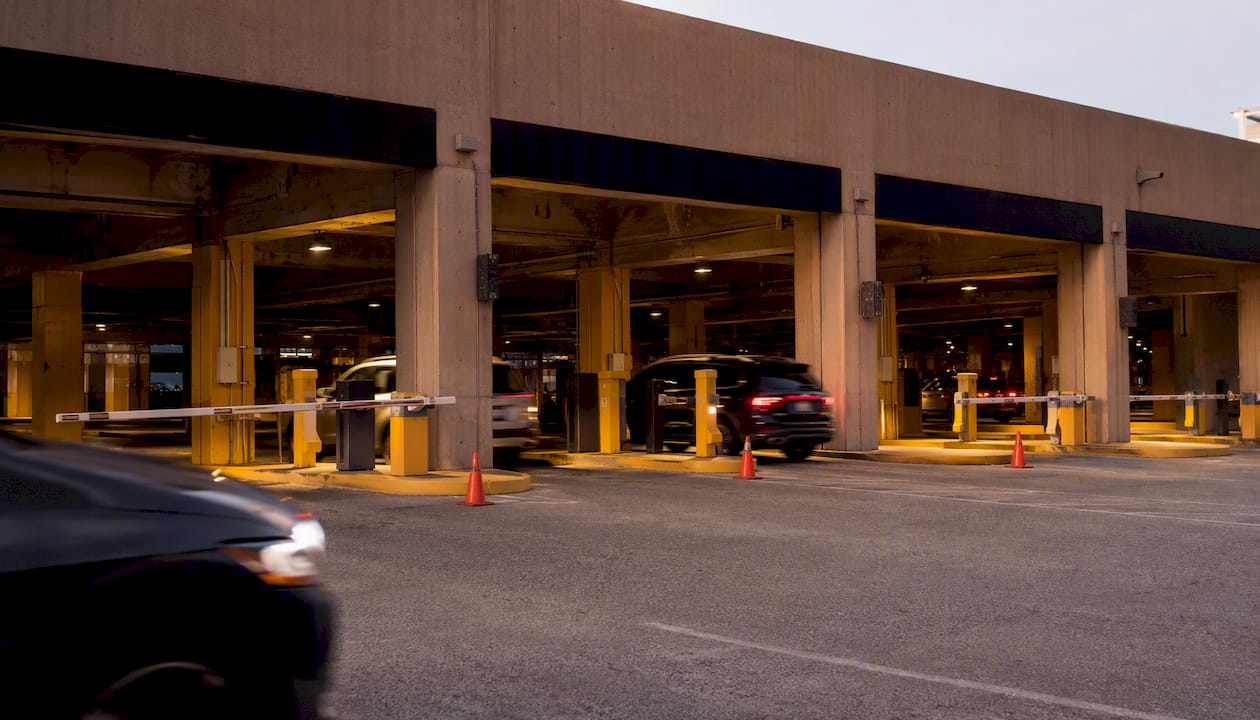
Most facilities handle this with one of three approaches: a dedicated on-site garage with fixed capacity, a first-come gate system with no reservations, or a hybrid that redirects overflow traffic to an off-site lot once the main garage fills. Garage layout matters more than people realize. Terminals with multiple entry and exit points and license plate recognition systems process cars faster and hit capacity limits later in the day than terminals with a single choke-point entrance.
The shortage risk comes down to simple arithmetic. Two large ships sailing the same morning can exceed a mid-size garage's capacity even if each ship individually would have fit fine. Industry analysts increasingly argue that terminals need to shift from time-based to voyage-based planning, building capacity around specific overlapping departures rather than average daily traffic.
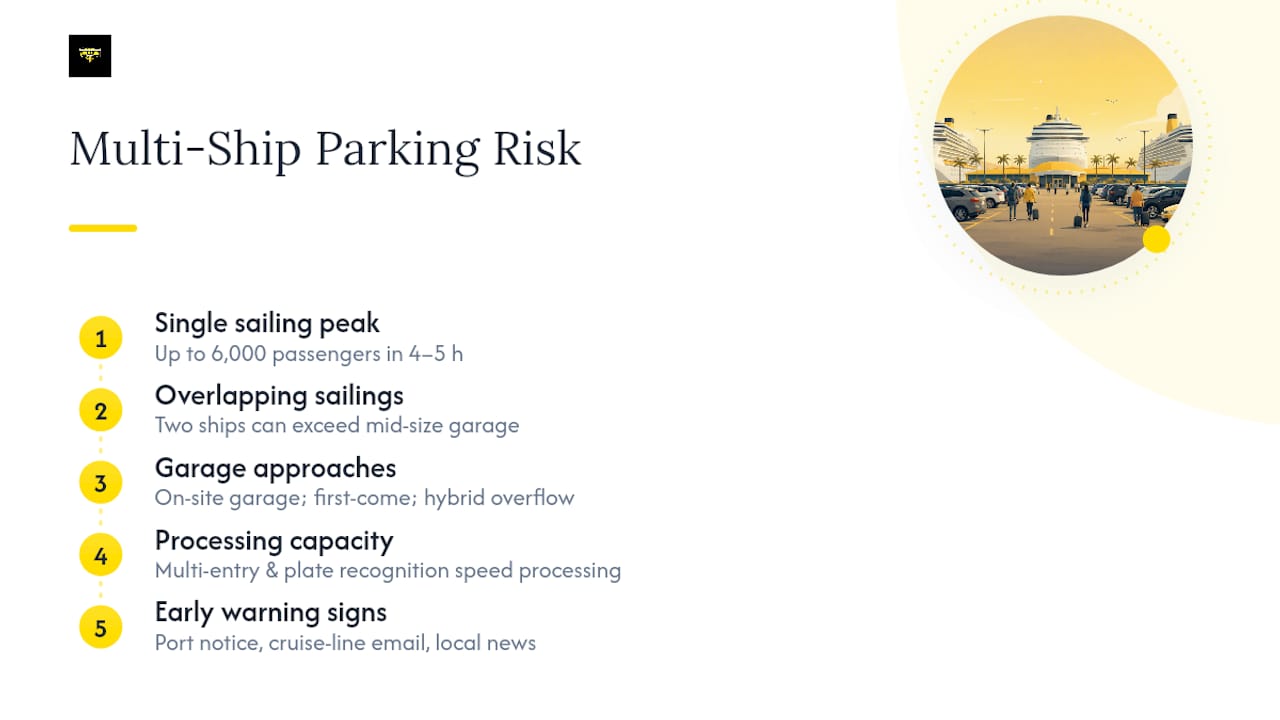
Pro Tip: Watch for three early warning signs of a capacity crunch: a port-issued parking notice, an email from your cruise line about "limited terminal parking," or local news coverage of a recent overflow event at your port. Any one of those is your cue to book an off-site spot instead of rolling the dice.
How to Confirm Parking Will Be Available for Your Sailing
Don't wait until you're circling the garage to find out there's no room. A few minutes of checking beforehand tells you whether to drive with confidence or arrange a backup.
Where to check:
- Your cruise line's app or online check-in portal, which usually lists your specific terminal number
- The port authority's official FAQ page, which often posts garage hours and capacity statements
- Recent port alerts or local news about parking shortages at your terminal
Steps to take the week before departure:
- Confirm your ship's assigned terminal. Norfolk, Miami, and other multi-terminal ports run several buildings, and brand alone won't tell you which one you're using.
- Look up the terminal's posted garage opening time and any capacity or "lot may fill" language.
- Call the terminal parking office directly if the website is vague. A two-minute phone call beats guessing.
- Search recent headlines for your port's name plus "parking." A real overflow event at Long Beach showed guests being redirected to off-site lots with shuttle service when two Carnival ships sailed the same day.
If everything checks out, drive as planned. If you see any warning sign, book a reserved off-site space now rather than the morning of.
When to Arrive and How the Drop-Off Process Works
Terminals process passengers and vehicles in a specific order, and knowing that order saves you time on a crowded morning.
- Passenger and luggage drop-off comes first. Porters take bags curbside before the driver moves to parking, so the car and the luggage separate almost immediately.
- Parking agents direct traffic to whatever space is currently open, whether that's the main garage, a secondary level, or an overflow lot down the road.
- You board a shuttle or walk to the terminal entrance, depending on where you land.
Most ports recommend arriving within a two to three hour window before your boarding time, not the moment check-in opens and not right before all-aboard. Arriving too early sometimes means waiting in a queue before the garage even opens; arriving too late means hitting the peak crunch when three ships' worth of traffic converges on one entrance.
A sample timeline: arrive at 10:30 AM for a 1:00 PM boarding call, drop luggage curbside by 10:40, park or get redirected by 11:00, and board the shuttle to the terminal by 11:15.
Pro Tip: At multi-terminal ports, take the correct highway exit the first time. A wrong exit at a port with multiple terminal buildings can cost you 20 to 30 minutes of backtracking during exactly the window when every minute counts.
What Cruise Parking Actually Costs
Pricing at most terminals follows a simple rule: you're billed per calendar day the vehicle sits in the lot, and that includes your embarkation day and your return day, not just the nights you're actually sailing.
What to expect:
- A daily rate charged for the full span, so a seven-night cruise usually bills as eight or nine calendar days
- Payment collected on arrival at many ports, with card-only kiosks and no online reservation option at some terminals, including Port Canaveral
- Off-site lots that frequently undercut terminal daily rates while adding shuttle service to the price
Covered, indoor parking tends to cost more per day than an open outdoor lot, and that premium usually buys better security and protection from weather. Before you commit either way, confirm two things directly with the operator: whether cash is accepted, and whether prepaying earns any kind of discount over paying on arrival.
Your Options If the Terminal Lot Is Full
Getting turned away at a full garage isn't a dead end. It just means picking the right backup fast.
- Pre-reserved off-site lots with shuttle service guarantee a spot before you leave home and typically run cheaper per day than terminal parking.
- Municipal or port-run overflow lots absorb the extra traffic when the main garage fills, though these usually require dropping luggage at the terminal first, then following written directions to a remote lot before catching a shuttle back.
- Private indoor storage facilities make more sense for longer cruises where weeks of outdoor exposure add real risk.
- Drop-off plus remote parking, where a companion drives you and continues on, works if you don't need your own vehicle waiting at the dock.
The right pick depends on your trip length and vehicle type. A three-night cruise probably doesn't justify indoor storage fees. A two-week sailing in an RV almost always does. Check the nearby cruise parking options available to your specific terminal before you're standing at a closed gate deciding under pressure.
Pro Tip: If a port redirects you to overflow parking, keep your boarding pass and reservation confirmation on you. Overflow lots almost always require both before they'll let you on the shuttle.
How to Reserve a Guaranteed Parking Spot
Reservation systems tie a parking space to your specific sailing date, and the better ones use license plate recognition so your car is recognized and waved through without a manual check at the gate.
Steps to lock in a guaranteed space:
- Search for off-site reservation partners near your terminal well before your sail date, especially if you already know two ships are departing the same day.
- Compare shuttle schedules and confirm the drop-off procedure at your terminal.
- Pay in advance to secure the rate and the space.
- Save your confirmation and bring it printed or on your phone.
Why pre-booking beats rolling the dice:
- A guaranteed reservation removes the uncertainty of a first-come garage entirely
- Costs are locked in before you travel, with no surprise per-day rate hikes
- Priority shuttle service gets you to the terminal faster than a standard overflow shuttle
- Guaranteed access materially cuts the risk of late boarding tied to a full lot on a multi-ship morning
Asphaltlotsva built its VIP Unlimited Parking Membership around exactly this problem. It reserves a spot for every cruise day, sight unseen, so members never find out the hard way that two ships picked the same Tuesday. The membership includes indoor parking with round-the-clock surveillance, a reserved bay waiting on arrival, and priority shuttle service to the terminal, all without the per-day billing surprises common at port lots.
ADA and Oversized Vehicle Parking Rules
Most terminals offer designated ADA stalls close to the drop-off lane, but availability during multi-ship days is tighter than on a normal day. Call ahead to confirm a spot is held, rather than assuming one will be open.
Oversized vehicles and RVs run into a different problem: many terminal garages simply can't fit them. Low clearance heights and narrow bays rule out anything beyond a standard SUV in a lot built for passenger cars.
What to do instead:
- Call the terminal in advance to ask about height and length restrictions
- Reserve an off-site lot with larger bays if the terminal can't accommodate your vehicle
- Have your vehicle's exact dimensions ready when you call or book
Security Features and Long-Term Storage
If your vehicle is sitting for a week or two while you're at sea, security stops being a nice extra and becomes the whole point.
What to check before you park:
- 24/7 camera coverage and gated access, not just a sign that says the lot is monitored
- Whether the lot is covered or open-air, and whether that changes the price
- Staff presence during off-hours, and whether in-and-out access is restricted for long-term vehicles
Longer dwell times change how a facility manages inventory. A ten-day cruise ties up a space far longer than a three-day one, which is part of why long-term rates and daily rates rarely match up cleanly. Before you drop off the keys, top off the tire pressure, disconnect anything that drains the battery, and remove valuables. Ask the operator directly what their liability policy covers if anything happens while your car is stored.
Your Day-Before and Day-Of Checklist
The day before:
- Confirm your terminal assignment one more time.
- Print or screenshot your reservation confirmation.
- Charge or check your vehicle's battery.
- Photograph the vehicle's condition from all four sides.
- Confirm your shuttle pickup time and location if you're using off-site parking.
The day of:
- Leave with enough buffer for your specific arrival window, not a generic guess
- Drop passengers and luggage first, then proceed to parking or the overflow lot
- Carry your boarding pass and reservation confirmation at all times
If you arrive and find the terminal directing overflow traffic, follow the posted signage or agent instructions exactly, and keep your documents ready for the shuttle check-in.
Why a Reserved Spot Beats Betting on First-Come Parking
First-come, first-served terminal parking is a bet, and on multi-ship days, the odds get worse the later you arrive. Two ships sharing a garage built for one is an operational reality at plenty of ports, not a rare fluke, and no amount of early planning fixes a lot that's already full when you pull in.
A reserved, pre-paid spot removes that bet entirely. It's the one variable in the whole embarkation-day process you can control completely, and for travelers who cruise more than once a year, that predictability is worth far more than the price difference.
Guaranteed Parking for Multi-Ship Days With Asphaltlotsva
Terminal lots can't promise you a space when two ships share a dock, but Asphaltlotsva can. Located 15 minutes from Norfolk, this veteran-owned facility offers secure indoor parking with 24/7 surveillance, so your car sits protected from weather and theft risk for the full length of your cruise, whether that's four days or fourteen.
The VIP Unlimited Parking Membership is built specifically for travelers who don't want to gamble on overflow lots: a reserved spot on every cruise day, priority shuttle service straight to the terminal, and none of the per-day billing surprises common at port garages. For anyone sailing regularly out of Norfolk, that membership pays for itself in avoided stress alone, not just avoided parking fees. Compare the secure indoor parking options against your terminal's posted hours and shuttle times, then book your spot before your next sail date. You'll get a confirmation email with your reserved bay details and shuttle pickup window well ahead of embarkation day.
Frequently Asked Questions
Can I always find parking if two cruise ships leave from the same terminal on the same day? Not reliably. Many terminals operate first-come, first-served, and a garage built for one ship's worth of traffic can fill before every car from a second sailing arrives. Reserving an off-site spot in advance is the only way to eliminate that risk entirely.
How do I know if my terminal has a parking shortage risk? Check your cruise line's app for terminal-specific notices, search recent news for your port's name plus "parking," and look at the terminal's official FAQ page for capacity statements. Any mention of "limited parking" or "overflow lot" is a sign to book a backup.
What happens if I arrive and the garage is already full? Terminal staff typically redirect you to an off-site overflow lot, often after you've dropped luggage curbside. You'll usually get written directions and a shuttle ride back to the terminal, so keep your boarding pass and reservation confirmation handy.
Is off-site parking with a shuttle actually cheaper than the terminal garage? Often, yes. Off-site lots frequently charge less per day than terminal daily rates and bundle in shuttle service, though covered indoor facilities can carry a premium for the added security.
Can I bring an RV or oversized vehicle to a cruise terminal garage? Usually not. Most terminal garages have height and width limits built for passenger cars and SUVs. Call ahead to confirm, and reserve an off-site lot with larger bays if the terminal can't accommodate your vehicle.
Sources
- Cruise Terminal and Port Parking: Multi-Day Vehicle Storage and Passenger Processing | Parking Professional
- Port Canaveral cruise arrival day logistics 2026
- Two Carnival Cruises Hit With Parking Crunch at Port of Long Beach
- Why Cruise Port Parking Is Unlike Any Other Parking Operation — netPark Software