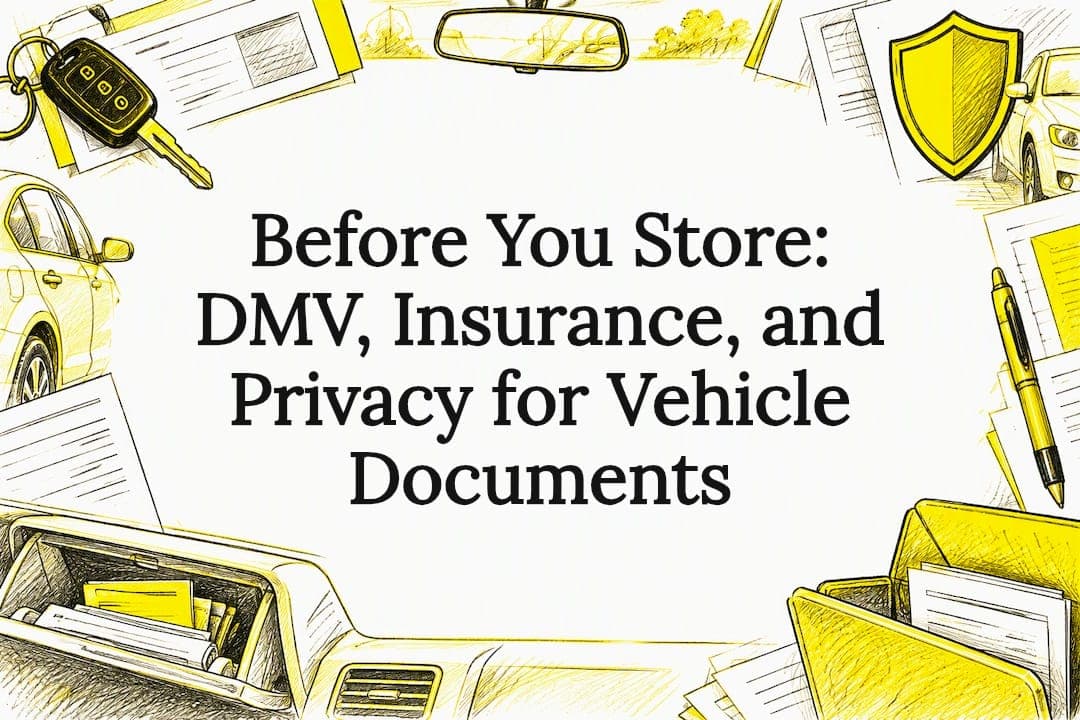
Keep your registration, an insurance declarations page or card, a photo ID, and a photocopy of the title, not the original, accessible while the car is in storage. The registration proves current legal status, the insurance document proves active coverage, the ID confirms ownership identity if facility staff need it, and the title copy helps with ownership disputes without risking the original if a window gets broken. Back everything up digitally and clear your personal data from the infotainment system before you walk away.
TL;DR:
- Storage does not automatically suspend registration: Nebraska and Colorado offer nonuse filings, but emissions testing may still apply, so confirm requirements with your state DMV.
- Lenders usually require continuous coverage, while comprehensive protects against theft, vandalism, fire, and weather; confirm terms before dropping collision or canceling a policy.
- Facilities may request a signed storage agreement and a Certificate of Insurance; cruise or deployment travelers should reserve 60 to 90 days ahead.
- Consumer Reports recommends battery maintenance, periodic engine runs, and rodent prevention; record each check, then shift from weekly visits to monthly after the first month.
Table of Contents
- What belongs in the car and what belongs somewhere safer
- Registration and insurance rules for a stored vehicle
- Storing documents safely: physical, digital, and privacy steps
- A pre-storage checklist and maintenance log that actually helps
- What a storage facility actually asks for at intake
- Why verification beats convenience every time
- Where Asphalt Lots fits if you want the paperwork handled for you
- FAQ
- Sources
What belongs in the car and what belongs somewhere safer
Sorting vehicle documents in car storage comes down to one question: does this paper help someone identify or operate the car legally, or does it unlock your finances and identity? The first category rides with the vehicle. The second stays with you.
Keep with the car:
- Current registration card, since an officer, tow operator, or facility manager may need to confirm the vehicle is legally registered.
- Proof of insurance, ideally a printed declarations page rather than just the wallet-sized card, because it lists coverage limits and effective dates in one place.
- A photocopy of the vehicle title, which satisfies most identification requests without exposing the original.
- A spare key, kept separate from the primary set if the facility allows it, so you are not locked out during an emergency visit.
- A simple maintenance log noting the last oil change, tire rotation, or inspection date.
Keep with you, never in the car:
- The original title. Replacing a lost or stolen title can take weeks and involves notarized affidavits in most states, a hassle you avoid by leaving the original in a home file or safe-deposit box.
- Loan or lease payment books, bank statements, or anything with account numbers.
- Unencrypted USB drives, old phones, or garage door remotes paired to your home.
A weatherproof document sleeve, the kind used for boat or RV paperwork, works well for the items that do stay in the car. Slide the registration, insurance declarations page, and title photocopy into one sleeve and store it in the glovebox rather than the console or door pocket, where it is more likely to shift or get soaked if a window seal fails. Some owners prefer a small locked document box bolted inside the trunk, which adds a layer of protection against casual break-ins without making the paperwork hard to reach for facility staff.
Pro Tip: Photograph both sides of every document you place in the car before you store it, and email the photos to yourself. If the physical copies are ever lost or damaged, you have a dated digital record in minutes.

Registration and insurance rules for a stored vehicle
Storing a car does not pause your legal obligations automatically. Many states still expect an active registration unless you file specific paperwork, and insurance decisions during storage carry real financial tradeoffs.
Some states offer a formal path to suspend registration obligations while a vehicle sits unused. Nebraska, for example, provides a storage and non-use registration option that lets owners avoid standard registration fees and penalties while the car is not driven on public roads. Colorado runs a similar system, where the DR2303 form for stored vehicles documents non-use and, depending on the county, may substitute for maintaining active insurance. These programs exist precisely because registration and insurance mandates are built around vehicles in regular use, not cars sitting in a garage or storage facility for months.
The catch is that rules vary significantly by state, and even within a state, by county. Colorado's own guidance notes that if your vehicle is subject to emissions testing, that requirement does not disappear just because the car is in storage, and skipping it can trigger late fees. There is no single national standard here. The only safe approach is to call your state DMV directly and ask what form, if any, applies to a vehicle that will not be driven for an extended period.
Insurance decisions follow a similar logic but carry their own risks. According to Progressive's guidance on stored vehicle insurance, owners generally have three options: keep the full policy active, drop collision coverage while retaining comprehensive, or cancel the policy outright. Comprehensive coverage matters most during storage because it protects against theft, vandalism, fire, and weather damage, risks that do not go away just because the car is parked.
Canceling entirely is the cheapest option month to month, but it comes with strings attached. If you have a loan or lease, your lender almost certainly requires continuous coverage as a condition of the financing agreement, and gaps can trigger force-placed insurance at a much higher cost than your original policy. If you own the car outright and are comfortable absorbing the risk of theft or weather damage, canceling is legally possible in most states, but you lose any protection the moment coverage lapses.
A practical sequence to avoid gaps or fines:
- Call your state DMV first and ask about storage registration, non-use affidavits, or any local exemption.
- Call your insurer next and ask specifically what happens to your rate and coverage if you switch to comprehensive-only or pause the policy.
- Get written confirmation of any filing or coverage change, whether by email or a mailed letter, before you surrender plates or stop paying premiums.
- Keep that written confirmation with your other stored documents, not just in an inbox you might not check for months.
Colorado's own data on this point is clear: vehicles subject to emissions testing requirements remain subject to them even while stored, and noncompliance can mean late fees stacking up before you ever drive the car again.
If your car qualifies as a classic or antique, storage conditions themselves can affect your coverage. The Insurance Information Institute notes that classic car insurers often require fully enclosed, locked storage as a condition of coverage eligibility, meaning an open carport or street parking could leave a claim denied even with an active policy. If you are moving a vehicle a long distance before storing it, Move Craft Moving Solutions' guidance on preparing a car for relocation covers the documentation and condition checks worth doing before transport, which overlaps closely with what a storage facility will want at intake.
For a deeper breakdown of which coverages make sense for your specific situation, our guide to stored car insurance costs walks through the math on keeping versus dropping different coverage types.
Storing documents safely: physical, digital, and privacy steps
Protecting vehicle documents in car storage means thinking about three separate risks: someone breaking in and stealing the papers, water or heat damaging them, and modern infotainment systems leaking your personal data long after you have walked away.
For physical storage, the glovebox is convenient but not foolproof. It is the first place a thief checks and offers no protection from humidity if the car sits for months. A sealed, water-resistant document sleeve inside the glovebox solves the moisture problem. A small locked box secured inside the trunk adds a layer against casual theft, though it is less convenient for facility staff who may need quick access. For the original title, loan documents, and anything with account numbers, skip the car entirely. A home safe, a safe-deposit box, or a sealed folder with a trusted family member all work better than anything inside an unattended vehicle.
A simple digital backup workflow:
- Scan or photograph every document you plan to keep with the car, plus the original title you are keeping elsewhere.
- Save the files with clear names and dates, then encrypt the folder or use a password-protected cloud service.
- Upload a copy to at least one cloud location and one offline backup, such as an external drive stored at home.
- Test access from a second device, like a phone instead of your laptop, to confirm you can actually retrieve the files under pressure.
Privacy steps matter more with every new vehicle model year. The Federal Trade Commission recommends unpairing phones, deleting linked accounts, and performing a factory reset on the infotainment system before long-term storage or any transfer of the vehicle. Modern systems retain contact lists, call logs, garage door codes, and sometimes payment information tied to in-car purchase apps. Services like Privacy4Cars specialize in walking owners through exactly which menus to check for lingering personal data, since manufacturers bury these settings differently across brands.
Pro Tip: Before you store the car, write down your infotainment login and any paired-account details somewhere other than the car itself. Factory resets are permanent, and you do not want to be locked out of a system you need to reconfigure later.
For a full walkthrough of preparing a vehicle for months of storage, our guide to storing a car safely covers the mechanical side that pairs well with this document checklist.
A pre-storage checklist and maintenance log that actually helps
Getting your paperwork in order before the car goes into storage saves headaches later, especially if you need to file an insurance claim or sell the car once it comes back out.
Pre-storage tasks, in order:
- Photograph and photocopy every document: registration, insurance declarations page, title, and photo ID.
- Call your insurer and DMV to confirm current status and any filing requirements, then save written confirmation.
- Request intake paperwork from your storage facility, including a Certificate of Insurance if they ask for one naming the facility.
- Write down an emergency contact and leave a copy with a trusted person who knows the car is in storage.
- Place the agreed-upon documents in a sealed sleeve inside the vehicle and store the rest off-site.
Once the car is parked, a maintenance log is worth keeping even if nobody is driving it. Consumer Reports recommends treating a stored car proactively rather than ignoring it: using a battery maintainer, starting and briefly running the engine periodically, and guarding against rodents all help prevent the kind of mechanical damage that shows up only after months of neglect.
A simple log template covers:
- Date of each check or visit.
- Action taken, such as battery maintainer check, tire pressure check, or rodent deterrent refresh.
- Odometer reading, even if unchanged, to confirm the car has not moved.
- Battery voltage or state, if you are using a tender with a readout.
- Initials of whoever performed the check, especially useful if facility staff handle periodic monitoring.
A weekly check is reasonable for the first month, tapering to monthly once you confirm the car is stable in its storage environment. These records matter more than they seem to at the time. If you ever need to file a claim for weather damage or theft, a log showing you checked the car regularly strengthens your case. If you sell the car after storage, a buyer who sees a documented maintenance history during a lay-up period is far more confident than one looking at an unexplained gap in service records.
For storage situations involving a vehicle battery specifically, our car battery storage guide for cruise travelers covers verification steps that pair naturally with this log.
What a storage facility actually asks for at intake
A professional storage facility has its own paperwork expectations, separate from what the DMV or your insurer requires, and knowing them in advance speeds up check-in considerably.
Typical intake requirements include:
- Proof of current insurance, usually a declarations page rather than just a card, since it documents coverage limits clearly.
- Current vehicle registration to confirm the car is legally on the road or eligible for storage.
- A signed storage agreement outlining duration, access terms, and liability.
- A Certificate of Insurance naming the facility, when a facility requests one for added liability clarity.
Timing matters as much as the paperwork itself. For deployment or cruise travel specifically, reserving a spot 60 to 90 days ahead gives you enough runway to sort registration questions, confirm insurance coverage, and gather intake documents without a last-minute scramble. Our guide for service members reserving storage before deployment covers this timing in more detail, since deployment schedules often leave little room for paperwork surprises.
A facility that documents intake carefully protects both sides. Clear records of a vehicle's condition and paperwork at drop-off make any later dispute, whether about damage or missing documents, far easier to resolve. Owners who show up with their documents already organized and photocopied, rather than digging through a glovebox at the counter, tend to move through intake in a few minutes rather than a long back-and-forth.
Why verification beats convenience every time
The instinct with vehicle documents in car storage is to prioritize whatever is easiest to grab. I think that instinct is backward. A digital encrypted copy beats a physical original whenever the original would be catastrophic to lose, the title being the clearest example. Convenience should only win for the documents you can afford to have stolen or damaged, like a registration printout you can reissue for a few dollars.
Getting written confirmation from your DMV or insurer feels like an extra step nobody wants to take, but it is the cheapest insurance against a fine or coverage gap you will not notice until it is expensive. Three rules cover most of this: verify your status with both agencies before you walk away, document everything with photos and copies, and test your digital backups before you need them under pressure.
— Martin
Where Asphalt Lots fits if you want the paperwork handled for you
Managing vehicle documents in car storage on your own works fine if you are organized and patient with DMV phone calls. If you would rather hand off the intake process entirely, we built our storage service around exactly that problem.
We ask for proof of insurance and current registration at intake and keep your storage agreement on file so you are not reconstructing paperwork months later. Reserved spots mean you are not negotiating availability the week before a cruise or deployment, and shuttle service is available to get you to the terminal.
What we offer that matters for document handling:
- Norfolk Carnival Cruise Parking at $10 per day, with intake paperwork handled on arrival.
- The Unlimited VIP Cruise Parking Membership at $100 per month, which guarantees a reserved spot on cruise days.
- Monthly Parking and Deployment & Long-Term Parking, priced on request, for owners storing a vehicle for weeks or months.
- A Reliable Shuttle Service bundled into cruise parking visits.
| Service | Best for |
|---|---|
| Norfolk Carnival Cruise Parking | A single cruise trip |
| Unlimited VIP Cruise Parking Membership | Frequent cruisers who want guaranteed spots |
| Deployment & Long-Term Parking | Extended storage during deployment or travel |
| Monthly Parking | Local residents needing ongoing secure parking |
Managed storage costs more than parking in your own driveway, but it earns that cost back when you factor in the time saved not chasing DMV forms or insurance letters yourself. Check availability and see what to bring at intake on our services page, or browse our veteran-owned apparel collection while you are there.
This article is general information, not a substitute for advice from a qualified lawyer. Consult a qualified legal professional about your own circumstances before acting on anything here.
FAQ
What documents need to be kept in the car?
Keep your current registration, an insurance declarations page or card, and a photocopy of the title accessible in the car. Never leave the original title, loan paperwork, or anything with account numbers inside an unattended vehicle.
Does a vehicle in storage need to be registered?
Requirements vary by state: some, like Nebraska and Colorado, offer a storage or non-use registration form that can reduce fees or exempt a stored car from standard registration. Other states still require active registration and even emissions testing regardless of storage status, so check with your own DMV before assuming an exemption applies.
Where should I store my car document holder?
A sealed, weatherproof document sleeve in the glovebox works better than a door pocket or console, since it resists moisture and stays out of plain sight. Keep the original title and any financial paperwork out of the car entirely, stored at home or in a safe-deposit box instead.
How should you prepare a vehicle for storage?
Photograph and photocopy every important document, confirm your registration and insurance status in writing, and clear personal data from the infotainment system before storing the car. Follow FTC guidance on clearing personal data. Reserving a storage spot 60 to 90 days ahead, as recommended for deployment and cruise travel, gives enough time to handle paperwork without a last-minute rush.
Should I keep full insurance coverage on a stored car?
It depends on your lender and risk tolerance: Progressive's guidance notes that comprehensive coverage protects against theft, vandalism, and weather damage even while a car sits unused, and lenders often require continuous coverage as a loan condition. Owners who own the car outright and accept the risk can sometimes drop collision coverage or cancel entirely, but doing so without checking lender requirements first can create a costly gap.
Sources
- Storage and Non-Use Registration | Nebraska DMV
- Do I Need Insurance for a Car in Storage? | Progressive
- How to maintain a car that isn't driven much | Consumer Reports
- Selling your car? Clear your personal data first | FTC