The best move for most service members is off-base indoor or covered storage for deployments over six months, on-base storage when a slot is open, or a trusted family member for short trips. Whatever you pick, the single step that prevents disasters is a notarized limited Power of Attorney, done through JAG, paired with a reservation made 60 to 90 days out. Leave your POA holder copies of your orders, registration, and insurance card before you leave.
TL;DR:
- On-base storage is usually the cheapest and most secure option, but limited availability and restricted access hours may pose challenges for long deployments.
- Using a notarized limited Power of Attorney through your JAG office and making a reservation 60 to 90 days in advance are essential steps to prevent storage disputes.
- Indoor climate-controlled units are the best choice for long-term storage to protect your vehicle from weather, theft, and vandalism, especially if unattended for over six months.
- Proper vehicle preparation, including handling the battery, inflation, and pest deterrents, can prevent damage and save costly repairs upon your return.
- Starting the process early, including verifying facility policies and payment arrangements, reduces the risk of losing a key storage spot or facing unexpected fees.
Table of Contents
- How Do You Store a Car During Deployment?
- Vehicle Prep Checklist Before Long-Term Storage
- What Paperwork Do You Need Before Deployment?
- How Much Does Deployment Vehicle Storage Cost?
- What Should You Look for in a Storage Facility?
- Does Asphalt Lots Cover What Deployed Service Members Need?
- What Most Service Members Get Wrong About Storage
- Book Deployment Storage Before You Ship Out
- Sources
- FAQ
How Do You Store a Car During Deployment?
Three real paths exist, and the right one depends on how long you're gone and what you're willing to risk.
On-base storage is usually the cheapest option, sometimes free through MWR, and it comes with built-in security. The catch: spots are limited and fill fast, and access windows are often restricted to business hours, which matters if your PCS timeline shifts. Availability varies a lot base to base, so check with your installation's transportation office as soon as orders drop.
Leaving the car with family or a trusted friend costs nothing and means someone can start the engine occasionally, but it shifts liability onto them and assumes they actually will follow through. A car sitting in a cousin's driveway for a year with nobody checking the oil is a common way service members come home to a dead battery and a flat spot on every tire.
Off-base storage breaks into three tiers:
- Uncovered outdoor lots — cheapest off-base option, but full weather exposure over a long deployment adds up in paint damage and interior wear.
- Covered storage — a roof over the car without full enclosure, a middle ground on price and protection.
- Indoor units — the most protection from weather, theft, and vandalism, and the better call for long, unmonitored absences.
If you're facing a multi-year assignment with an older or low-value vehicle, consider selling instead, as cumulative storage fees over time may approach or exceed the vehicle's value.
Vehicle Prep Checklist Before Long-Term Storage
Skipping prep is how a fine car turns into a project car by the time you're back. Work through this in order, ideally the week before drop-off.
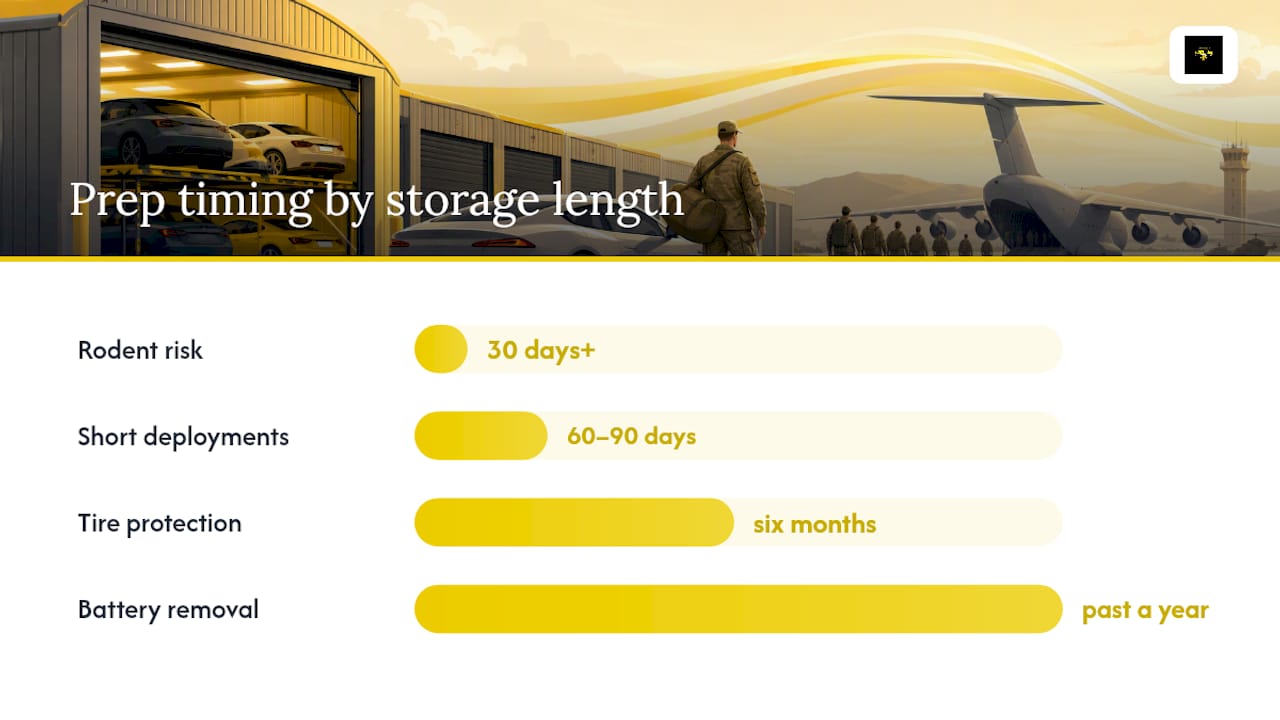
- Handle basic mechanical prep first. Get an oil change, check coolant levels, and have someone inspect belts and hoses. A fresh oil change matters because old oil left sitting for months can develop sludge and acidic buildup.
- Fill the tank and add fuel stabilizer. A full tank leaves less room for condensation to form inside it, and stabilizer keeps the fuel from degrading over months of sitting.
- Deal with the battery. For deployments stretching past a year, pull the battery and store it indoors. Otherwise, disconnect the negative terminal or hook up a battery tender rated for long-term maintenance, which holds safe voltage far better than leaving a battery connected and idle.
- Inflate tires to spec, or slightly above. For storage beyond six months, use jack stands to lift the tires off the ground entirely and prevent flat spots from forming where the rubber sits under constant weight.
- Clean the car, including the undercarriage, and use pest deterrents. Facilities and mechanics alike flag rodents as a leading cause of chewed wiring in cars parked for 30 days or more. Remove food wrappers, trash, and anything that smells like a snack to a mouse.
- Document everything. Photograph the interior, exterior, and odometer reading, and write down the VIN and mileage. Hand your POA holder a simple checklist so there's no dispute about the car's condition when you get back.
Pro Tip: Skip jack stands if the facility offers a periodic movement service instead. Rolling the car a few feet every couple of weeks does almost the same job of preventing flat spots without you needing special equipment.
For a deeper walkthrough on avoiding tire damage specifically, see how to prevent flat spots during storage.
What Paperwork Do You Need Before Deployment?
A general POA won't cut it for most storage facilities or DMV transactions. Get a notarized limited Power of Attorney through your installation's JAG office, scoped specifically to vehicle registration, insurance, and storage account management, with an expiration date set past your expected return.
Leave your POA holder and the storage facility copies of:
- Your deployment orders
- Vehicle registration and title
- Current proof of insurance
- A spare key
- The notarized POA itself
On insurance, keep comprehensive coverage active the entire time your car sits. Some drivers drop liability and collision while the car is parked, but call your insurer first and ask directly about deployment policies and military discounts, since suspending the wrong coverage can leave gaps if the car is stolen or damaged in storage.
Set up autopay or prepay the full storage term before you leave. Missed payments are how facility liens and auctions happen, and while SCRA protections can help service members contest unfair contract terms, they won't undo a car that's already been sold at auction.
How Much Does Deployment Vehicle Storage Cost?
Typical monthly ranges run $0 to $50 on-base, $50 to $100 for off-base outdoor, $75 to $150 for covered, and $100 to $250 for indoor climate-controlled storage, with many facilities offering 10 to 20% military discounts.
Book 60 to 90 days ahead of your report date. On-base slots go first, so call your MWR office the moment orders are official.
SCRA gives you real leverage here. If your storage agreement was signed before deployment orders came through, SCRA generally allows early lease termination tied to those orders, though facility recognition of that right varies. Ask directly before signing.
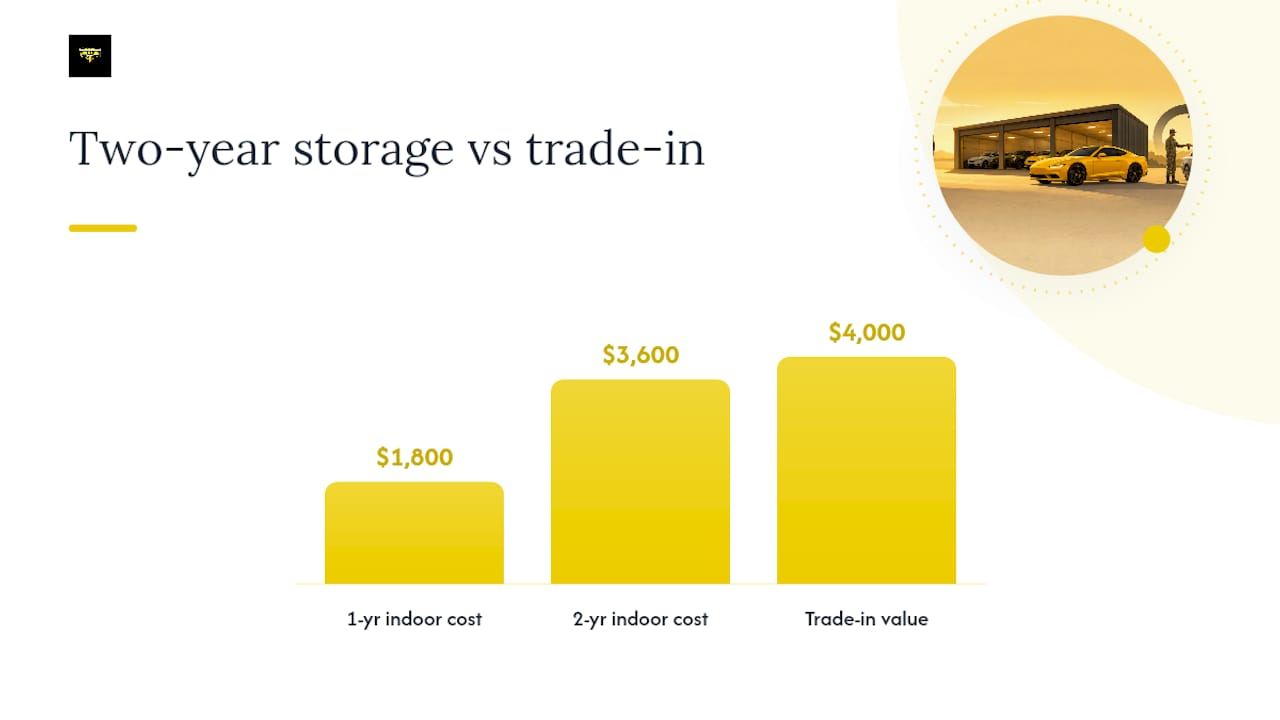
For a multi-year unaccompanied tour, do the math: a $150 monthly indoor unit runs $1,800 a year. If your car's trade-in value sits at $4,000 and you're gone two years, you'll spend $3,600 storing a car that's depreciating anyway. That's when selling and buying used on return starts looking smarter than storing. See more on the cost comparison for long-term storage.
What Should You Look for in a Storage Facility?
Before signing anything, check for:
- 24/7 camera surveillance, adequate lighting, and secured fencing
- Indoor or covered bays, not just an open lot
- Staff on-site rather than a fully unmanned facility
- Explicit acceptance of a POA holder for account changes and pickup
- Written confirmation of any military discount or SCRA recognition, not just a verbal promise
- A clear, written policy on what happens if a payment is missed
When you call, ask directly: Do you accept a POA for account access? What's your military discount? Can I set up autopay from a deployed location? What access windows exist for pickup? A facility that can't answer these clearly is one to skip. For more on how indoor protection compares to open lots, see indoor versus outdoor parking.
Does Asphalt Lots Cover What Deployed Service Members Need?
Asphalt Lots is a veteran-owned, indoor parking facility located just outside Norfolk, built around exactly the gaps that make deployment storage risky elsewhere.
- Indoor parking with round-the-clock surveillance, addressing the security concerns that come with leaving a car unattended for months
- Deployment and long-term vehicle storage as a dedicated service, not an afterthought to daily parking
- Reserved spot guarantees, so you're not gambling on availability the way you might with an on-base lot
- Shuttle service infrastructure already in place for cruise travelers, which speaks to a facility built around coordinated pickup and drop-off logistics
Before booking, ask Asphalt Lots directly about POA acceptance for account management, any military discount available, what documentation they require at drop-off, and whether you can arrange transportation and pickup/delivery services if needed.
What Most Service Members Get Wrong About Storage
The biggest mistake isn't picking the wrong storage type. It's waiting until two weeks before deployment to figure any of this out, by which point on-base slots are gone and JAG's appointment calendar is full of people making the same mistake.
Reserve your spot and get your notarized POA done 60 to 90 days out, before the administrative crunch hits. Photograph the car's condition the day you hand it off. That single photo record has saved more than one service member from a dispute over damage that happened on someone else's watch.
— Martin
Book Deployment Storage Before You Ship Out
Family driveways and open-air lots both come with tradeoffs: liability on one side, weather exposure on the other. There is an option built specifically for long, unattended absences: indoor parking with 24/7 surveillance and reserved spots near Norfolk, reducing the risk of last-minute availability issues.
Ask about POA acceptance, documentation requirements, and payment setup before your report date, and check current terms directly through Asphalt Lots' deployment and long-term parking services. If you're weighing daily versus long-term rates or want details on VIP membership options, the full breakdown lives at Asphalt Lots' FAQ page. Reserve early. Spots for extended storage fill the same way on-base slots do.
Sources
- Military
- Military vehicle storage guide | StowHelp
- Military
- Car storage options, cost & how to prep | ReloPeak
FAQ
What Is the $3,000 Rule for Buying Cars?
This isn't a formal legal rule but common financial advice suggesting you avoid financing or maintaining a vehicle worth less than roughly $3,000 in ongoing costs relative to its value. It's often cited when deciding whether storing an older car through a long deployment still makes financial sense compared to selling it.
Is It Illegal to Store a Car in a Storage Unit?
Storing a car in a vehicle storage facility is legal, but many general self-storage units prohibit vehicles with fluids like gas and oil due to fire codes. Confirm the facility is licensed for vehicle storage specifically, not just general household goods.
How Long Can a Car Be Stored Without Starting?
A car can typically sit two to four weeks without issue, but beyond a month, the battery, fuel, and tires start needing the prep steps covered above, including a fuel stabilizer and battery tender. Deployments running six months or longer call for jack stands or periodic movement to prevent tire flat spots.
Do You Keep Your Phone on Deployment?
Phone policies depend entirely on your unit, deployment location, and operational security requirements, so check with your command rather than assuming. What matters for vehicle storage is having a reliable way for your POA holder to reach you or your command if a storage or insurance issue comes up.
Does Asphalt Lots Accept a Power of Attorney for Deployment Storage?
Contact Asphalt Lots directly to confirm their current POA acceptance policy and documentation requirements before booking, since these details are best verified at reservation time.