A commonwealth attorney is the chief elected prosecutor representing the state in a local jurisdiction, typically a county or independent city. The title is used primarily in Virginia and Kentucky; everywhere else, the same office goes by district attorney, state's attorney, or solicitor. The job is functionally equivalent across those titles — prosecuting crimes on behalf of the public, not on behalf of any individual victim.
Key Takeaways
A commonwealth attorney is the chief elected local prosecutor in Virginia and Kentucky, equivalent to a district attorney elsewhere, with broad discretion over charging, pleas, and diversion.
| Point | Details |
|---|---|
| Role and title | Chief elected prosecutor in Virginia and Kentucky; functionally equivalent to a district attorney in other states. |
| Virginia duties | Must prosecute all felonies under § 15.2-1627; may prosecute misdemeanors at discretion; serves four-year terms. |
| Kentucky structure | Handles Circuit Court felonies under KRS 15.725; District Court matters go to the County Attorney; serves six-year terms. |
| Victims' first step | Contact the victim/witness coordinator at your local office for rights, notifications, and case updates. |
| Verify official policies | Check the office's official county or city website; use state bar or public records requests to verify conduct and policy. |
Table of Contents
- What does a commonwealth attorney actually do?
- How the role differs in Virginia versus Kentucky
- Is a commonwealth attorney the same as a district attorney?
- How prosecutorial discretion shapes outcomes in your community
- How to find and contact your local commonwealth attorney's office
- What victims, defendants, and defense attorneys should do next
- How commonwealth attorneys are chosen and held accountable
- Common misconceptions and a note on legal advice
- A note on this guide
- Sources
What does a commonwealth attorney actually do?
The core job is prosecuting felonies. That means presenting cases to a grand jury, trying cases in circuit court, handling appeals, and enforcing asset forfeitures. Virginia Code § 15.2-1627 spells this out directly: attorneys for the Commonwealth must prosecute every warrant, indictment, or information charging a felony, and may at their discretion prosecute certain misdemeanors and other specified matters.

Beyond the courtroom, most offices run victim and witness services, coordinate with law enforcement on legal standards and training, and administer diversion programs for eligible defendants. The Virginia Association of Commonwealth's Attorneys describes the role this way:
Virginia has 120 elected Commonwealth's Attorneys, one for each county and independent city. Each office sets its own internal priorities, staffing, and community programs within the statutory framework.
Key prosecutorial duties include:
- Prosecuting felony indictments and presenting evidence to grand juries
- Handling Commonwealth appeals in criminal cases
- Enforcing civil asset forfeitures tied to criminal conduct
- Overseeing victim and witness assistance programs
- Advising law enforcement on legal standards and probable cause
- Running or referring defendants to diversion programs
Assistant prosecutors and deputies handle much of the daily caseload. The elected attorney sets policy, supervises staff, and personally handles the most serious matters.
How the role differs in Virginia versus Kentucky
Both states use the title, but the job is structured differently.
| Feature | Virginia | Kentucky |
|---|---|---|
| Term length | 4 years | 6 years |
| Primary court jurisdiction | Circuit Court (felonies) | Circuit Court (felonies) |
| Misdemeanor authority | Discretionary under § 15.2-1627 | Handled by County Attorney |
| District Court matters | May handle at discretion | County Attorney's responsibility |
| Duty-sharing mechanism | Assistants within office | Written agreements with County Attorney |
KRS 15.725 requires Kentucky's Commonwealth's Attorneys to attend each Circuit Court session, prosecute violations within Circuit Court jurisdiction, and present evidence to grand juries. Critically, the statute also permits written agreements with County Attorneys to redistribute duties when practical. That bifurcated structure means a Kentucky resident dealing with a traffic offense or a misdemeanor charge should contact the County Attorney's office, not the Commonwealth's Attorney.
Virginia works differently. The Commonwealth's Attorney has discretion to prosecute misdemeanors and can reach into matters that in Kentucky would belong to a separate office. The Kentucky Commonwealth's Attorneys Association notes that Kentucky prosecutors serve six-year terms, compared to Virginia's four-year cycle.
For practical contact purposes: if you are in Virginia, your Commonwealth's Attorney office handles most criminal matters. If you are in Kentucky and your case is in District Court, start with the County Attorney.
County office pages give you the clearest picture of local operations. The King George County, VA page and the Fauquier County, VA page both publish staff directories, office hours, victim services contacts, and brief descriptions of what the office prosecutes. That is the model to look for in your own jurisdiction.
Is a commonwealth attorney the same as a district attorney?
Yes, functionally. The title differs; the job does not. Here is how the common synonyms map:
- District Attorney (DA): used in most states, including California, New York, and Texas
- State's Attorney: used in Maryland, Illinois, and several other states
- Solicitor: used in some South Carolina and Georgia circuits
- Commonwealth's Attorney: Virginia and Kentucky
- Prosecutor / County Prosecutor: used in New Jersey and Ohio
The authority each office holds is defined by state statute, so minor differences in jurisdiction, term length, and appointment versus election exist. But the core job — deciding whether to charge, what to charge, and how to prosecute — is the same across all of them.
Common misconceptions worth clearing up:
- "The commonwealth attorney investigates crimes." They do not. Police and investigators establish probable cause; the prosecutor receives the case after that threshold is met.
- "They handle all criminal matters in the county." In Kentucky, District Court matters go to the County Attorney. In Virginia, misdemeanors may or may not be handled depending on office policy.
- "The office represents crime victims as their personal attorney." The office prosecutes on behalf of the state. Victims have rights and services, but the attorney's client is the Commonwealth.
How prosecutorial discretion shapes outcomes in your community
The statute gives a commonwealth attorney the authority to prosecute. It does not tell them which cases to prioritize, when to offer a plea, or whether to run a diversion program. Those decisions are entirely discretionary, and they vary significantly between offices.
An office in a rural Virginia county might prosecute nearly every felony arrest through trial. An urban office might route first-time drug offenders into treatment programs. Neither approach violates the law — both reflect the elected attorney's policy choices.
The Vera Institute has reported that Virginia's funding structure for prosecutors, which ties compensation partly to conviction volume, can create financial pressure against diversion programs. The result, the Vera Institute argues, is that some offices face incentives to pursue convictions rather than alternatives that might better serve public safety.
That systemic pressure is worth understanding if you are a defendant hoping for diversion, or a victim wondering why a case resolved the way it did.
Pro Tip: To find an office's formal charging and diversion policies, check the office's official website for annual reports, press releases, or published policy statements. Some offices post these publicly; others require a public records request.
How to find and contact your local commonwealth attorney's office
- Identify your county or independent city. In Virginia, independent cities have their own offices separate from the surrounding county. In Kentucky, the county boundary defines the office.
- Search the official county or city government website. Look for a "Commonwealth's Attorney" or "Prosecutor" link under the government or departments section. Avoid third-party directories for contact information — they go stale.
- Verify hours and accepted contact methods. Most offices list a main phone number, a fax line, and sometimes a secure email or online portal. Hours vary; many offices are open Monday through Friday, 8:00 AM to 5:00 PM.
- Prepare before you call. Have your case number, the date of the incident, the names of any involved parties, and your attorney's contact information ready. The office cannot give legal advice on a first call, but staff can confirm case status and direct you to the right unit.
- Ask for the victim/witness coordinator if you are a victim. This is a dedicated staff role in most offices and your fastest path to services, notifications, and rights information.
- Use official portals for case status. Many Virginia circuit courts publish case status online through the Virginia Judicial System's case information portal.
Pro Tip: If you receive a call or letter claiming to be from the Commonwealth's Attorney's office and asking for payment or personal information, verify by calling the office's published main number directly. Scammers impersonate prosecutor offices.
What victims, defendants, and defense attorneys should do next
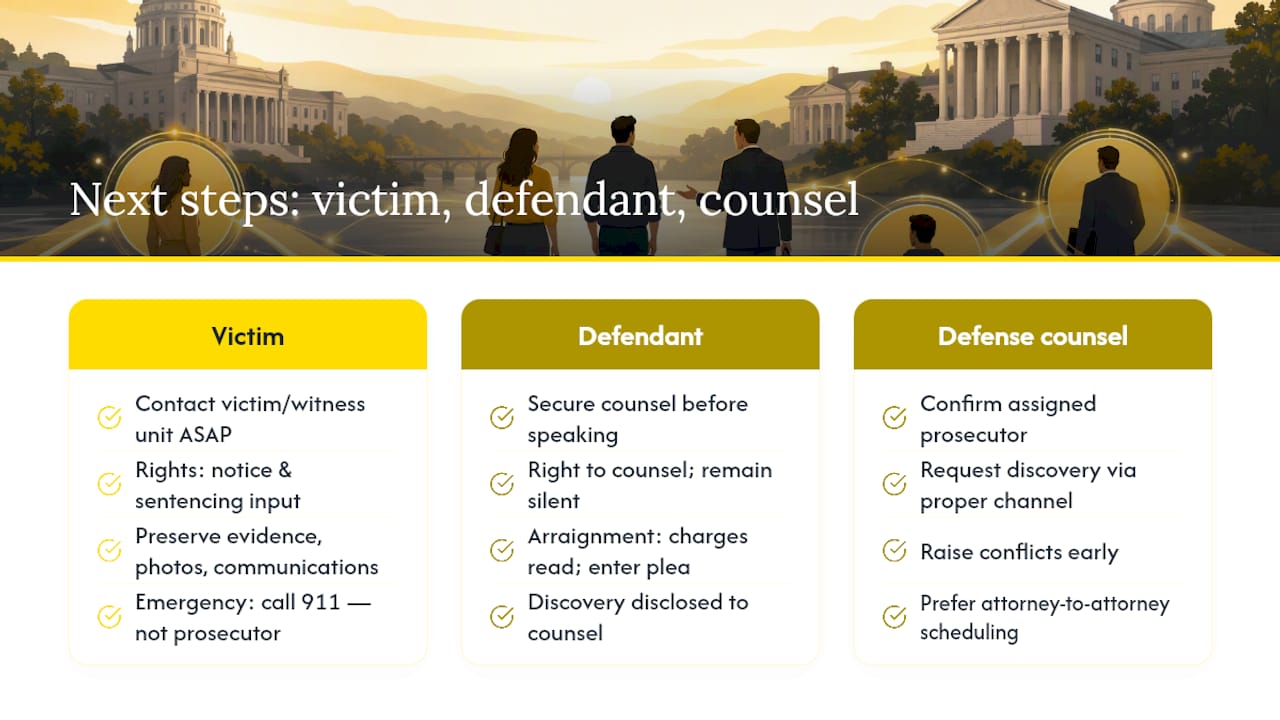
If you are a victim: Contact the office's victim/witness services unit as soon as possible. You have statutory rights to notification, to be heard at sentencing, and to receive information about the case. Preserve any evidence, photographs, or communications related to the incident. In an emergency, call 911 first; the prosecutor's office is not an emergency contact.
If you are a defendant: Secure legal representation before speaking with anyone from the prosecutor's office. You have the right to counsel, and anything you say can be used against you. At arraignment, you will be informed of the charges and asked to enter a plea. Discovery — the evidence the prosecution intends to use — must be disclosed to your attorney under applicable rules.
If you are defense counsel: Contact the prosecutor's office to identify the assigned assistant commonwealth's attorney on the case. Request discovery through the proper procedural channel for that jurisdiction. If a conflict of interest exists, raise it early. For scheduling hearings or continuances, most offices prefer direct attorney-to-attorney contact rather than written motions as a first step.
Local public defender offices, legal aid organizations, and victim assistance programs operate alongside the commonwealth attorney's office and can provide referrals when the prosecutor's office is not the right contact.
How commonwealth attorneys are chosen and held accountable
Commonwealth's Attorneys are elected by voters in their county or city. Virginia holds these elections on a four-year cycle; Kentucky on a six-year cycle. The elections are partisan in both states, meaning candidates run on party tickets.
Accountability mechanisms include:
- State bar ethics rules: Prosecutors are licensed attorneys subject to professional conduct rules, including duties of candor and fairness. Complaints go to the state bar's disciplinary authority.
- Judicial oversight: Judges can sanction prosecutorial misconduct in court, exclude evidence, or dismiss cases.
- Formal complaints: Most state bars have an online complaint process. In Virginia, that is the Virginia State Bar; in Kentucky, the Kentucky Bar Association.
- Public records: Office budgets, charging data, and some case statistics are public record and can be requested under state freedom of information laws.
- Elections: The most direct accountability tool. Voters can remove an attorney who does not reflect community priorities.
To influence office policy between elections, attend public meetings, submit written comments when the office solicits input, and contact the office directly. Some offices publish community advisory processes or hold public forums on charging priorities.
Common misconceptions and a note on legal advice
This guide is general information, not legal advice. For guidance specific to your case, consult a licensed attorney in your jurisdiction.
A few quick clarifications:
- Prosecutors are not investigators. They receive cases after law enforcement establishes probable cause.
- Office funding does not automatically equal office policy. Funding structures create incentives, but individual attorneys still exercise discretion.
- Commonwealth's Attorneys handle criminal matters only. Civil disputes, licensing issues, and regulatory complaints go to different agencies.
For the exact statutory text governing these offices, read Virginia Code § 15.2-1627 and KRS 15.725 directly.
A note on this guide
This guide was compiled to help residents, victims, defendants, and attorneys understand how Commonwealth's Attorney offices work in Virginia and Kentucky. Sources include state statutes, official county office pages, the Virginia Association of Commonwealth's Attorneys, the Kentucky Commonwealth's Attorneys Association, and policy research from the Vera Institute.
Asphaltlotsva is a veteran-owned secure parking operator located near Norfolk, Virginia, serving cruise travelers and local residents. Publishing accurate, locally relevant information about Virginia institutions is part of how the brand serves its community. Readers looking for local Norfolk-area resources will find that same commitment to accuracy in everything Asphaltlotsva publishes.

Heading to the Norfolk cruise terminal? Asphaltlotsva offers secure indoor parking with 24/7 surveillance, a free shuttle to the terminal, and a VIP Unlimited Cruise Parking Membership with guaranteed reserved spots. Reserve your spot before your next sailing.
Sources
- Commonwealth's Attorney — Wikipedia
- § 15.2-1627. Duties of attorneys for the Commonwealth and their assistants — Virginia Code
- KRS 15.725 — Duties of Commonwealth's attorney and county attorneys — Kentucky Legislature
- Role of the Prosecutor — Virginia Association of Commonwealth's Attorneys
This article is general information, not a substitute for advice from a qualified lawyer. Consult a qualified legal professional about your own circumstances before acting on anything here.