Use a secure off-site indoor facility with surveillance and shuttle service. It beats port parking on cost and security, and it removes the stress of maneuvering a motorcycle through cruise terminal traffic on embarkation morning. Asphalt Lots, near Norfolk, is one vetted local option built around exactly this need.
TL;DR:
- Off-site parking with shuttle service generally costs 20 to 40 percent less than port parking, with Norfolk lot rates at about $10 per day and cheaper memberships available.
- Indoor or covered outdoor storage with 24/7 surveillance and controlled access is essential to protect a motorcycle from theft and weather damage during long trips.
- Before leaving, document the bike's condition, photograph all sides and the odometer, and ensure your spot and receipts are clearly recorded for dispute resolution if needed.
- Booking early guarantees a reserved space, with a recommended arrival 60 to 90 minutes before the cruise, and confirmation of shuttle details helps avoid last-minute surprises.
- Your insurance should cover theft, vandalism, and weather damage, and check that the facility's liability limits align with your bike's value to avoid gaps in protection.
Table of Contents
- What Does Secure Motorcycle Storage for Cruises Actually Cost?
- How Do You Choose a Secure Off-Site Motorcycle Storage Facility?
- Security and Packing Checklist Before You Leave Your Bike for Days or Weeks
- How Do You Book and Reserve Off-Site Motorcycle Parking?
- Who's Liable if Something Happens to Your Motorcycle in Storage?
- What Are Typical Cancellation and Refund Policies?
- Is Off-Site Storage Better for Short Trips or Long-Term Parking?
- What Insurance Coverage Should You Have for a Stored Motorcycle?
- Why a Purpose-Built Facility Changes the Equation
- Ready to Book Secure Parking Near Your Cruise Terminal?
- Sources
- FAQ
What Does Secure Motorcycle Storage for Cruises Actually Cost?
Port lots charge by the day, and those days add up fast on a week-long cruise. Official port parking typically runs $15 to $35 per day, which puts a standard 7-night cruise at roughly $105 to $245 just to leave your vehicle sitting in a fenced lot with minimal coverage for a motorcycle specifically.
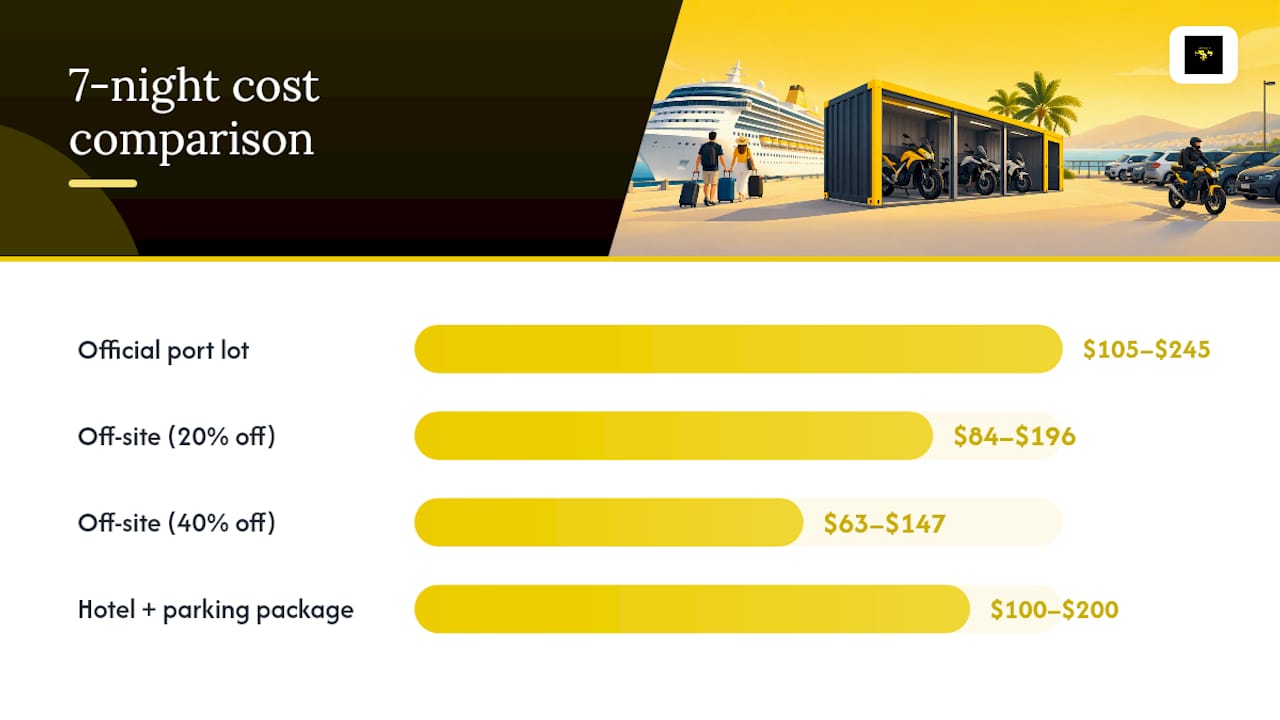
Off-site lots that include shuttle service commonly save 20 to 40 percent off those official port rates, and many are built with tighter security than a sprawling municipal or cruise-line lot ever offers. For shorter trips, a hotel-plus-parking package can be the better play. These bundles often run $100 to $200 total, covering a pre-cruise hotel night, parking for the duration of the trip, and shuttle service to the terminal.
What actually moves your total up or down:
- Season and demand. Spring break and summer sailings push port rates toward the top of the range.
- Which port you're using. Norfolk, Miami, and Port Canaveral all price differently based on local competition and land costs.
- How far in advance you book. Off-site lots frequently reward early reservations with lower locked-in rates.
- Trip length. A 4-night cruise and a 10-night cruise scale very differently, so always calculate the per-day rate against your actual sailing length rather than assuming a flat weekly number.
A quick way to sanity-check any quote: divide the total price by the number of nights you'll be away, then compare that per-day figure across your shortlisted lots side by side.
How Do You Choose a Secure Off-Site Motorcycle Storage Facility?
A motorcycle needs different protection than a sedan sitting in the same lot. Bikes get stolen faster, damaged more easily by weather, and are harder to secure with a single generic strategy. Before you book anything, run through this checklist.
- Confirm indoor parking or, at minimum, covered and monitored outdoor space. Ask directly whether motorcycles are stored inside a building or under a roof, not just parked in the open section of a larger lot.
- Verify 24/7 surveillance and controlled access. A facility should have cameras covering the actual parking area, not just the entrance, plus a gate or staffed checkpoint that limits who can walk in.
- Ask about ground anchors or fixed tie-down points. Layered security that combines an anchor, a heavy chain, and a disc lock cuts theft risk far more than any single lock, and a facility that provides anchor points does half that work for you.
- Get the shuttle details in writing. Confirm frequency, the exact meeting point, whether luggage space is guaranteed, and total ride time to the terminal.
- Check for guaranteed or VIP reserved spots. A facility that promises your space in advance removes the "what if it's full" anxiety that hits during peak cruise season.
- Read recent reviews, not just the top three. Look specifically for comments about motorcycle handling, not just car parking, since not every reviewer arrives on two wheels.
- Ask about the intake and claims process before you book, not after something goes wrong. A facility that documents your bike's condition at drop-off with photos and a written receipt is one that takes disputes seriously.
Pro Tip: Call the facility directly and ask specifically how many motorcycles they park during a typical cruise weekend. A lot that handles bikes regularly will have real answers about anchoring, spacing, and cover. A lot that mostly does cars will hesitate.
Security and Packing Checklist Before You Leave Your Bike for Days or Weeks
A car left for a week can survive on a locked door and a decent parking spot. A motorcycle needs more, because it's lighter, more portable, and a far easier target for a thief with a van and thirty seconds.
Security experts consistently point to layered protection over any single device. Combining a ground anchor, a heavy chain through the frame, and a disc lock creates enough friction that most opportunistic thieves move on to an easier target. For trips longer than a couple of nights, that combination matters even more, and upgrading to Sold Secure Gold or Diamond rated hardware is worth the extra cost given how long the bike will sit unattended.
Before you hand over your keys, work through this list:
- Remove all valuables from saddlebags, tank bags, and any storage compartment.
- Photograph the bike from all four sides plus the odometer reading, so you have a timestamped record of condition and mileage before you leave.
- Note your exact parking spot number and keep any intake receipt somewhere accessible, not buried in a suitcase.
- Use a trickle charger or tender if the facility allows it, or disconnect the battery for stays longer than a week to prevent a dead battery on return.
- Drain or stabilize fuel if you're storing longer than a few weeks, since sitting gasoline degrades and can gum up injectors.
- Use a breathable cover, not a tarp, to prevent trapped moisture from causing corrosion, and make sure the bike is on a stable stand or securely tied down if it will be moved indoors.
Documenting condition and location before departure isn't paranoia. It's the single easiest way to resolve a dispute quickly if anything looks different when you get back.
How Do You Book and Reserve Off-Site Motorcycle Parking?
Booking early is the difference between a guaranteed spot and a phone call telling you the lot is full. Here's the sequence that avoids surprises on either end of your trip.
- Reserve in advance online, providing your vehicle registration, license plate, a valid ID, and payment details. Most facilities lock in your rate at the time of booking rather than charging port-day pricing.
- Plan your arrival for at least 60 to 90 minutes before your recommended terminal check-in time. This buffers against port traffic and gives you time for the intake process without rushing.
- Go through intake carefully. A legitimate facility will photograph your bike, note existing scratches or wear, and hand you a receipt or confirmation number. Keep that documentation with your cruise essentials, not packed away.
- On return, expect a short wait during peak disembarkation windows as shuttles cycle through drop-offs. Ask about late pickup fees before you book if your return flight or plans are flexible.
- Before you ride off, check tire pressure, the battery, and any tie-down straps that need removing, since a bike sitting for a week can lose a few PSI even without a leak.
A related read on shuttle pickup logistics breaks down meeting points and timing in more detail if you're cutting it close on a tight embarkation schedule.
Who's Liable if Something Happens to Your Motorcycle in Storage?
Liability comes down to what's actually written in the storage agreement, not what a website implies in its marketing copy. Most off-site lots operate under a bailment relationship, meaning the facility takes on a duty of reasonable care while your bike is in their custody, but that duty typically has limits spelled out in the fine print.
Read the terms before you sign anything, specifically looking for a stated maximum liability amount. Many facilities cap their responsibility at a flat dollar figure per vehicle, which may fall well short of a motorcycle's actual value, especially on a newer or customized bike. That gap is exactly why your own insurance matters, a point worth returning to later in this guide.
Ask these questions directly before booking:
- What happens if the facility's own negligence causes damage, versus vandalism or theft by a third party?
- Is there a written claims process, and how long does it typically take to resolve a claim?
- Does the facility carry commercial general liability coverage, and will they confirm that in writing?
A facility that hesitates to answer these questions clearly is telling you something. One that has a documented intake photo process and a clear claims procedure is signaling it has handled disputes before and has a system for it, not just a hope that nothing goes wrong.
What Are Typical Cancellation and Refund Policies?
Cancellation terms vary more between facilities than almost any other policy, so this is worth confirming before you pay, not after your cruise gets rescheduled. Cruises get delayed by weather, itinerary changes, and mechanical issues more often than most first-time cruisers expect, and your parking reservation should have some flexibility built in.
Look for a few specific terms in any booking confirmation:
- A defined cancellation window, such as 24 or 48 hours before your scheduled drop-off, after which a fee or forfeiture may apply.
- Whether refunds are issued as cash back or facility credit. Credit toward a future booking is common, but you want that stated clearly rather than assumed.
- How itinerary changes are handled. If your cruise line pushes your sailing date, does the facility adjust your reservation at no cost, or do you have to rebook from scratch?
- Membership-specific terms, since a subscription-style plan often has different cancellation rules than a single-day reservation.
None of this should require a phone call to figure out. A trustworthy facility publishes its cancellation and refund terms plainly, often in a dedicated FAQ, rather than burying them in a booking confirmation email you only see after you've already paid.
Is Off-Site Storage Better for Short Trips or Long-Term Parking?
The right facility depends heavily on how long your bike will actually sit. A weekend cruise and a six-month deployment are not the same storage problem, even though both involve leaving a motorcycle somewhere unattended.
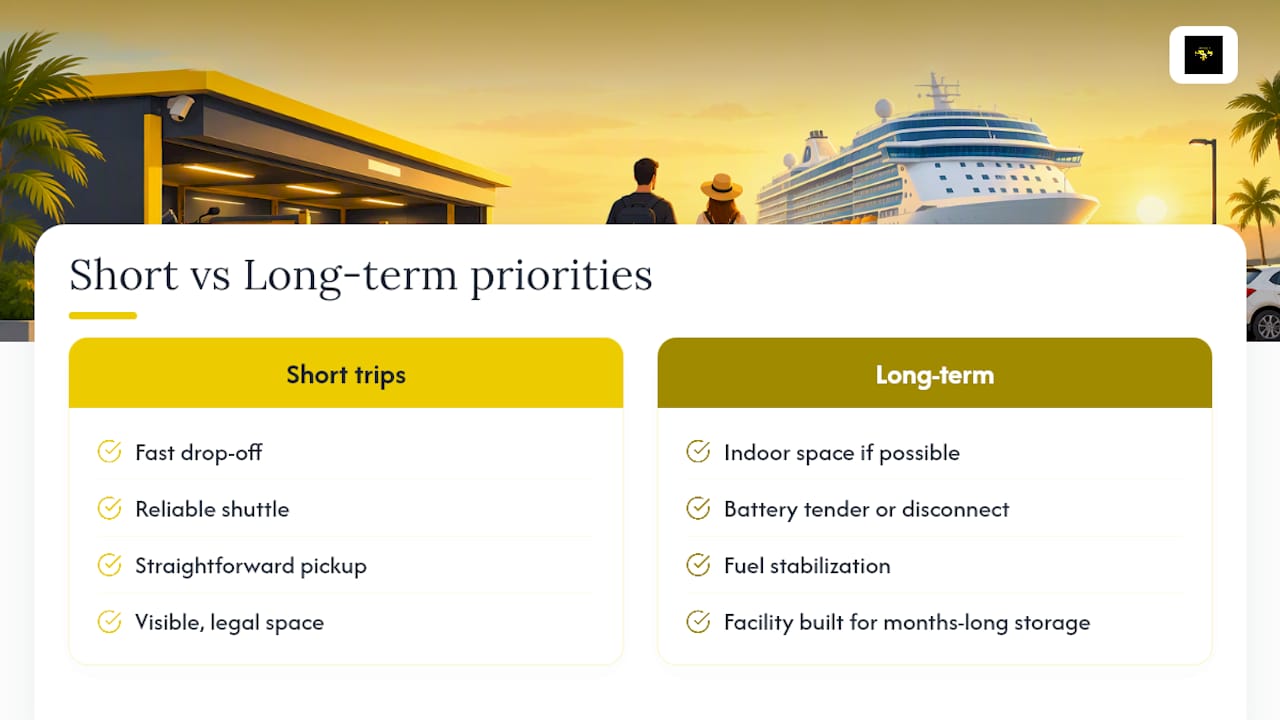
For short trips of a few days to a week, the priority is speed and convenience: fast drop-off, a reliable shuttle, and straightforward pickup. Short-duration parking calls for a visible, legal space and a quick-immobilizer approach rather than the full long-term security buildout, since the exposure window is smaller.
Long-term storage, the kind military personnel need during deployment or riders need during an extended trip, calls for a completely different posture. That means indoor space if at all possible, a battery tender or disconnected battery, fuel stabilization, and a facility that's comfortable managing a vehicle for months rather than days. Ask specifically whether a facility differentiates its pricing and service model for long-term parking versus daily cruise parking. A facility built primarily around quick daily turnover may not have the infrastructure for a bike sitting untouched for months, while one that explicitly offers deployment and long-term parking has likely built processes around exactly that use case.
What Insurance Coverage Should You Have for a Stored Motorcycle?
Facility liability limits rarely cover a motorcycle's full replacement value, which means your own policy is doing more work than you might assume while your bike sits in someone else's lot.
Check these coverage points before you leave your bike anywhere for an extended stretch:
- Comprehensive coverage, which typically handles theft, vandalism, and weather damage, the exact risks a stored vehicle faces even in a secured lot.
- Confirm your policy covers the bike while parked at a third-party facility, not just at your home address, since some policies have location-specific terms.
- Ask your insurer whether a gap exists between the facility's stated liability cap and your bike's actual value. If the facility caps liability at a modest flat amount and your bike is worth considerably more, that gap is yours to cover unless your own policy fills it.
- For long-term storage, ask about a "storage" or "layup" policy adjustment, which some insurers offer at a reduced rate since a stored bike isn't accumulating road risk the same way a daily rider does.
None of this takes more than a five-minute call to your insurance agent, and it's the cheapest insurance against a very expensive surprise.
Why a Purpose-Built Facility Changes the Equation
A general parking lot treats a motorcycle like an afterthought. A facility built with bikes in mind treats it as the point. Asphalt Lots is a veteran-owned, indoor secure facility with 24/7 surveillance, and that combination matters more for a motorcycle than for almost any other vehicle type, given how exposed a bike is compared to something sealed inside a car.
The VIP Unlimited Cruise Parking Membership changes embarkation day significantly. Instead of hoping a spot is open, you know it's reserved, and priority shuttle service means you're not standing in a line built for the slowest arrivals. For a frequent cruiser, that predictability removes a real source of pre-trip anxiety.
If you want more on the mechanics covered here, battery care and long-term storage prep in particular, Asphalt Lots' blog goes deeper into both.
— Martin
Ready to Book Secure Parking Near Your Cruise Terminal?
Asphalt Lots is the alternative to standing in a chaotic port lot wondering if your bike will still be there when you get back. Indoor secure parking and 24/7 surveillance provide peace of mind, and shuttle service can help get you to the terminal without adding another logistics headache to your trip.
Whether you need a single day of Norfolk Carnival Cruise Parking at $10 per day, ongoing coverage through the Unlimited VIP Cruise Parking Membership at $100 per month, or deployment and long-term storage for an extended stretch, the booking process is the same either way: reserve online, confirm your details, and show up with the security checklist above already done. If you're weighing a hotel-plus-parking combo instead, Asphalt Lots also connects riders with nearby hotel options for a full pre-cruise package. Head to the services page to check current availability and lock in your spot before your next sailing date.
Sources
- Cruise Port Parking Guide 2026: Costs & Tips for Every Major Port | Cruise Ship Tracker
- Motorcycle theft prevention guide | Rips & Rides
- Ultimate Guide To Motorcycle Parking Safety - RecNation Storage
- How to stop Motorcycle Theft: Sold Secure | Demon Tweeks Blog
FAQ
How much does off-site motorcycle storage cost compared to port parking?
Off-site lots with shuttle service commonly save 20 to 40 percent compared to official port rates, which run $15 to $35 per day. Asphalt Lots' Norfolk Carnival Cruise Parking is priced at $10 per day, and frequent cruisers can save further with the $100 per month VIP membership.
Is indoor storage necessary for a motorcycle on a week-long cruise?
Indoor storage isn't strictly required, but it significantly reduces weather-related risk and theft exposure compared to an open outdoor lot. For a 7-night sailing, the added protection is usually worth the modest cost difference, especially in humid or storm-prone regions.
What should I photograph before leaving my bike at a storage facility?
Photograph all four sides of the motorcycle plus the odometer reading, and note your exact parking spot number along with any intake receipt. This documentation protects you if a dispute comes up after you return.
Do I need a ground anchor if the facility already has surveillance?
Surveillance deters some theft attempts but doesn't physically stop them. Layering an anchor, chain, and disc lock alongside facility security gives you the strongest combined protection, particularly for stays longer than a few days.
Does Asphalt Lots offer a membership for frequent cruisers?
Yes, the Unlimited VIP Cruise Parking Membership guarantees a reserved spot on every cruise day along with priority shuttle service, for $100 per month. Details and current terms are listed on the FAQ page.