Show up at the start of your assigned check-in window, not before, not hours after. For most first-time cruisers, that window falls somewhere between about 11:00 a.m. and 1:00 p.m., and the cruise line assigns it to you during online check-in weeks before you sail.
Here's the whole day in one line: curb drop-off and porter handoff, then security and document check, then a wait in a terminal lounge until your boarding group is called, then you're aboard while your cabin is still being cleaned, then the muster drill, then your luggage shows up sometime in the afternoon or evening, then all-aboard. Then sail-away. Miss the "all-aboard" cutoff and the ship leaves without you. Show up too early and you just wait in a longer line for no reward.
Before you do anything else today, handle these three things:
- Finish online check-in and confirm your arrival appointment if you haven't already.
- Pack a carry-on with medications, your passport or ID, boarding documents, a swimsuit, and one change of clothes.
- Double-check your printed or digital boarding pass for the exact final boarding time listed by your cruise line.
Key Takeaways
Arriving at the start of your assigned check-in window, with online check-in and carry-on essentials already handled, is the single decision that determines whether embarkation day feels calm or chaotic.
| Point | Details |
|---|---|
| Arrive on time, not early | Show up at your assigned check-in window; arriving hours early just means waiting longer at the terminal. |
| Finish online check-in first | Complete it 30 to 45 days out to secure your preferred arrival appointment and speed up curb-to-aboard time. |
| Pack a real carry-on | Include medications, ID and boarding pass, a swimsuit, a change of clothes, and chargers. |
| Arrive the night before if flying | Same-day flights carry real risk since the ship won't wait for a delayed connection. |
| Build in parking and shuttle time | Arrive at your parking lot 60 to 90 minutes ahead of your terminal window if a shuttle transfer is involved. |
Table of Contents
- What Is the Typical First-Time Cruiser Arrival Timeline?
- Getting Ready Before You Leave Home
- What Happens Step by Step at the Terminal
- Why Your Cabin Isn't Ready When You Board
- When Is the Muster Drill and How Long Does It Take?
- Common First-Time Embarkation Mistakes to Avoid
- Should You Drive to the Port? Parking and Shuttle Timing
- Should You Pick an Early or Late Check-In Slot?
- Where to Verify Line-Specific Embarkation Rules
- What Getting This Right Actually Comes Down To
- Sources
What Is the Typical First-Time Cruiser Arrival Timeline?
Cruise terminals usually open a few hours before the ship's scheduled departure, and that opening time tracks the previous sailing's disembarkation, not a fixed clock. If the ship in port that morning is running late getting everyone off, your terminal open time slides too. This is exactly why cruise lines stopped letting everyone show up whenever they wanted and switched to staggered arrival appointments assigned during online check-in.
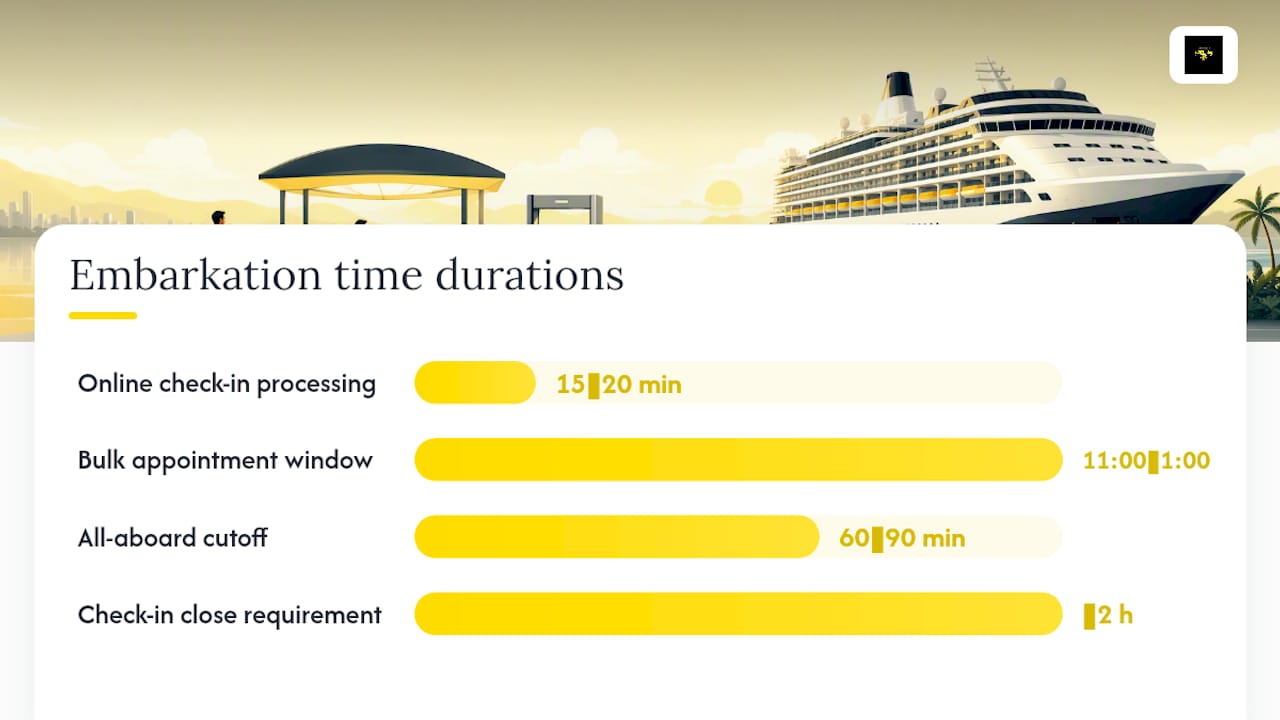
Most lines build appointment windows in blocks between late morning and mid-afternoon, commonly 11:00 a.m. to 1:00 p.m. for the bulk of passengers, with some earlier and later slots for suite guests, loyalty tiers, or people who check in late. Once you're inside the terminal with online check-in already done, the curb-to-aboard process moves fast. With online check-in finished, that stretch can take just 15 to 30 minutes; skip it, and you're filling out paperwork at a kiosk while everyone who prepped in advance walks past you.
| Time (approximate) | What's happening |
|---|---|
| Terminal opens | Doors open for the first assigned arrival groups; porters are ready curbside |
| Your appointment window | Check-in desks process documents; boarding passes activate |
| Shortly after check-in | Boarding groups are called in sequence; security and document check completed |
| Early afternoon | Cabins typically become ready between 1:00 and 2:00 p.m. |
| Mid-afternoon to evening | Checked luggage delivered to staterooms in waves |
| 60 to 90 minutes before departure | Final boarding cutoff; all passengers must be aboard well before departure |
A quick warning worth building into your plan: buffet crowds often peak within the first period after boarding. If you walk straight from the gangway to the lido deck buffet, you'll spend your first hour aboard in a line. Check the cruise app for a sit-down casual venue instead.
What tends to happen in practice:
- Terminal opens, staggered appointments begin processing in order.
- Security and document checks run continuously, similar to an airport checkpoint.
- Boarding groups get called by number or letter, usually printed right on your boarding pass.
- Cabins open early afternoon, but you can explore the ship immediately after boarding.
- All-aboard time is typically about one to two hours before the ship's published departure, and most lines require check-in to close at least 2 hours before departure.
That all-aboard number is not a suggestion. Cruise ships operate on maritime schedules tied to port slots, pilot availability, and downstream itinerary stops. A ship that waits for stragglers risks a cascading delay at every subsequent port.
Getting Ready Before You Leave Home
The work you do in the weeks before your cruise determines how smooth embarkation day feels, more than anything you do that morning. Online check-in typically opens 30 to 45 days before sailing, and the best arrival appointments go fast because slots are capacity controlled to manage flow. Log in the day it opens if you want an 11:00 a.m. slot instead of getting stuck with whatever's left, often the earliest morning or the latest afternoon options nobody else wanted.
During check-in, you'll upload a photo for facial-recognition boarding where the line offers it, enter passport or ID details, fill out a health questionnaire, and get your SetSail or boarding pass. A few common pitfalls trip up first-timers here: blurry photo uploads that get rejected and have to be redone, passport names that don't exactly match booking names, and waiting until the last week to check in, by which point only leftover appointment slots remain.
Pro Tip: Screenshot your boarding pass and save it to your phone's photo gallery, not just an app. Terminal Wi-Fi can be spotty, and a saved image works even with no signal.
What goes in your carry-on for embarkation day:
- All medications for at least the first 24 hours, in original bottles.
- Passport, birth certificate, or government ID, plus your boarding pass.
- A swimsuit and one full change of clothes.
- Phone chargers and a portable battery.
- Any documents for shore excursions booked directly through the cruise line.
On timing your travel: if you're flying to your embarkation city, arriving the night before rather than the same day is the safer call. Flights get delayed, canceled, and rerouted, and a cruise ship has no obligation to hold the gangway for a missed connection. A same-day flight can work if it lands by mid-morning with a wide buffer, but plenty of first-time cruisers have learned this lesson the expensive way. If you want more packing specifics beyond the essentials, this planning guide covers the details worth sorting out before you leave home.
What Happens Step by Step at the Terminal
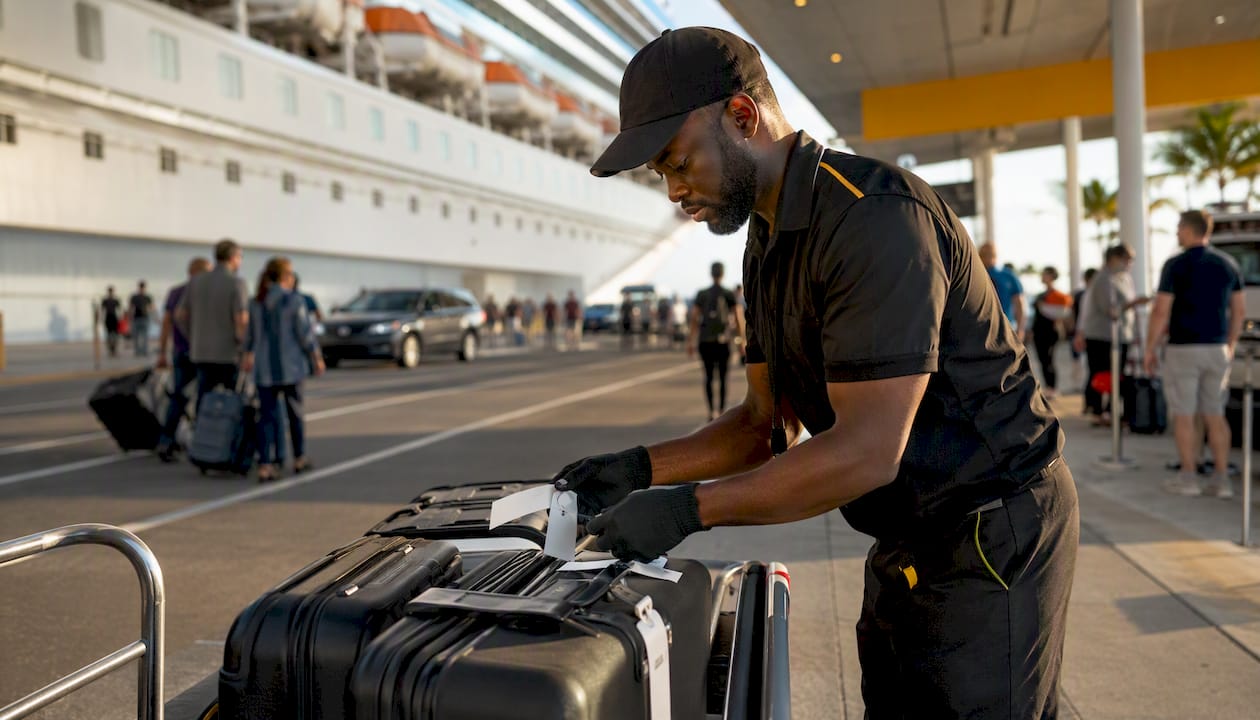
Curbside is your first checkpoint. Porters take checked luggage right at the curb, tag it with your cabin number, and send it into the ship's own delivery pipeline. Tipping $1 to $2 per bag is customary and keeps things moving. Keep your carry-on, documents, and boarding pass with you. Those bags don't go with the porter.
Security screening comes next, and it runs almost exactly like an airport: bags through an X-ray belt, metal detector walk-through, and any prohibited items (certain irons, candles, excess alcohol depending on the line's policy) get pulled aside. What slows people down here isn't the screening itself, it's fumbling with laptops, water bottles, or oversized carry-ons nobody warned them to consolidate.
Document check follows security. An agent scans your boarding pass, confirms your identity against your ID or the photo you uploaded during check-in, and your arrival appointment either gets you waved through quickly or flagged if you're showing up outside your assigned window. This is the moment your online check-in prep actually pays off.
After that, you wait, sometimes for a few minutes, sometimes longer, in a terminal seating area until your boarding group number gets called over the intercom or lights up on a screen. This is a good time to use the restroom, grab a coffee if the terminal has vendors, or just people-watch. Once your group is called, you walk the gangway and you're aboard.
Pro Tip: Wear slip-off shoes and keep metal items in your carry-on's outer pocket. Security moves faster when you're not digging through bags at the X-ray belt.
Why Your Cabin Isn't Ready When You Board
Here's something that catches first-timers off guard every time: you can be aboard the ship by noon and still not get into your cabin until 1:00 or 2:00 p.m., sometimes later. Staterooms typically become ready in that early-afternoon window because housekeeping crews are turning over thousands of rooms from the passengers who disembarked that same morning. That's not a small task on a ship carrying 3,000 to 6,000 people.
Hallways near unfinished cabins often get roped off or blocked with housekeeping carts while crews work through their zones in sequence. Don't take it personally if a crew member redirects you. They're working against a hard deadline too.
Checked luggage follows its own timeline, usually arriving outside staterooms sometime between mid-afternoon and evening. Bags can take several hours to be delivered, which is exactly why your carry-on needs to carry your swimsuit, meds, and a change of clothes rather than assuming you'll have full luggage access within the hour. If your bag hasn't shown up by dinner, guest services can usually track it down.
What to actually do with your pre-cabin hours:
- Explore the ship deck by deck while it's less crowded than it will be later in the week.
- Grab a casual lunch somewhere other than the main buffet.
- Locate your muster station and any specialty restaurants you'll want to book.
- Check the daily schedule (usually in the app) for embarkation-day activities.
Pro Tip: Book a specialty dining reservation for embarkation night the moment you board. Those slots fill fast once everyone else remembers to do it too.
When Is the Muster Drill and How Long Does It Take?
The muster drill isn't optional, and it isn't a formality either. It's a legal requirement under international maritime safety rules (SOLAS), and every single passenger has to be accounted for before the ship is cleared to leave port. No exceptions for being tired, seasick before you've even sailed, or convinced you already know where the life jackets are.
Most major lines have moved to e-mustering, where you complete a safety briefing through the cruise app or your cabin's television, then simply check in at your assigned muster station for a headcount rather than sitting through a full group briefing on the deck. It's faster, and it means the actual in-person portion often takes just a few minutes once you know your station number.
Cruise lines typically schedule the muster drill in the hours after boarding, in ample time before sail-away, so the crew has time to resolve any no-shows before the ship needs to depart. Complete the e-muster video as early as possible, ideally right after you board, so you're not scrambling to finish it while everyone else is also trying to log into the app at once.
Three things make this painless: finish the e-muster module before you even leave the terminal if your line's app allows it, know your muster station number before the drill starts, and show up to your physical check-in station a few minutes early rather than right at the deadline. Miss the headcount, and crew members will come looking for you, cabin by cabin, which delays the ship for everyone else aboard.
Common First-Time Embarkation Mistakes to Avoid
Most embarkation-day problems trace back to the same handful of avoidable decisions, and first-timers make them constantly because nobody warns them in advance.
Arriving three or four hours before your assigned window is the classic mistake. You don't get aboard any faster. You just sit in a terminal lobby longer than anyone else, and some terminals won't even let you in before your scheduled window. Arriving late is worse: miss your slot by too much and you risk not making the ship at all if you cut it close to the final boarding cutoff.
Packing medications, passports, or your boarding documents into checked luggage is the second most common error, and it's the one with the worst consequences. If your bag doesn't reach your cabin until 6:00 p.m. and your blood pressure medication is in it, that's a genuinely bad afternoon.
Standing around hallways waiting for a cabin door to unlock is a waste of vacation time nobody gets back. Go explore. Your steward will have the room ready soon enough, and hovering doesn't speed anything up.
Skipping online check-in, or skipping the photo upload for facial-recognition boarding, means slower processing at the terminal and a worse arrival appointment selection to begin with.
If something goes wrong on Day 1 (a cabin issue, a billing question, a missing bag), guest services can handle urgent problems immediately, but for anything non-critical, waiting until Day 2 gets you a much shorter line, since every other passenger is dealing with the same embarkation-day chaos you are.
Pro Tip: Take a photo of your cabin's condition and any visible damage the moment you walk in. It saves arguing about pre-existing issues at the end of the cruise.
Should You Drive to the Port? Parking and Shuttle Timing
If you're driving to your embarkation port, your timeline needs one more layer built in before your terminal appointment. Getting from your car to the ship isn't instant, and treating it like an afterthought is how people end up sprinting through a parking lot with luggage.
Plan to arrive at your parking facility 60 to 90 minutes before your chosen terminal arrival window if the lot uses shuttle transfers. That buffer covers parking, checking in with the lot attendant, and catching the shuttle without feeling rushed. A secure, veteran-owned facility like Asphalt Lots, located about 15 minutes from Norfolk, builds shuttle runs around cruise departure schedules specifically so that buffer holds up even on a busy sailing day.
Shuttle frequency and lot retrieval speed matter more than most first-time cruisers expect. A lot with infrequent shuttles or long retrieval waits can eat into the same buffer that's supposed to protect you from missing your terminal appointment, let alone the ship's hard all-aboard cutoff. This is where reserved or membership-based parking earns its cost. A VIP Unlimited Parking Membership guarantees a reserved spot and priority shuttle boarding, which removes the "will there even be room" question entirely for frequent cruisers.
Guaranteed availability and reserved shuttle boarding are the two perks that actually matter for anyone worried about the last mile between the parking lot and the gangway. Everything else is a nice bonus. Those two solve the actual risk.
For anyone flying into the embarkation city, pairing a hotel night with secure long-term parking removes another layer of risk. Book the parking reservation, confirm the shuttle schedule the day before, and you've eliminated the two biggest variables in a first-time cruiser's arrival timeline: unpredictable flights and last-minute parking scrambles. For a deeper walkthrough of curb drop-off logistics and coordinating that last-mile transfer, this terminal drop-off guide covers the specifics, and comparing parking providers before you book is worth the ten minutes it takes.
Pro Tip: Book your parking reservation the same week you complete online check-in. Popular sailing dates fill parking lots fast, and waiting until the week of your cruise limits your options.
Should You Pick an Early or Late Check-In Slot?
Early appointments, typically the 11:00 a.m. block, get you aboard sooner, which means more time to explore the ship before it fills up and an earlier shot at completing your e-muster before the crowds hit the app. Later slots, closer to 1:00 p.m. or beyond, suit people who'd rather sleep in, avoid a security line, or have a flight landing later that morning.
Neither choice is objectively better, but boarding earlier than your assigned window rarely gets you into your cabin any sooner, since cabin readiness runs on its own crew schedule regardless of when you personally walked aboard. What an early slot does buy you is more hours to enjoy the ship's public spaces before everyone else arrives.
Choose an earlier window if you're traveling with small children who need the extra transition time, you want to be among the first exploring the pool deck or specialty venues, or there's an embarkation-day event you don't want to miss. Choose a later window if your flight lands mid-morning, you'd rather avoid the terminal's busiest processing hour, or you simply don't mind a shorter window aboard before dinner.
A short checklist for picking your slot during online check-in:
- Check your flight or driving arrival time first, and build in the parking and shuttle buffer if you're driving.
- If you have small kids or want early access to the ship, grab the earliest slot still available.
- If you'd rather sleep in or your flight lands late morning, a midday or early-afternoon slot works fine.
- Confirm your choice matches the final boarding cutoff printed on your boarding pass, not just the departure time.
Where to Verify Line-Specific Embarkation Rules
Every cruise line sets its own exact cutoff times and appointment structures, so confirm the specifics against your own boarding pass and cruise line's app before sailing day.
- Check your cruise line's official check-in and boarding FAQ page for line-specific arrival windows and final boarding cutoffs.
- Review Royal Caribbean's muster drill FAQ for how e-mustering works and what SOLAS actually requires.
- Read through embarkation guides like CruiseHuddle's embarkation day breakdown and The Points Guy's boarding times explainer for cross-line comparisons.
- Confirm the exact final boarding time printed on your own boarding pass. That number, not the ship's departure time, is the deadline that actually matters.
What Getting This Right Actually Comes Down To
Most embarkation-day advice treats every step as equally important, and that's the wrong way to think about it. The single highest-leverage decision a first-time cruiser makes is picking and honoring the arrival appointment, full stop. Everything else, the carry-on packing, the muster drill timing, the parking buffer, exists to protect that one choice from falling apart.
The conventional wisdom of "get there early to beat the crowds" is outdated advice from before staggered check-in existed, and it actively works against you now. Terminals are built around appointment slots specifically to prevent the old cattle-call chaos, and showing up three hours ahead of schedule just puts you in a longer line with people who made the same mistake.
What's genuinely underrated is the parking and transportation buffer for drivers. People spend weeks agonizing over packing lists and carry-on contents, then treat the drive to the port and the shuttle transfer as an afterthought they'll figure out that morning. That's backward. A missed shuttle or a full parking lot on a Saturday morning creates far more stress than forgetting a phone charger ever will.
If there's one thing to prioritize above all the checklist items, it's this: protect your arrival appointment from every variable you can control. Book parking early. Arrive the night before if you're flying. Finish your online check-in the day it opens. The rest of embarkation day tends to sort itself out once that foundation is solid.
Sources
- Direct Line Cruises — When will my luggage arrive in my stateroom?
- Emma Cruises — 7 embarkation day mistakes
- CruiseProdigy — New to cruising: embarkation day