Book a vetted veteran-owned or veteran-friendly off-site lot instead of counting on a port exemption to come through. Free port parking for disabled veterans exists at some cruise terminals, but it's capped, residency-restricted, and handed out first-come, first-served. Asphalt Lots is one option that offers a VIP membership guaranteeing a secure indoor spot, which is more than most port exemptions can promise.
TL;DR:
- Disabled veterans with a 50% or higher service-connected disability and Louisiana residency can receive up to seven days of free parking at Port NOLA, provided they have the correct documentation and arrive early.
- Private veteran-owned parking lots, like Asphalt Lots, offer guaranteed reserved indoor spots, priority shuttle service, and long-term secure storage, making them more reliable than port exemptions.
- Verification of veteran-owned status should be done through official certificates, certification programs, or local veteran registries to avoid marketing claims that lack proof.
- Relying on first-come, first-served port exemptions is risky because spaces can fill quickly, especially during peak seasons or bad weather, making reservations or guaranteed spots a safer choice.
- When booking, ensure the lot provides adequate security, frequent shuttle service, clear cancellation policies, and confirmation of veteran discounts to avoid surprises.
Table of Contents
- Where to Find Veteran-Owned Cruise Parking
- Veteran Parking Benefits at Ports: What to Expect
- How to Claim Veteran Parking Benefits Without Getting Burned
- A Checklist for Secure, Veteran-Friendly Cruise Parking
- Asphalt Lots: A Veteran-Owned Option That Checks These Boxes
- Organizations That Support Veteran-Owned Parking Businesses
- Where Veteran-Owned Parking Falls Short
- Extra Perks Veteran-Owned Lots Offer Beyond Discounts
- What Actually Matters Here
- Book Secure Parking With Asphalt Lots
- Sources
- FAQ
Where to Find Veteran-Owned Cruise Parking
Cruise parking breaks down into four categories, and each fits a different traveler.
- Port-owned lots run by the cruise terminal itself, sometimes with a veteran exemption baked in
- Off-site long-term lots, often privately owned, some by veterans, with shuttle service to the terminal.
- Hotel park-and-cruise packages that bundle a pre-cruise night with parking for the length of your trip.
- Private membership lots that guarantee a reserved space on cruise days for a recurring fee.
Spotting a genuinely veteran-owned operator takes a little digging. Check the "About" page for an explicit ownership claim, look for a veteran-owned business badge or certification number, and search local veteran business registries for the company name. Booking pages sometimes bury veteran discounts in a promo code field rather than the headline price, so search the port name plus "veteran parking" or "military discount" directly, and cross-check state veteran affairs pages for any port-specific benefits before you assume a rate applies to you.
Veteran Parking Benefits at Ports: What to Expect
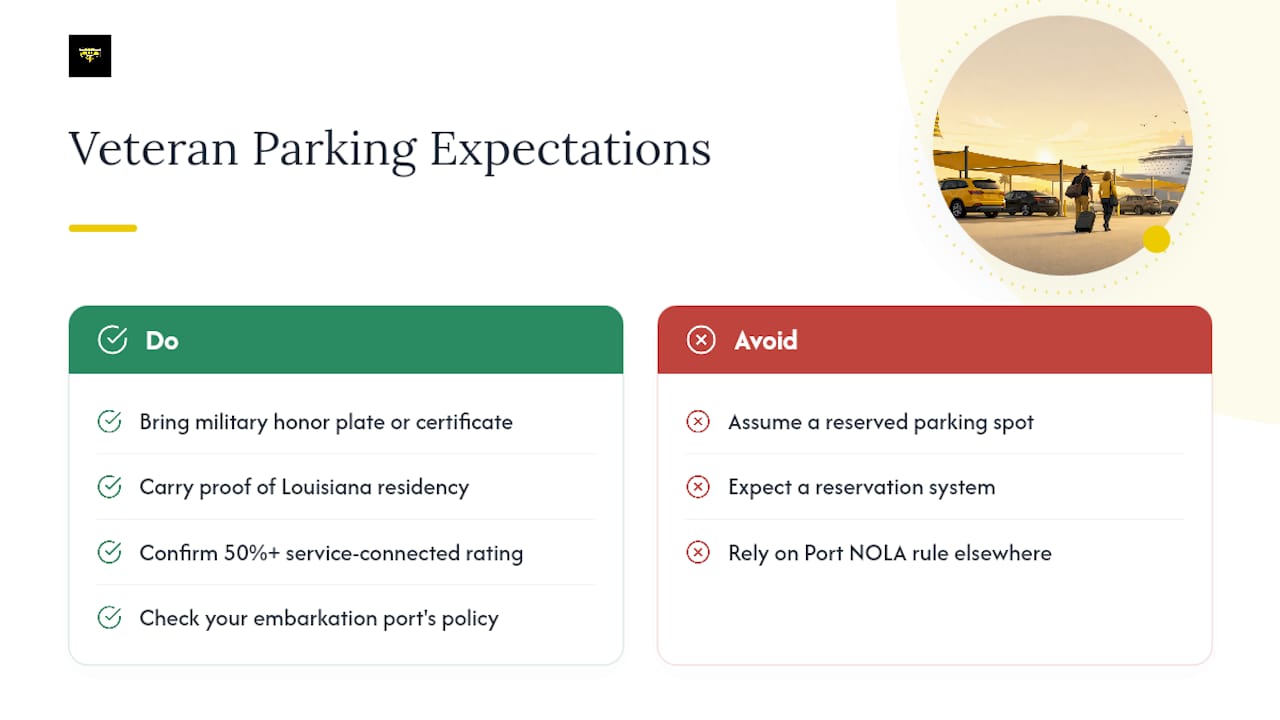
At the Port of New Orleans, disabled veterans with a service-connected disability rating of 50% or higher get free cruise terminal parking for up to seven days, provided they're Louisiana residents.
That's a real benefit, but it comes with real strings. The Louisiana statute governing the Port NOLA exemption requires either a military honor license plate or a certificate from the state Department of Veterans Affairs, plus proof of residency. The Louisiana Department of Veterans Affairs confirms the 50% threshold and notes that documentation requirements can shift depending on the specific benefit and location.
A benefit with limits: up to seven free days, Louisiana residents only, 50%+ service-connected disability rating required, and no guarantee of a spot once you arrive.
The Port NOLA FAQ spells out the part travelers miss most often: the benefit is first-come, first-served. There's no reservation system. Show up without a spot left in the exempt section, and you're paying full price like everyone else. Other ports run entirely different programs, or none at all, so what applies in New Orleans won't necessarily apply at your embarkation port. Check your specific port's page before building a trip plan around a benefit that may not exist there.
How to Claim Veteran Parking Benefits Without Getting Burned
Getting turned away at the gate because of a missing document is a common, avoidable mistake. Bring these items, and bring them as physical copies:
- Your VA benefits letter confirming service-connected disability status.
- Your disabled veteran (DV) license plate, if your vehicle has one.
- A state ID or other proof of residency, if the port requires it.
- A boarding pass showing the veteran's name, with that veteran physically present in the vehicle.
Arrive early. Because port exemptions run first-come, first-served, the exempt spaces can fill before you get there, especially during peak cruise season. If you show up without the right paperwork or the lot's exempt section is full, you may have to pay the standard rate. Some attendants will point you toward a supervisor for exceptions, but don't count on it.
Pro Tip: Digital copies on your phone aren't always accepted at the gate. Print your VA letter and keep it in the glove box the night before, not the morning of.
A Checklist for Secure, Veteran-Friendly Cruise Parking
Run any lot through this list before you hand over a card number.
- Security: Is the lot indoor or gated? Is there 24/7 surveillance, and is that stated plainly, not just implied?
- Shuttle: How often does it run, and does it match your ship's boarding window? A shuttle service that runs every 15 minutes beats one that runs on the hour.
- Reservation guarantee: Does the lot promise your spot, or is it first-come, first-served like most port exemptions?
- Membership value: A membership earns its cost if it guarantees availability and includes priority shuttle pickup, especially during hurricane season disruptions or peak sailing weeks.
- Price structure: Flat cruise-day rates are easier to budget than daily rates that creep up on longer trips.
- Cancellation policy: Ask what happens if your cruise gets rescheduled or canceled.
Pro Tip: Ask the lot directly what happens if your ship's return is delayed. A lot with a rigid daily cutoff can turn a great rate into a surprise fee.
Asphalt Lots: A Veteran-Owned Option That Checks These Boxes
Asphalt Lots offers secure indoor parking with 24/7 surveillance, which addresses the top worry most cruisers have: leaving a vehicle unattended for a week or more.
Its VIP Unlimited Parking Membership is built around the exact risk that port exemptions can't eliminate: uncertainty. Where a free port exemption might run out of exempt spaces before you arrive, the membership guarantees a reserved spot on cruise days.
- Guaranteed availability, so you're not gambling on a first-come space.
- Priority shuttle service to the terminal.
- Indoor storage that protects a vehicle from weather and prying eyes over a multi-day trip.
This setup tends to pay off most for frequent cruisers who sail multiple times a year, travelers booking during peak season when lots fill fast, and anyone sailing during hurricane season who wants a vehicle stored somewhere secured rather than sitting in an open surface lot. For a one-time cruiser taking a single short trip, a daily rate might make more sense than a membership. For someone who cruises three or four times a year, the math shifts quickly toward the membership.
Organizations That Support Veteran-Owned Parking Businesses
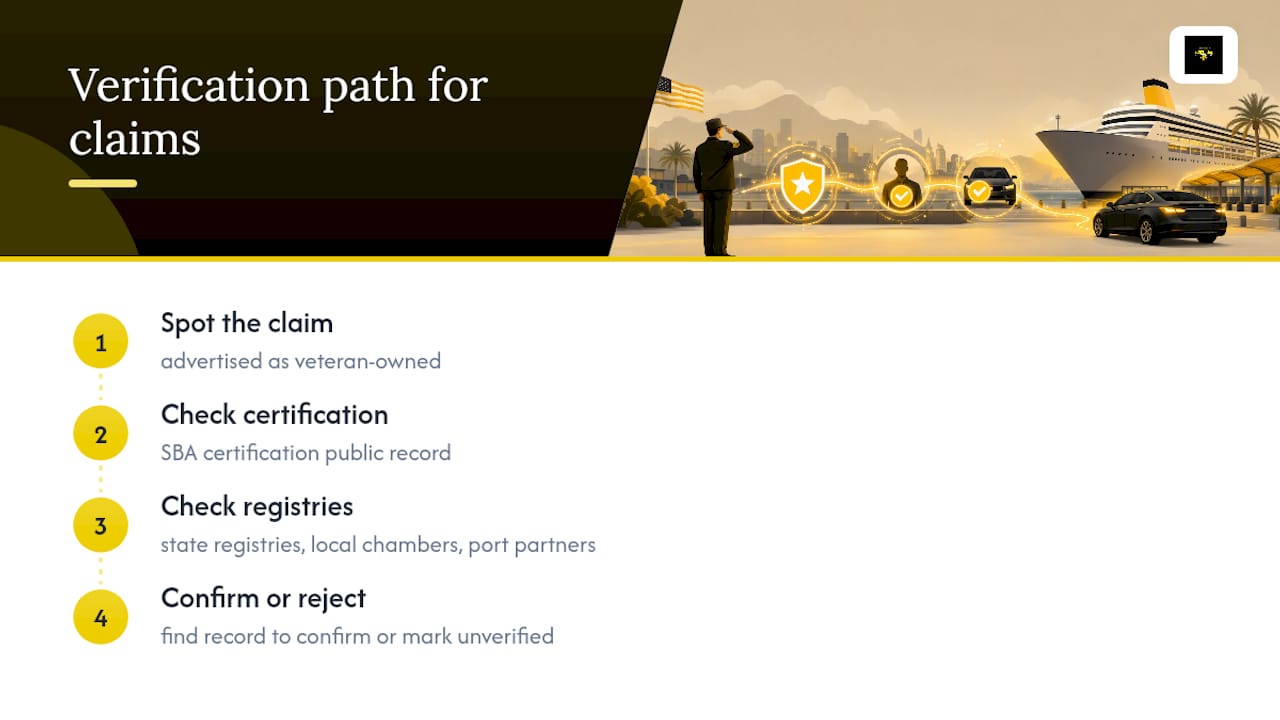
Veteran-owned parking operators don't build credibility in a vacuum. Several organizations exist specifically to certify and promote businesses owned by veterans, and knowing them helps you separate a real veteran-owned claim from marketing language.
The U.S. Small Business Administration runs certification programs for veteran-owned small businesses, which qualify certain companies for federal contracting preferences. That certification isn't required for a parking lot to legitimately call itself veteran-owned, but a business that has gone through it has a verifiable public record. State-level veteran affairs departments, like the one covering Louisiana's port benefits, also maintain registries and guidance that touch parking and transportation benefits specifically for disabled veterans.
Local chambers of commerce in port cities frequently maintain veteran business directories as well, and some cruise ports partner informally with veteran business associations to promote parking and transportation options near the terminal. None of this guarantees a specific discount or perk. It does mean that when a company advertises itself as veteran-owned, you can usually verify that claim through a certification body or a local registry rather than taking a website's word for it. If a parking operator's veteran-owned claim can't be traced to any registry, certification, or public record, treat it as an unverified marketing claim rather than a fact.
Where Veteran-Owned Parking Falls Short
Veteran-owned doesn't automatically mean cheapest, biggest, or most convenient. Smaller operators, veteran-owned or not, sometimes run fewer shuttle routes or narrower operating hours than the massive lots near major ports, so ask about shuttle frequency before you assume proximity to the terminal solves your timing problem.
Discount terms also vary widely between operators, and marketing pages don't always match what happens at the gate. A lot advertising veteran pricing might apply it only to certain days, certain veteran statuses, or certain vehicle types. Always confirm the exact terms in writing, ideally through a booking confirmation email, before you drive to the terminal expecting a rate that turns out to be conditional.
Capacity is another real constraint. A smaller, veteran-owned lot may simply have fewer spaces than a massive commercial operation, which matters during holiday sailings or hurricane season evacuations when demand spikes across every lot in a port city. That's exactly why membership-based guarantees exist. Without one, you're subject to the same first-come, first-served risk that applies to port exemptions, just with a private operator instead of the port authority.
Extra Perks Veteran-Owned Lots Offer Beyond Discounts
The discount is often the least interesting part of what a veteran-owned parking operator offers. Long-term vehicle storage during deployment is one example. A service member heading out on a months-long deployment needs somewhere secure to leave a vehicle that isn't a driveway sitting empty and visible, and veteran-owned operators near military hubs tend to build that service around military schedules rather than treating it as an afterthought.
Loyalty programs are another. Instead of a one-time discount, some operators reward repeat business with points, tiered pricing, or priority booking during high-demand periods. Monthly parking subscriptions serve local residents who need regular secure parking without booking a new reservation every time.
Then there's the intangible piece: an operator run by veterans, staffed partly by veterans, tends to understand military scheduling quirks, like a service member's leave dates shifting at the last minute, in a way a generic commercial lot might not prioritize. That familiarity shows up in small ways, from how flexible a cancellation policy is to how a shuttle driver handles a family traveling with a service dog.
What Actually Matters Here
The conventional advice on this topic treats port exemptions like a solved problem: qualify, show up, park free. That framing undersells how thin the safety net actually is. A first-come, first-served benefit with a residency requirement and a documentation checklist is not the same as a guaranteed free parking spot, and treating it that way sets travelers up for a bad morning at the terminal.
What the research actually supports is a hybrid strategy. If you clearly qualify for a port exemption like Port NOLA's, bring every document and arrive absurdly early, because the upside is real. But don't build your whole plan around it. The travelers who get burned aren't the ones who fail to qualify. They're the ones who qualify on paper, show up at a reasonable hour, and find the exempt section already full.
Prioritize certainty over savings when the trip matters, whether that's a milestone cruise, a short vacation window, or a sailing during hurricane season when a lot might close on short notice. A guaranteed reserved spot from a veteran-owned operator costs more than a free exemption that might not pan out, but it removes the one variable you can't control on embarkation morning: whether there's a space left with your name on it.
— Martin
Book Secure Parking With Asphalt Lots
Asphalt Lots provides an alternative to first-come, first-served port exemptions and open-air lots that leave vehicles exposed for a week or more. It offers indoor parking with 24/7 surveillance and a free shuttle to the terminal, helping travelers balance cost against security risk.
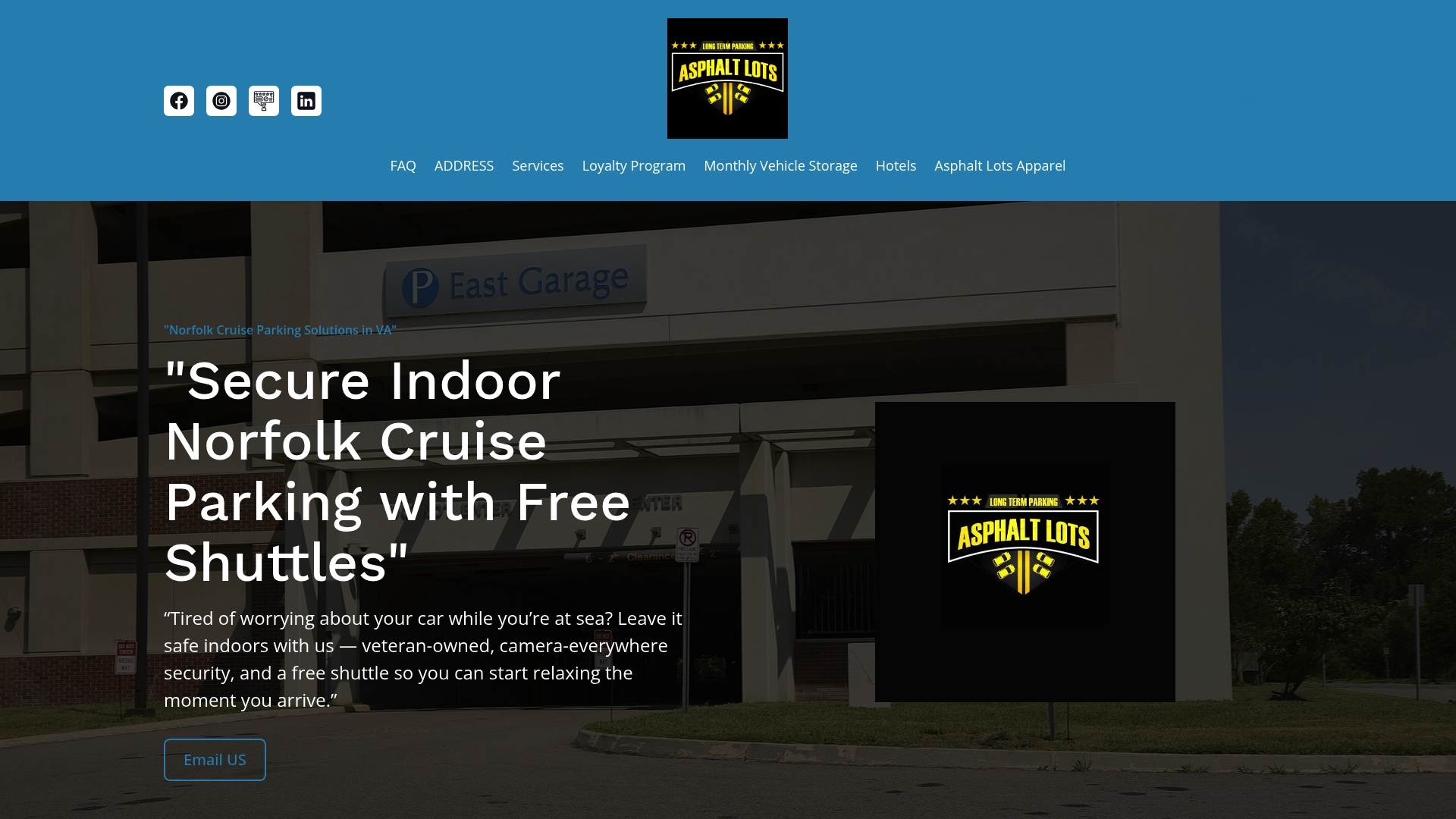
Booking options cover daily parking for a single sailing, monthly parking for local residents needing regular secure storage, and a VIP Unlimited Parking Membership offering reserved spots on cruise days. Long-term storage is also available for deployment or extended trips. Visit the Asphalt Lots landing page for current availability and booking.
Sources
- §27.2. Port of New Orleans cruise terminal parking fee exemption for Louisiana disabled veterans
- FAQs | Cruises | Port of New Orleans
- State Benefits | Louisiana Department Of Veteran Affairs
FAQ
Does Port Canaveral Offer a Military Discount for Parking?
Port Canaveral's official parking policy does not include the same statutory disabled-veteran exemption that Port NOLA offers. Off-site, veteran-friendly operators near Port Canaveral sometimes advertise their own military pricing, so check individual lots directly and confirm the terms in writing.
Where Can I Park for My Carnival Cruise in New Orleans?
You can park directly at the Port of New Orleans cruise terminal, use an off-site long-term lot with shuttle service, or book a hotel park-and-cruise package. Qualifying disabled veterans may get up to seven free days at the port terminal under Louisiana's exemption, allocated first-come, first-served.
Where Can I Park for a Carnival Cruise in Norfolk?
Norfolk-area cruisers can choose port lots, off-site lots, or a facility like Asphalt Lots, which offers secure indoor parking, a free shuttle, and a VIP membership with guaranteed reserved spots.
How Much Does It Cost to Park at Port Canaveral?
Port Canaveral parking rates are set by the port authority and vary by lot and length of stay; check the port's official parking page directly for current rates rather than relying on third-party estimates, since prices change by season.