Package deals are the single biggest variable in cruise budgeting, capable of adding hundreds or even thousands of dollars to a trip that looked affordable at first glance. The base cruise fare is essentially a teaser rate. Base fares cover only 40–45% of the total vacation cost, meaning the majority of what you actually spend comes from add-ons, packages, and logistics. Cruise lines like Carnival, Royal Caribbean, and Norwegian all sell bundled packages covering drinks, dining, excursions, and Wi-Fi. Understanding the role of package deals in cruise budgeting before you book is the difference between a vacation that fits your finances and one that blindsides you at checkout.
What types of cruise package deals are available and how do they affect your budget?
Cruise packages fall into four main categories: beverage packages, specialty dining packages, excursion packages, and Wi-Fi bundles. Each carries a different price point and a different risk of overspending. Knowing what each one costs upfront lets you build a realistic budget instead of guessing.
Beverage packages are the most debated. Drink packages on mainstream lines typically cost $70–$95 per person per day. On a 7-night cruise, that adds $980–$1,330 per couple before you board. The math only works in your favor if you drink consistently throughout the day, every day.
Specialty dining packages let you prepay for a set number of meals at premium restaurants onboard. These packages generally offer better value than drink packages because the per-meal savings are more predictable. Pre-booking specialty dining saves 20–30% compared to paying onboard prices.
Excursion packages vary widely by destination. A Caribbean port stop might offer a $60 snorkeling tour, while an Alaskan glacier excursion can run $200 or more per person. Booking excursions through the cruise line adds convenience but usually costs more than booking independently through local operators.
Wi-Fi bundles are increasingly standard. Prices range from basic social media access to full streaming plans. For a week-long trip, a full Wi-Fi package typically runs $20–$30 per day per device.
| Package Type | Typical Daily Cost | 7-Night Estimate (per person) |
|---|---|---|
| Beverage package | $70–$95 | $490–$665 |
| Specialty dining | $30–$60 | $210–$420 |
| Excursion bundle | $50–$200 | $350–$1,400 |
| Wi-Fi (full plan) | $20–$30 | $140–$210 |
Pro Tip: Norwegian Cruise Line's "Free at Sea" and Royal Caribbean's "Royal Perks" programs bundle several of these categories together. Always price each component separately before accepting a bundle as a deal.
How do you evaluate whether a cruise package deal is worth the cost?
The right framework for evaluating packages is intentional spending. Matching package choices to personal vacation priorities reduces financial stress and improves budgeting accuracy. That means neither buying every package available nor refusing all extras on principle.
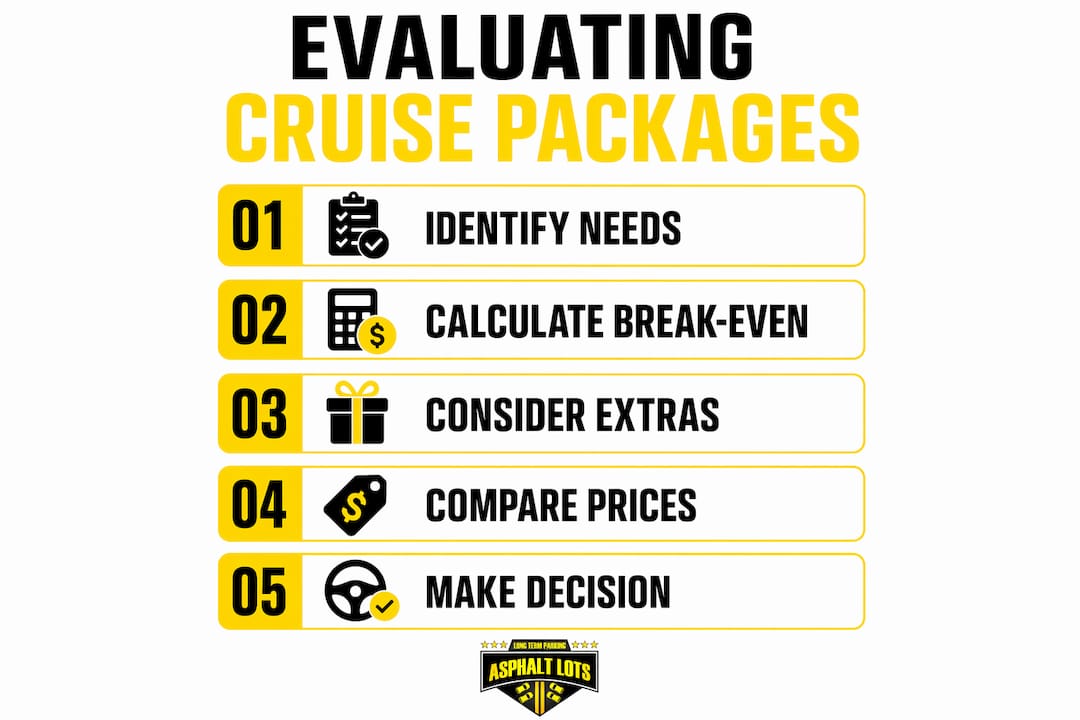
Start with the drink package break-even calculation. Most cruisers do not break even on deluxe beverage packages. You need roughly 10 drinks per day to justify the daily cost. Skipping the package and paying à la carte can save $600–$1,000 per couple on a week-long cruise. If you drink two or three cocktails a day, the math does not work in your favor.
Bundles marketed as great deals often include unwanted perks. Programs like "Free at Sea" sometimes embed mandatory gratuities on "free" drink packages, adding $18–$25 per person per day in fees you did not expect. Always read the fine print on what "free" actually costs.
| Item | À la carte price | Bundled price | Savings |
|---|---|---|---|
| Cocktail (per drink) | $12–$16 | Included | Varies |
| Specialty dinner | $35–$55 | $25–$40 | $10–$15 |
| Shore excursion | $80–$200 | $60–$160 | $20–$40 |
| Wi-Fi (per day) | $25–$35 | $18–$28 | $7–$10 |
Pro Tip: Build a simple spreadsheet before booking. List every package you are considering, calculate the break-even usage, and compare it honestly against your actual habits. Most people overestimate how much they drink and underestimate how little they use Wi-Fi.
When and how should you book cruise packages to get the best price?
Timing is the most underused tool in cruise deal comparisons. Booking during Wave Season, which runs from january through march, yields savings of $500–$1,500 per cabin. Cruise lines run their deepest promotions during this window, and package add-ons are often discounted or bundled at no extra charge.
Pre-purchasing packages online before departure is consistently cheaper than buying them onboard. Pre-booking packages online can save up to 32% compared to onboard prices. Cruise lines charge a premium for convenience once you are at sea.
Travel agents are another underused resource. Cruise-specialized travel agents can secure $50–$300 in onboard credit on bookings at no extra cost to you. That credit effectively lowers your net package spend without requiring a fare reduction.
A practical booking checklist for getting the best package prices:
- Research Wave Season dates and set price alerts for your target sailing.
- Compare the cruise line's website price against a travel agent quote for the same package.
- Calculate break-even usage for any beverage package before purchasing.
- Pre-purchase specialty dining and Wi-Fi online at least 30 days before departure.
- Ask your travel agent specifically about onboard credit offers tied to package purchases.
- Review gratuity policies on any "free" or bundled package before confirming.
How do surrounding logistics fit into your total cruise budget?
Package deals get most of the attention, but surrounding logistics like flights, hotels, and transfers represent 18–25% of total trip cost. That is a significant budget line that many travelers ignore until they are already committed to a sailing. Ignoring it produces the same result as ignoring package costs: a budget that falls apart mid-trip.
Flights to a departure port can easily run $300–$600 per person round trip. A pre-cruise hotel near the port adds another $100–$200 per night. Port transfers, whether by taxi, rideshare, or shuttle, add $30–$80 per person each way. These costs stack up fast and are rarely included in any package deal.
Driving to the port and parking is one of the most effective ways to cut this portion of your budget. Driving and parking instead of flying can reduce total trip expenses by approximately 35% for travelers within driving distance of a major port. For families departing from Norfolk, Virginia, that math is especially compelling.
- Book pre-cruise hotels with free cancellation in case of itinerary changes.
- Use a LAX to Long Beach transfer service to cut airport-to-port costs if flying into Los Angeles.
- Compare the total cost of flying versus driving, including parking, before committing.
- Factor in luggage handling fees, especially at European ports where Amsterdam cruise port storage services can simplify embarkation day logistics.
What are the most common mistakes travelers make with cruise package deals?
The most costly mistake is assuming a cruise is fully all-inclusive. More than 90% of cruisers pay for extras beyond their initial fare, and those extras can increase total trip cost by 55–60%. Treating the base fare as the full price sets up a budget failure before the trip even starts.
The second most common mistake is buying a drink package without running the numbers. Most travelers overestimate their daily consumption. Paying à la carte for three to four drinks a day costs far less than a $90-per-day unlimited package.
A third mistake is ignoring mandatory fees embedded in bundles. Gratuities on "free" drink packages, service charges on specialty dining, and port fees on excursion bundles all add to the real cost of a deal that looked attractive at face value.
Pro Tip: Before finalizing any package, add up every mandatory fee attached to it. The true cost of a "free" drink package with gratuities often exceeds the cost of simply buying drinks individually.
- Never assume a low base fare means a low total cost.
- Always calculate break-even usage before buying a beverage package.
- Read gratuity and service charge policies on every bundled offer.
- Budget for pre-cruise and post-cruise logistics as a separate line item.
- Use a travel agent to access onboard credits that offset package costs.
Key takeaways
Package deals determine the majority of what a cruise actually costs, and intentional pre-trip planning is the only reliable way to control that spending.
| Point | Details |
|---|---|
| Base fare is not the full cost | Base fares cover only 40–45% of total trip cost; packages and logistics make up the rest. |
| Drink packages rarely break even | You need roughly 10 drinks per day to justify a deluxe beverage package; most travelers save by paying à la carte. |
| Timing cuts package prices | Booking during Wave Season and pre-purchasing online can save up to 32% on packages. |
| Logistics are a hidden budget line | Flights, hotels, and transfers represent 18–25% of total trip cost and are rarely included in any package. |
| Travel agents add real value | A cruise-specialized agent can secure $50–$300 in onboard credit at no extra cost to you. |
Why I think most cruise budgets fail before departure
Most cruise budgets fail not because travelers are careless, but because the industry is designed to obscure the real cost until you are already committed. I have watched travelers book a $499-per-person fare and end up spending $2,500 per person by the time they return. The base fare is a marketing tool. The real product is everything sold after it.
The travelers who come home satisfied with their spending share one habit: they decided in advance what mattered to them and spent there, and said no to everything else. One couple I know skips every drink package and every Wi-Fi plan. They spend that money on two premium shore excursions per port. They come home with memories instead of a bar tab. Another traveler I know buys the specialty dining package every time because food is the center of his vacation. He skips excursions entirely. Both approaches work because both are intentional.
The mistake is letting the cruise line decide your priorities for you through bundled promotions. Norwegian's "Free at Sea" and Carnival's bundled packages are built to maximize onboard revenue, not your satisfaction. That does not make them bad deals. It means you need to evaluate them on your terms, not theirs.
— Martin
Plan your full cruise budget with Asphaltlotsva
Packages and logistics both shape your final cruise cost, and parking is one logistics expense you can control completely. Asphaltlotsva provides secure indoor parking just 15 minutes from Norfolk's cruise terminal, with round-the-clock surveillance and a free shuttle to the port. For frequent cruisers, the VIP Unlimited Parking Membership guarantees a reserved spot on every sailing day with priority shuttle service. You lock in your parking cost in advance, which means one fewer budget surprise on departure day. Visit Asphaltlotsva's Norfolk parking page to check rates and reserve your spot before your next sailing.
FAQ
What does a cruise package deal typically include?
Cruise package deals typically include some combination of beverages, specialty dining, shore excursions, and Wi-Fi. The exact contents vary by cruise line and the specific bundle purchased.
How much do drink packages add to a cruise budget?
A 7-night beverage package costs $980–$1,330 per couple on mainstream cruise lines. Most travelers do not consume enough to break even on the daily cost.
When is the best time to buy cruise packages?
Wave Season, running from january through march, offers the deepest discounts. Pre-purchasing packages online at least 30 days before departure saves up to 32% compared to onboard prices.
Are all-inclusive cruise packages worth it?
All-inclusive packages are worth it only if the included items match your actual vacation habits. Bundles that include unwanted perks or mandatory gratuities often cost more than buying selectively à la carte.
How do I factor parking into my cruise budget?
Parking near the port is a fixed, predictable cost that is easy to plan for in advance. Facilities like Asphaltlotsva near Norfolk offer secure indoor parking with a free shuttle, making it a straightforward line item in your total trip budget.