
A local shuttle service to a cruise terminal is a pre-scheduled, dedicated transport option that moves passengers between airports, hotels, or parking facilities and their embarkation port. The three most common formats are hotel shuttles, shared vans, and private transfers. Services like Go Airport Shuttle, Carnival Cruise line transfers, and professional ground transport operators serve major ports including Port Everglades, Port Canaveral, and the Norfolk Cruise Terminal. Rideshare apps like Uber and Lyft also fill this role, but they carry real risks on busy cruise days that most travelers underestimate.
How does a local shuttle service to a cruise terminal work?
The mechanics of port shuttle transport are straightforward once you know the booking process and what to expect on pickup day.
Booking your ride starts online. Most operators run their own websites with real-time availability. Cruise lines like Carnival and Royal Caribbean sell transfers directly through their booking portals. Third-party platforms like Go Airport Shuttle aggregate multiple operators for comparison. You enter your flight number, hotel address, passenger count, and luggage details at checkout.

Pickup locations fall into three categories: airport curb, hotel lobby, or a designated staging area near the terminal. Professional shuttle companies operate 24/7 to cover early morning flights and late arrivals. That matters because cab shortages at 4 a.m. are real, and rideshare surge pricing at odd hours can double your expected fare.
Pricing varies by service type. Shared van seats run $28–$40 per person, while private transfer vans typically cost $140–$185 for the full vehicle. Hotel shuttles are often complimentary if you stay the night before embarkation.
Key features to confirm before booking:
- Flight tracking so the driver adjusts for delays
- Luggage assistance at pickup and drop-off
- Child safety seats if traveling with young children
- Confirmed drop-off at the correct terminal entrance, not a general port gate
Pro Tip: Book your shuttle with a 30–45 minute buffer after your scheduled arrival time to absorb customs and baggage claim delays. Premium operators include flight tracking as standard, but that buffer is your real safety net.
Timing is the variable most travelers get wrong. Cruise terminals close boarding windows sharply. Missing your window means missing your ship.
What types of shuttle services are available at cruise ports?
Four main transport types serve cruise terminals. Each fits a different traveler profile.
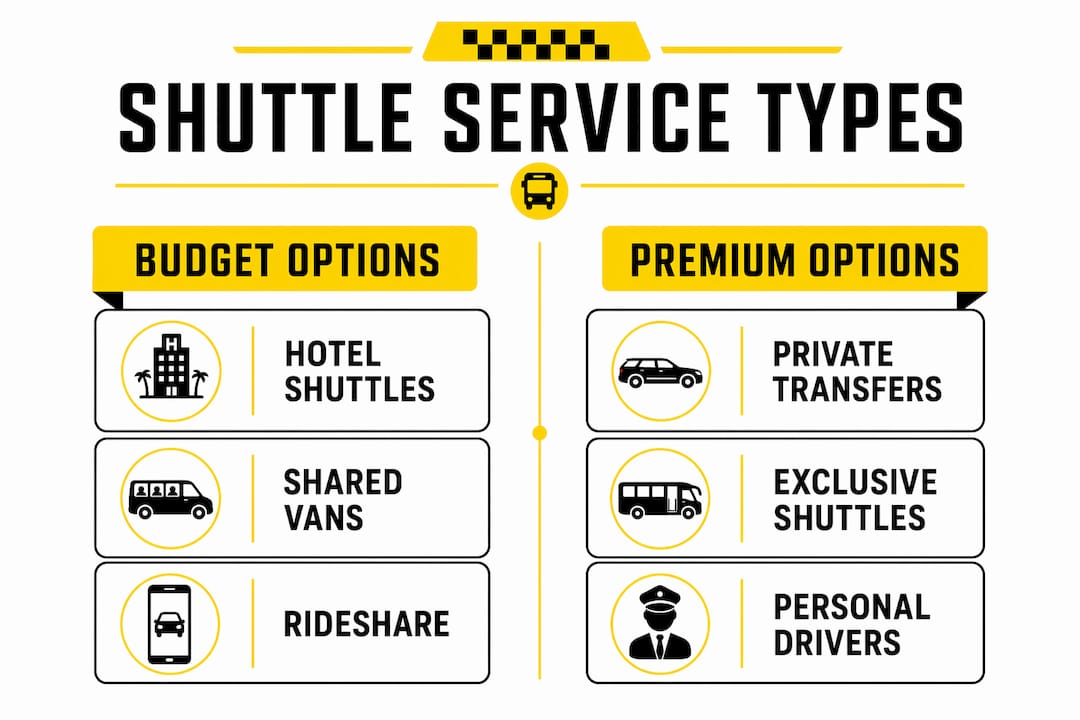
| Type | Typical Cost | Best For | Key Drawback |
|---|---|---|---|
| Hotel Shuttle | Free | Solo travelers staying nearby | Limited schedule, hotel guests only |
| Shared Van | $28–$40/person | Budget-conscious solo or pairs | Wait for full capacity before departure |
| Private Transfer | $140–$185/vehicle | Groups of 3 or more | Higher upfront cost |
| Rideshare (Uber/Lyft) | Varies | Short trips under 20 miles | Surge pricing on peak cruise days |
Hotel shuttles
Hotel shuttles are free but inflexible. They run on fixed schedules and only serve registered guests. If your flight lands at 11 p.m. and the shuttle runs at 8 a.m., you are waiting. They work best when you book a pre-cruise hotel package that includes the transfer.
Shared vans
Shared vans are the most popular budget option for solo travelers and couples. The catch is the fill-to-capacity model. Shared shuttles wait for full passenger loads before departing, which can add an hour or more to your transit time during peak embarkation windows. For a family cruise port trip with young children, that wait is genuinely uncomfortable.
Private transfers
Private transfers are the strongest choice for groups. Groups of six or more save money with a private vehicle compared to booking multiple rideshares, and they eliminate the coordination chaos of splitting a party across separate cars. Professional dispatch teams monitor arrivals in real time and adjust departure schedules accordingly. That means fewer surprises when your flight lands 20 minutes late.
Rideshare apps
Rideshare is fine for routes under 20 miles with light luggage. The problem is price volatility. Rideshare prices have risen 7.2% in the past year, and surges during peak cruise departure windows can run 50–100% above base rates. If you are traveling on a Saturday morning when three ships are boarding simultaneously, your $22 Uber estimate can become $45 before you finish reading the confirmation screen.
The right transport method balances your risk tolerance against price and reliability. Rideshare wins on flexibility. Private shuttles win on fixed pricing and predictability.
How to book and prepare your shuttle to the cruise port
A smooth embarkation starts with a complete booking. Follow these steps to avoid the most common mistakes.
-
Gather your booking details first. You need passenger count, number of checked bags, your cruise terminal name and berth number, flight arrival time, and hotel address if applicable. Missing any of these causes booking errors that are hard to fix day-of.
-
Confirm your terminal assignment. Checking your terminal or berth assignment before embarkation day prevents being dropped at the wrong entrance. Pin the exact terminal map on your phone. Large ports like Port Everglades have multiple buildings spread across a wide area.
-
Choose your service type. Use the comparison table above. For trips under 20 miles with one or two passengers, a shared van or rideshare works. For groups of four or more, or trips over 50 miles, private group transport becomes cost effective and logistically simpler.
-
Book early, not the night before. Peak cruise days fill shuttle capacity fast. Booking two to four weeks out locks in your rate and guarantees vehicle availability.
-
Save your driver's contact information. Most professional operators send a confirmation with a dispatch number. Store it in your phone. If your flight is delayed, call immediately so the driver adjusts rather than marking you as a no-show.
-
Plan your pickup window relative to boarding. Most cruise lines open boarding two to three hours before departure. Work backward from that window, add your transit time, and add a 30-minute buffer. That is your latest acceptable pickup time.
Pro Tip: For groups with large amounts of luggage, prioritize curb-to-curb assistance. Cruise port security restricts drivers from entering terminal buildings, so curbside handoff is the standard. Confirm your operator handles luggage at both ends before you book.
Multi-stop pickups for groups require consolidated bookings. Some operators provide complimentary short errand stops if pre-arranged, but you must request this at booking, not on the day of travel.
What are the most common shuttle problems at cruise terminals?
Even well-planned transfers run into issues. Knowing the most common problems lets you solve them before they become emergencies.
Late pickups are the most frequent complaint. They usually stem from the driver running behind on a previous route. The fix is simple: call dispatch as soon as you are 10 minutes past your scheduled pickup time. Do not wait 30 minutes hoping the driver appears.
Terminal confusion is the second most common issue. Large ports have multiple terminals, and a driver unfamiliar with the layout may drop you at the wrong building. Pin the exact terminal map on your phone and confirm the drop-off address with your driver before you leave the pickup point.
Luggage restrictions catch travelers off guard. Some shared vans cap luggage at one checked bag per person. If you are traveling with oversized bags or sports equipment, book a private transfer with confirmed cargo capacity.
Relying solely on rideshare on peak cruise days is the single biggest avoidable risk in port transportation. Surge pricing, limited vehicle availability, and drivers unfamiliar with terminal layouts combine to create real embarkation risk. A missed boarding window is not a recoverable situation.
Cancellations and delays require a backup plan. Keep the number for a local taxi company or a second rideshare app on your phone. If your shuttle cancels within two hours of pickup, you need an immediate alternative, not a 20-minute search.
Security protocols at cruise ports restrict access. Drivers cannot enter terminal buildings. Passengers with mobility needs or heavy luggage should confirm in advance that their operator provides a porter or luggage cart at the curb. This is not a standard feature across all services.
Key takeaways
The most reliable way to reach your cruise terminal on time is to book a dedicated shuttle service matched to your group size, distance, and luggage load well before departure day.
| Point | Details |
|---|---|
| Match service to group size | Private transfers save money and reduce chaos for groups of four or more passengers. |
| Book with a timing buffer | Add 30–45 minutes to your scheduled arrival time to absorb customs and baggage delays. |
| Confirm terminal details early | Pin your exact berth location before departure to avoid costly drop-off errors. |
| Avoid rideshare on peak days | Surge pricing on busy cruise mornings can run 50–100% above base rates. |
| Secure your booking early | Peak cruise days fill shuttle capacity fast; booking two to four weeks out locks in rates. |
What i have learned after years of watching cruise transfers go wrong
The conventional wisdom says rideshare is the smart, flexible choice for getting to the port. I disagree, at least for most cruise travelers.
Here is what I have actually observed: the travelers who miss boarding windows or arrive flustered are almost always the ones who booked nothing in advance and trusted a rideshare app on a Saturday morning. The ones who board calmly, with luggage intact, are almost always on a pre-booked private or shared shuttle with a confirmed driver.
The math on rideshare looks good until the day of travel. A $30 Uber sounds better than a $40 shared van seat. But when surge pricing hits 80% on a peak embarkation morning, that $30 becomes $54, and you are still competing with 200 other passengers for available cars. Private shuttles offer fixed pricing. That predictability is worth more than the nominal savings from a rideshare on a normal day.
Terminal familiarity is the other thing most travelers overlook. I have watched groups walk the wrong direction for 15 minutes at Port Everglades because their driver dropped them at the nearest gate rather than their specific terminal. Pinning your berth assignment on your phone before you leave the hotel takes 90 seconds and eliminates that risk entirely.
My honest recommendation: use a shared van for solo travel or pairs on short routes. Use a private transfer for any group of four or more, any trip over 30 miles, or any family cruise port trip with children and strollers. And always, always have a backup contact number for a local car service saved before you leave home.
— Martin
Stress-free parking and shuttle service for norfolk cruise travelers
Sorting out your ride to the terminal is only half the equation. Your vehicle needs a safe home while you are at sea.
Asphaltlotsva is a veteran-owned facility located 15 minutes from the Norfolk Cruise Terminal. It offers secure indoor parking with round-the-clock surveillance and a free shuttle to the terminal included with every booking. The VIP Unlimited Parking Membership gives frequent cruisers reserved spots on departure days, guaranteed availability, and priority shuttle service so you never wait in a general lot line. If you want your vehicle protected and your port transfer handled in one booking, explore Norfolk cruise parking at Asphaltlotsva before your next sailing date fills up.
FAQ
What is a local shuttle service to a cruise terminal?
A local shuttle service to a cruise terminal is a pre-booked, dedicated vehicle that transports passengers between airports, hotels, or parking facilities and their embarkation port. The three main types are hotel shuttles, shared vans, and private transfers.
How much does a shuttle to a cruise port cost?
Shared van seats typically cost $28–$40 per person, while private transfer vans run $140–$185 for the full vehicle. Hotel shuttles are often free for overnight guests.
When should i book my cruise terminal shuttle?
Book two to four weeks before your departure date to secure availability and lock in your rate. On peak cruise days, shuttle capacity fills quickly and last-minute bookings may not be available.
Is rideshare a reliable option for getting to the cruise terminal?
Rideshare works well for short trips under 20 miles with light luggage, but surge pricing on peak cruise days can run 50–100% above base rates. A pre-booked shuttle offers fixed pricing and a confirmed driver.
What happens if my shuttle is late on embarkation day?
Call dispatch immediately if your driver is more than 10 minutes late. Keep a backup contact for a local taxi or second rideshare app, since cruise boarding windows close at a fixed time regardless of transport delays.