Your cruise departure experience is defined by the role of location in cruise departure ease before you ever step aboard the ship. Port geography, local road networks, parking models, and boarding protocols all combine to determine whether embarkation day feels effortless or chaotic. Ports like Port Canaveral, Port of Galveston, and Fort Lauderdale's Port Everglades each present a different access equation. Driving to a nearby port typically beats flying because it removes flight delay risk entirely. Understanding how these location factors interact gives you a real edge on embarkation day.
How does geographic proximity affect cruise departure ease?
Location affects cruise departure ease through travel time reliability, not just raw distance. A port 30 miles from your home with predictable highway access beats a port 10 miles away through congested city streets every time. The maturity of local circulation systems, including transport providers, road networks, and clear signage, defines how easy a port actually is to reach.
Transportation options matter enormously. Cruisers typically arrive by personal vehicle, rideshare, airport shuttle, or public transit. Each mode carries different reliability risks. Personal vehicles give you the most control over timing, but they require a solid parking plan. Rideshares and shuttles depend on driver availability and traffic, which can spike unpredictably on busy sailing days.
Local road conditions directly shape the importance of cruise port location. The Port of Galveston illustrates this perfectly. Starting may 29, 2026, Terminal 28 access is restricted due to TxDOT construction, requiring drivers to use 37th Street and follow police direction for Carnival sailings. That single infrastructure change adds meaningful travel time for thousands of cruisers who assumed their usual route would work.
- Check traffic advisories at least one week before sailing, not just the morning of departure.
- Identify alternate routes to your terminal in advance using Google Maps or Waze.
- Allow extra buffer time when construction or special events are near the port.
- Monitor port authority websites for real-time access updates, especially at high-volume ports like Galveston and Port Canaveral.
Pro Tip: Roadway routing changes from construction can severely impact embarkation regardless of proximity. Treat port traffic advisories as mandatory reading the week before your cruise, not optional.
How do parking models affect smooth cruise embarkation?
Parking logistics are one of the most underestimated factors in how location affects cruise boarding. The difference between a park-and-walk facility and a shuttle-dependent lot can mean 30 to 60 minutes of added stress on embarkation morning.
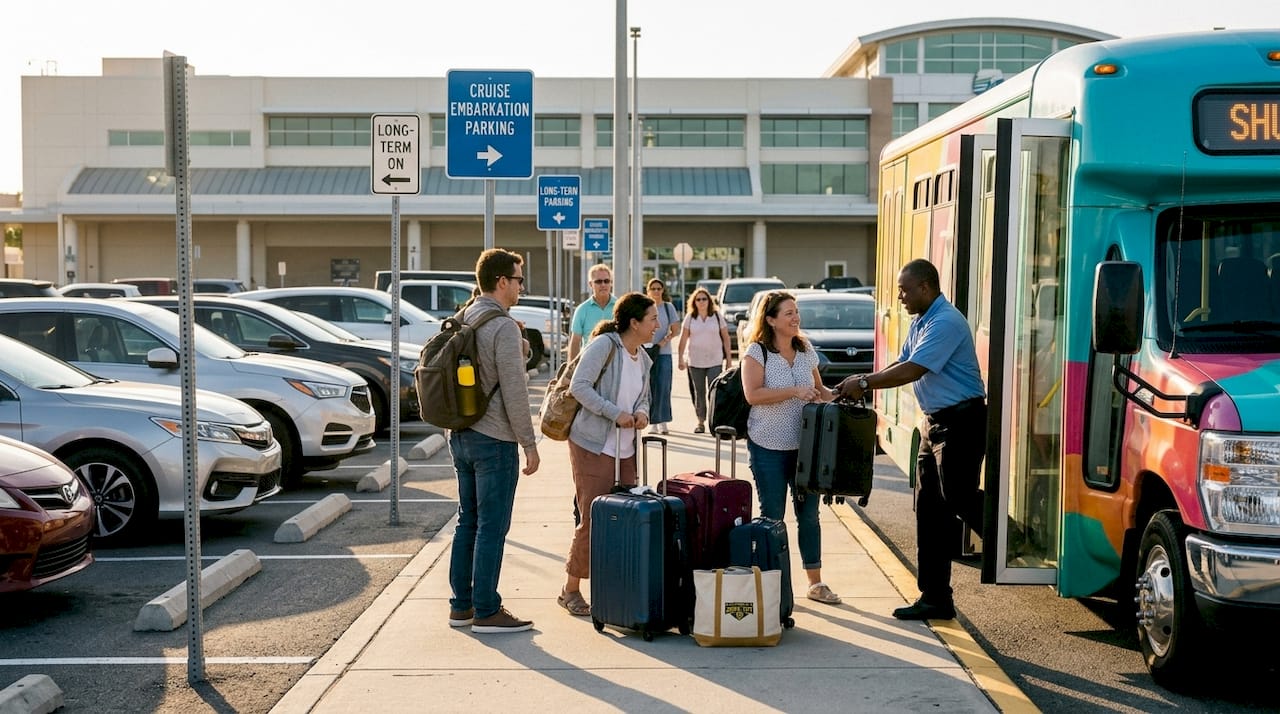
Port Canaveral offers one of the clearest examples of a port-friendly parking model. Parking facilities sit directly adjacent to the terminals, eliminating shuttle wait times entirely. Rates run approximately $20 per day plus tax, charged for both the embarkation and debarkation days. That pricing is transparent and predictable, which matters when you are managing a travel budget.
Shuttle-dependent ports work differently. You park in an off-site lot, load your luggage onto a shuttle, and wait for the next departure. During peak sailing times, that wait can stretch. Park-and-walk models drastically reduce uncertainty compared to shuttle-dependent parking, which adds both wait time and transit time on embarkation day.
| Parking model | Typical time to terminal | Key advantage | Key risk |
|---|---|---|---|
| Park-and-walk (Port Canaveral) | 2–5 minutes | No shuttle wait, direct access | Higher daily rate at some ports |
| On-site shuttle lot | 10–20 minutes | Often lower cost | Shuttle delays during peak hours |
| Off-site private garage | 15–30 minutes | Competitive pricing, security | Longest transit to terminal |
| Rideshare or taxi drop-off | 5–10 minutes | No parking cost | Surge pricing, driver availability |
- Book parking in advance, especially for sailings in june, july, and december when demand peaks.
- Confirm whether your lot is park-and-walk or shuttle-based before arrival day.
- Factor parking costs into your total port comparison, not just cruise fare.
Pro Tip: When comparing departure ports for your next cruise, include the parking model in your decision. A slightly farther port with walk-to-terminal parking often delivers a calmer, faster embarkation than a closer port with shuttle-only access.
What boarding cutoff rules should you know before embarkation day?
Cruise lines set firm boarding cutoffs that directly define how much location-based travel time you can safely absorb. Check-in closes approximately 90 minutes before sailing, and late arrivals face denied boarding with no refund. That rule makes your travel time buffer a financial decision, not just a comfort preference.
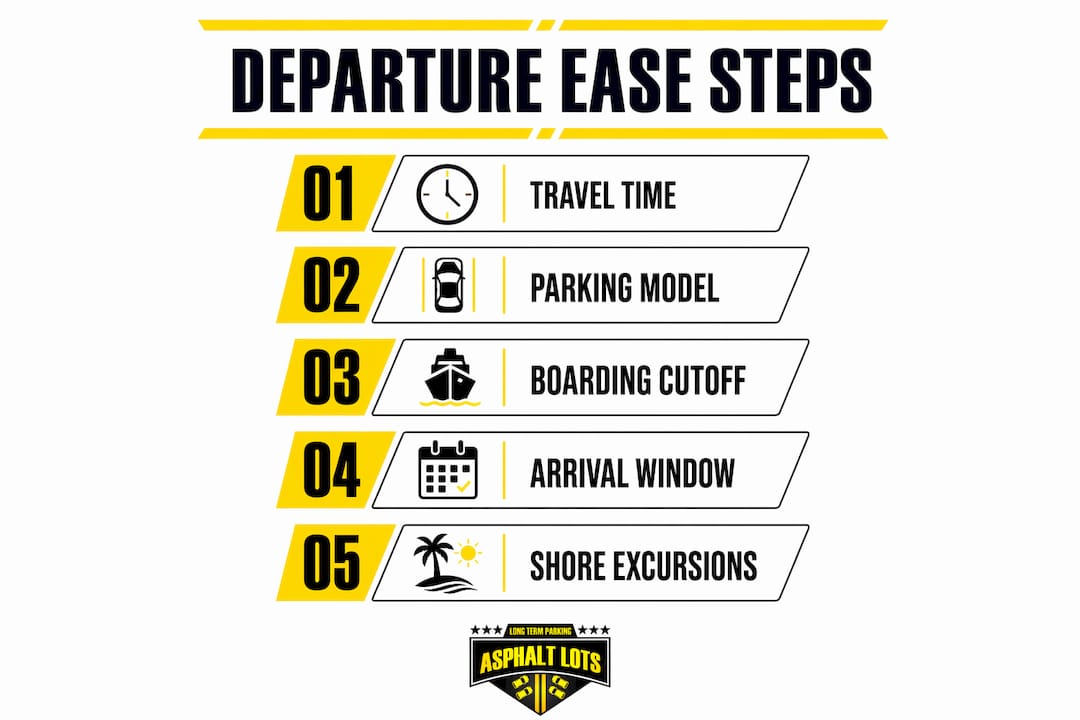
Most cruise lines now use scheduled arrival windows assigned during online check-in, typically 30–45 days before sailing. Arriving within your assigned window minimizes wait time and avoids the congestion that builds when early arrivals stack up outside the terminal. Arriving too early often means waiting outside in the heat or rain with your luggage. Arriving too late risks missing the cutoff entirely.
Here is a practical sequence for timing your embarkation day arrival:
- Confirm your assigned arrival window during online check-in, 30–45 days before sailing.
- Calculate your drive time from home to the terminal under normal conditions, then add 20–30 minutes for traffic variability.
- Add parking time based on your lot type: 5 minutes for park-and-walk, 20–30 minutes for shuttle-dependent facilities.
- Check port traffic advisories the week before and the morning of departure for construction or event-related delays.
- Arrive at the terminal entrance no more than 15 minutes before your window opens to avoid unnecessary waiting.
- Never cut it closer than 2 hours before sailing when driving from more than 60 miles away.
Timed arrival windows reduce on-site congestion and improve passenger throughput. Ports that use this system reward cruisers who plan precisely and penalize those who show up whenever they feel like it.
Pro Tip: Arriving just before your window opens rather than early is the single most effective way to avoid long terminal queues. Ports with staggered systems move faster when passengers respect their assigned times.
How does port location affect your shore excursion time?
The impact of geography on cruise travel extends beyond embarkation. Port location shapes how much usable time you actually get at your destinations, not just how easily you board.
Some ports sit far from the attractions they serve. Industrial gateway ports require shuttle and train transfers that eat directly into shore excursion hours. A port serving Florence, for example, can require a shuttle plus an 80–90 minute rail journey each way. That is nearly three hours of transit for a single day ashore.
The best locations for cruise embarkation combine easy terminal access with proximity to meaningful destinations. Ports where the ship docks close to city centers, like Nassau or Cozumel, give you maximum time without transit overhead. Ports that require long inland transfers reduce your effective excursion window significantly.
- Research transit time from port to main attraction before booking itineraries with gateway ports.
- Factor round-trip transit into your shore day plan, not just one-way travel.
- Choose itineraries where port cities are the destination, not just the gateway, when time efficiency matters.
- A smooth departure from cruise ports sets the tone for the entire trip. Starting the cruise with a stressful embarkation carries into the first day at sea.
The connection between smooth departure and overall cruise enjoyment is direct. Cruisers who arrive on time, park without incident, and board efficiently arrive at their first port rested and ready. Those who scramble through embarkation often spend the first sea day recovering.
Key Takeaways
Location determines cruise departure ease through transport reliability, parking access, and boarding timing, not just how close you live to the port.
| Point | Details |
|---|---|
| Proximity is not the whole story | Travel time reliability and road infrastructure matter more than raw distance to the terminal. |
| Parking model changes everything | Park-and-walk facilities like Port Canaveral eliminate shuttle delays and reduce embarkation stress significantly. |
| Boarding cutoffs are non-negotiable | Check-in closes 90 minutes before sailing; late arrivals face denied boarding with no refund. |
| Arrival windows reward precise timing | Arriving just before your assigned window opens reduces wait time and avoids terminal congestion. |
| Shore time depends on port geography | Gateway ports with long inland transfers reduce usable excursion hours, making port proximity to attractions a real planning factor. |
What I've learned from watching cruisers get location wrong
Most cruisers focus on the ship and the itinerary. They treat embarkation day as an afterthought. That is the single biggest mistake I see repeated across every major U.S. departure port.
The cruisers who have the smoothest departures share one habit: they treat the port like a destination in itself. They research the terminal layout, confirm parking in advance, and check traffic advisories the week before sailing. They know their arrival window and they plan backward from the check-in cutoff, not forward from when they feel like leaving home.
The Galveston construction situation is a perfect example of why this matters. Thousands of cruisers will show up at Terminal 28 in 2026 using their usual route, only to find it blocked. The ones who checked the port advisory will have already adjusted. The ones who did not will be stuck in redirected traffic, watching their arrival window close.
My honest advice: pick your port based on the full access picture. A port 90 minutes away with reliable highways, walk-to-terminal parking, and clear signage beats a port 30 minutes away with shuttle chaos and construction detours. The importance of cruise port location is amplified when the surrounding city functions as a reliable transit hub. When it does not, proximity becomes almost irrelevant.
— Martin
Parking near Norfolk's cruise terminal, solved by Asphaltlotsva
Cruisers departing from the Norfolk area face the same location-based challenges covered throughout this guide: parking access, shuttle timing, and arrival reliability. Asphaltlotsva addresses all three directly.
Located just 15 minutes from Norfolk's cruise terminal, Asphaltlotsva provides secure indoor parking with round-the-clock surveillance and a free shuttle service to the terminal. The VIP Unlimited Parking Membership guarantees a reserved spot on sailing days, priority shuttle pickup, and no availability surprises. For frequent cruisers who have dealt with full lots and missed shuttle windows, that guarantee changes embarkation day entirely. Pre-booking your parking through Asphaltlotsva is one of the most direct ways to remove location-based stress from your next departure.
FAQ
Why does location matter more than distance for cruise departures?
Location determines travel time reliability through road infrastructure, traffic patterns, and parking access. A port farther away with reliable highways and walk-to-terminal parking often delivers a smoother embarkation than a closer port with congested access routes.
What is the boarding cutoff time for most cruise lines?
Cruise lines close check-in approximately 90 minutes before sailing. Arriving after that cutoff results in denied boarding with no refund, regardless of the reason for the delay.
What is the difference between park-and-walk and shuttle parking at cruise ports?
Park-and-walk facilities, like those at Port Canaveral, place your vehicle directly adjacent to the terminal for immediate access. Shuttle-dependent lots require a separate transit step that adds 10–30 minutes and depends on shuttle availability during peak boarding times.
How do arrival windows work at cruise terminals?
Ports assign arrival windows during online check-in, typically 30–45 days before sailing. Arriving within your window reduces wait time and prevents the congestion that builds when passengers arrive too early or too late.
How does port location affect shore excursion time?
Ports that require long inland transfers, such as gateway ports serving Florence with 80–90 minute rail connections, reduce your usable time ashore significantly. Choosing ports where the ship docks close to the main destination maximizes your time off the ship.